
Financial Modelling: Structure, Assumptions & Best Practices
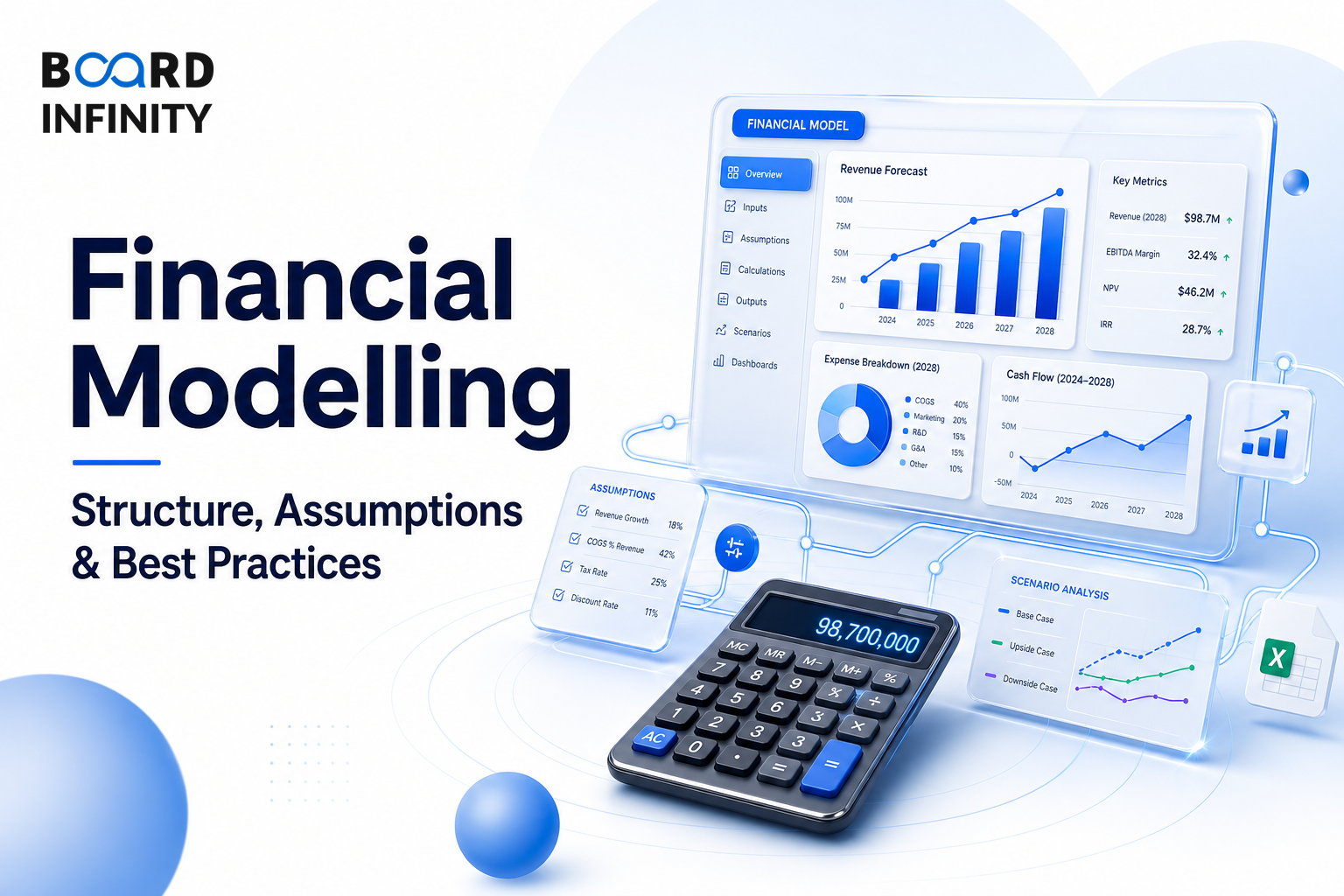
After the Financial Modelling Cheat Sheet: Excel & Bloomberg, the next question is how to turn Excel and market-data fluency into a bank-grade model. Financial modelling is the core skill for IB, PE, ER, and corporate finance roles. A well-built model is not just accurate - it is auditable, flexible, and tells a story. In interviews, this matters because you are often tested on structure, assumptions, hygiene, red-flag avoidance, and whether you can build a quick DCF under time pressure.
- Every financial model at a top bank follows a 3-statement integrated model where the Income Statement, Balance Sheet, and Cash Flow Statement are dynamically linked.
- Every model must have a clearly separated assumptions page. Never hardcode numbers into formulas.
- Revenue growth, margins, capex, working capital, cost of capital, terminal value, and tax rate are the key assumption categories interviewers probe.
- Bank-grade model hygiene includes colour coding, one row = one item, circular references OFF, annual to quarterly build, balance sheet checks, sensitivity tables, and scenario analysis.
- Modelling red flags include hardcoded numbers buried in formulas, revenue growing at 25% forever, terminal value > 75% of total valuation, and no error-check row at the bottom of the balance sheet.
- A quick DCF means forecasting revenue, EBITDA, FCFF, WACC, discounted FCFs, terminal value, and EV to equity in a tight 10-minute workflow.
The Big Picture: Financial Modelling as an Operating System
Financial modelling works when the architecture, assumptions, linkages, checks, and output all reinforce each other. The model starts with dynamically linked statements, separates assumptions from formulas, applies bank-grade hygiene, flags errors quickly, and then supports valuation work such as a DCF.
The 3-Statement Integrated Model - Architecture
Every financial model at a top bank follows this structure. The three statements must be dynamically linked so that changing one assumption flows through the entire model automatically.
Assumption Framework - The Input Page
Every model must have a clearly separated assumptions page. Never hardcode numbers into formulas. This is Rule #1 at every investment bank. Below are the key assumption categories:
DCF means Discounted Cash Flow: intrinsic valuation - sum of future FCFs discounted to present at WACC. WACC means Weighted Average Cost of Capital: blended cost of all financing.
Model Building Best Practices - Goldman/JPM Standard
A well-built model is not just accurate. It is auditable, flexible, and tells a story. These rules make the model easy to review, change, debug, and defend in an interview.
Common Modelling Mistakes - Interviewer Red Flags
These red flags cost points because they show the model is not auditable, not logically linked, or not valuation-ready.
Build Me a Quick DCF - 10-Minute Framework
In many IB/PE interviews, you will be given 15 minutes, a calculator, and a one-page company summary. Here is how to structure it:
"Based on my quick model with 12% revenue growth, 22% EBITDA margin, and 11% WACC, I arrive at an equity value of approximately ₹X per share, which represents Y% upside/downside to the current market price. Key sensitivities are terminal growth rate and margin trajectory. I'd want to cross-check this with trading comps to triangulate."
Structuring a Financial Modelling Interview Answer
"Build me a quick DCF."
Do not present a single-point answer. Real decisions are never single-point; always present a range.
The single most frequent error is hardcoded numbers buried in formulas - instant rejection at most banks. It costs points because the model stops being auditable, and auditors/MDs cannot change one number and see the full model impact instantly.
Conclusion
Financial modelling is interview-ready when it is dynamically linked, assumption-driven, auditable, flexible, and valuation-focused. Build the operating system first, keep the hygiene bank-grade, avoid red flags, and use the quick DCF workflow to communicate a clean decision under time pressure.