
Amul Brand-Building Case Study: Cooperative Brand Equity
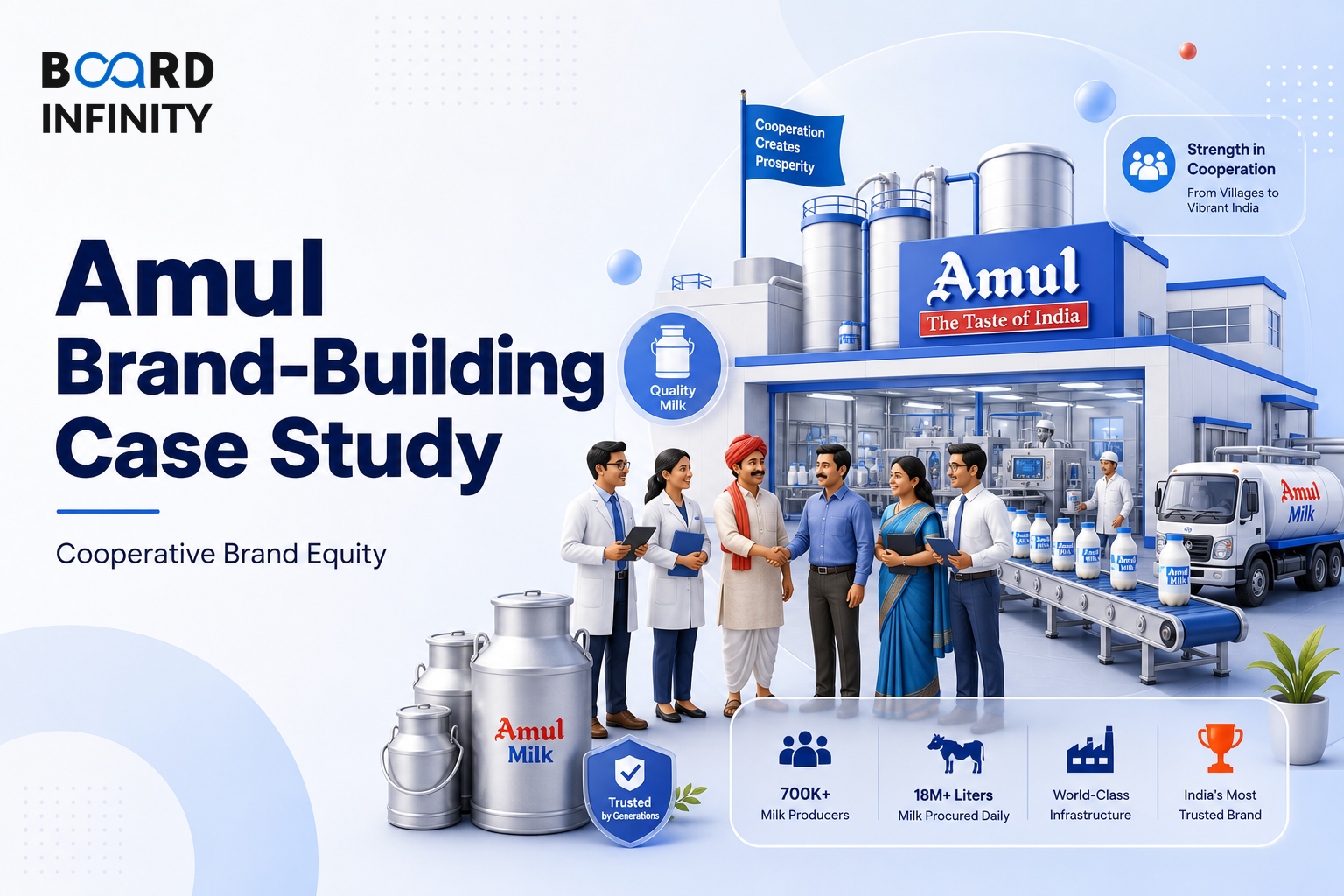
After Jio's penetration pricing showed how a company can use market entry and platform economics to reshape competition, Amul answers a different interview question: how can an Indian brand build lasting equity without venture capital or a global parent company? Amul is a cooperative of 36 lakh (3.6 million) dairy farmers in Gujarat, built entirely on cooperative economics where farmers own the brand. In interviews, this case matters because it connects Brand Architecture, Earned Media strategy, long-term brand equity building, cooperative business model, and rural procurement discussions.
- Amul is operated by GCMMF, founded in 1946, with revenue of ₹75,000+ Cr (2024).
- Amul is a cooperative of 36 lakh (3.6 million) dairy farmers in Gujarat, with no venture capital and no global parent company.
- Amul uses a Branded House strategy - one master brand, 'Amul', across 100+ products: milk, butter, cheese, ice cream, chocolates, paneer, ghee.
- 'Taste of India' positioning transcends categories, so every sub-product benefits from the master brand's trust.
- The Amul Girl campaign has been running since 1966 and is the world's longest-running outdoor advertising campaign, with topical, witty commentary on current events.
- Farmers receive 75-80% of the consumer price versus 30-40% in private dairy chains, which is the cooperative advantage.
- Amul is the go-to case for Brand Architecture, Earned Media strategy, long-term brand equity building, cooperative business model, and rural procurement discussions.
Context: Cooperative Brand Building
Company: GCMMF | Founded: 1946 | Revenue: ₹75,000+ Cr (2024). Amul is a cooperative of 36 lakh (3.6 million) dairy farmers in Gujarat. No venture capital, no global parent company. Built entirely on cooperative economics where farmers own the brand.
The big picture is simple: Amul combines a farmer-owned cooperative model, a single master brand, and topical earned media to create maximum brand resonance. Its producer economics support the business model, while the Amul Girl keeps the brand culturally relevant.
Amul: The Full Framework in One Business
Amul demonstrates the full brand-building framework because the same business links ownership, brand architecture, communication, producer economics, and brand equity. The result is not just an advertising story; it is a cooperative brand-building case.
A shallow answer stops at the Amul Girl. A complete answer connects the mascot to branded-house trust, earned media, cooperative economics, and long-term brand equity.
Branded House strategy - one master brand ('Amul') across 100+ products: milk, butter, cheese, ice cream, chocolates, paneer, ghee.
Brand Architecture: Branded House Strategy
Amul uses a Branded House strategy - one master brand ('Amul') across 100+ products: milk, butter, cheese, ice cream, chocolates, paneer, ghee. 'Taste of India' positioning transcends categories. Every sub-product benefits from the master brand's trust.
This is why Amul works well in Brand Architecture discussions. The master brand carries trust across categories, and the same brand can move into new products without each product needing to build trust from zero.
The Amul Girl and Earned Media
Running since 1966, the Amul Girl campaign is the world's longest-running outdoor advertising campaign (Guinness World Record). It is topical, witty commentary on current events - from politics to cricket to Bollywood. Zero paid digital amplification - the ads go viral organically every single time.
The campaign shows how consistent, culturally relevant content can keep a brand top-of-mind without directly selling. The Amul Girl gives the brand social currency because people share Amul Girl ads for social cachet.
Pricing and Farmer Economics
Farmers receive 75-80% of the consumer price versus 30-40% in private dairy chains. This is the cooperative advantage - cutting out intermediary profits and returning value to producers.
This point makes Amul more than a branding case. It is also excellent for cooperative business model and rural procurement discussions, because the brand is built on producer ownership and better value return to farmers.
Frameworks Applied
Amul can be mapped to three useful interview frameworks. Each framework helps explain a different part of the case: brand equity, category expansion, and shareable content.
Placement Takeaway
Amul is the go-to case for Brand Architecture (Branded House), Earned Media strategy, and long-term brand equity building. It is also excellent for cooperative business model and rural procurement discussions.
Structuring a Amul Interview Answer
"How would you use Amul as a case for brand architecture, earned media, and long-term brand equity building?"
Do not present Amul only as an advertising case. The strongest answer connects the Amul Girl to Branded House architecture, earned media, cooperative economics, and long-term brand equity building.
The most frequent error is treating Amul only as the Amul Girl campaign. That loses the bigger case: one master brand across 100+ products, farmer-owned cooperative economics, and a producer model where farmers receive 75-80% of the consumer price.
Conclusion
Amul is an Indian brand-building masterclass because a farmer-owned cooperative used a Branded House strategy, topical earned media, and cooperative economics to build lasting brand equity. For interviews, remember the core takeaway: Amul is not just a memorable mascot, it is a complete case in brand architecture, earned media, producer economics, and long-term trust.