
Jio's Penetration Pricing Strategy Explained
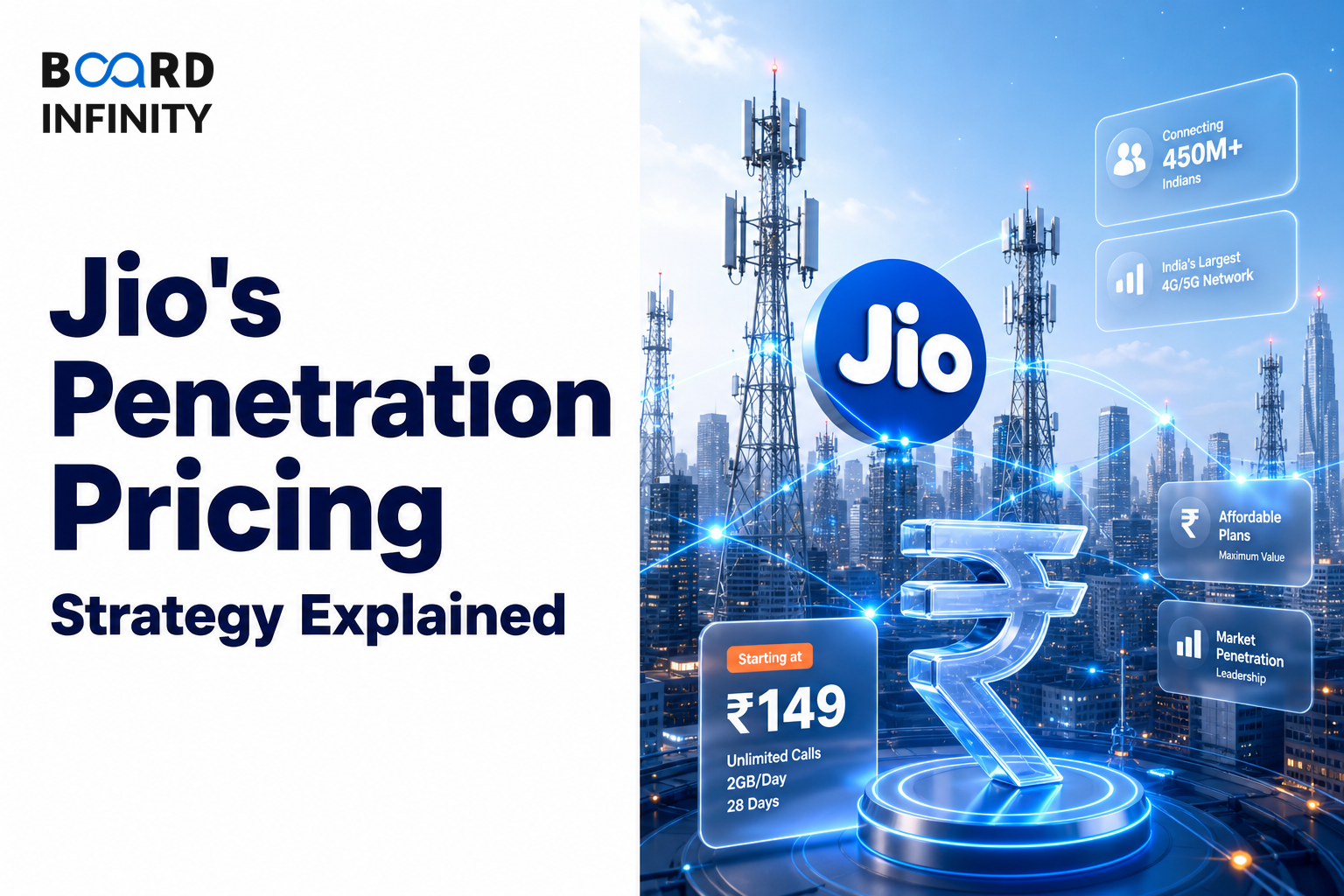
HUL Project Shakti showed how growth can come from solving rural Availability, Affordability, Acceptability, and Awareness. Jio's 2016 launch answers the pricing version of the same placement question: how can a company redesign access so aggressively that it changes an entire market? This matters in interviews because Jio is the definitive pricing and market entry case for pricing strategy, market disruption, and platform economics questions.
- Reliance Jio launched in September 2016 when mobile data in India cost ~₹250/GB and less than 5% of Indians used 4G.
- The strategy was free voice calls forever, data at ₹1.5/GB, a 6-month free trial (Jio Welcome Offer), and a ₹1,500 JioPhone for feature phone users.
- Jio reached 100 million users in 170 days - the fastest ramp in telecom history globally.
- Aircel shut down. Vodafone and Idea merged as a survival merger. Reliance Communications exited.
- India went from 150M to 950M+ internet users in under 8 years and became the world's largest mobile data consumer at ~19GB/user/month.
- The core insight is that the product was digital ecosystem lock-in, not telecom.
The Big Picture: Penetration Pricing as Market Entry
Reliance Jio's launch is best read as pricing, market entry, and platform economics in one case. The logic was to price far below market, remove the trial barrier, capture maximum share, and use telecom as the entry point into a digital ecosystem.
Reliance Jio: The Full Framework in One Business
Reliance Jio demonstrates the whole framework because the launch connected the challenge, strategy, results, and placement takeaway in one aggressive market-entry move.
A shallow answer describes Jio as a cheap telecom plan. A complete answer explains why subsidised connectivity helped build India's largest digital platform.
The Strategy: How Jio Removed the Entry Barrier
Penetration Pricing: Price far below market to capture maximum share.
The Challenge: India Before Jio
In 2016, mobile data in India cost ~₹250/GB. Less than 5% of Indians used 4G. Internet was a luxury, not a utility. The telecom market was an oligopoly of 10+ operators with high data prices.
The Indian telecom market was dominated by Airtel, Vodafone, Idea with high data prices (₹250/GB). Pre-Jio, Airtel and Vodafone sold small data packs.
Reliance Jio (2016): The Most Aggressive Penetration Pricing in Indian History
Jio used free voice and data for 6 months through the Jio Welcome Offer, then ultra-low pricing at ₹149 for 1GB/day. The objective was to acquire maximum subscribers to build ecosystem: JioCinema, JioMart, JioSaavn.
When Jio launched in September 2016 with free data and calls, it cut India's average data price from ~₹250/GB to under ₹10/GB within two years - the steepest decline in data pricing in telecom history globally.
The Results: Scale and Disruption
Frameworks Applied
Penetration Pricing: Price far below market to capture maximum share.
Blue Ocean Strategy: Created a new market of first-time internet users.
Porter's 5 Forces: Jio fundamentally restructured industry competition.
Platform economics: The product was not telecom - it was a digital ecosystem (JioCinema, JioMart, JioSaavn) with telecom as the entry point.
When Penetration Pricing Works
Penetration pricing works when you have:
- Deep pockets to sustain losses
- Network effects / ecosystem to monetize later
- Ability to change consumer behavior permanently
Placement Takeaway
Jio is the definitive pricing and market entry case. The insight: the product was digital ecosystem lock-in, not telecom. Jio subsidised connectivity to build India's largest digital platform.
Use this case for pricing strategy, market disruption, and platform economics questions.
Structuring a Jio's Penetration Pricing Strategy Explained Interview Answer
"How did Reliance Jio use penetration pricing to disrupt the Indian telecom market?"
The strongest answer does not stop at cheap data. It says Jio subsidised connectivity to build India's largest digital platform.
The most frequent error is to call Jio's launch only a cheap pricing move. That misses the main insight: the product was digital ecosystem lock-in, not telecom, and telecom was the entry point.
Conclusion
Jio's penetration pricing strategy worked because ultra-cheap connectivity captured maximum share, disrupted telecom competition, and built a digital ecosystem around JioCinema, JioMart, and JioSaavn. The final takeaway for interviews: explain Jio as a market-entry and platform economics case, not just a low-price telecom case.