
Basel Norms Explained: Basel I, II and III
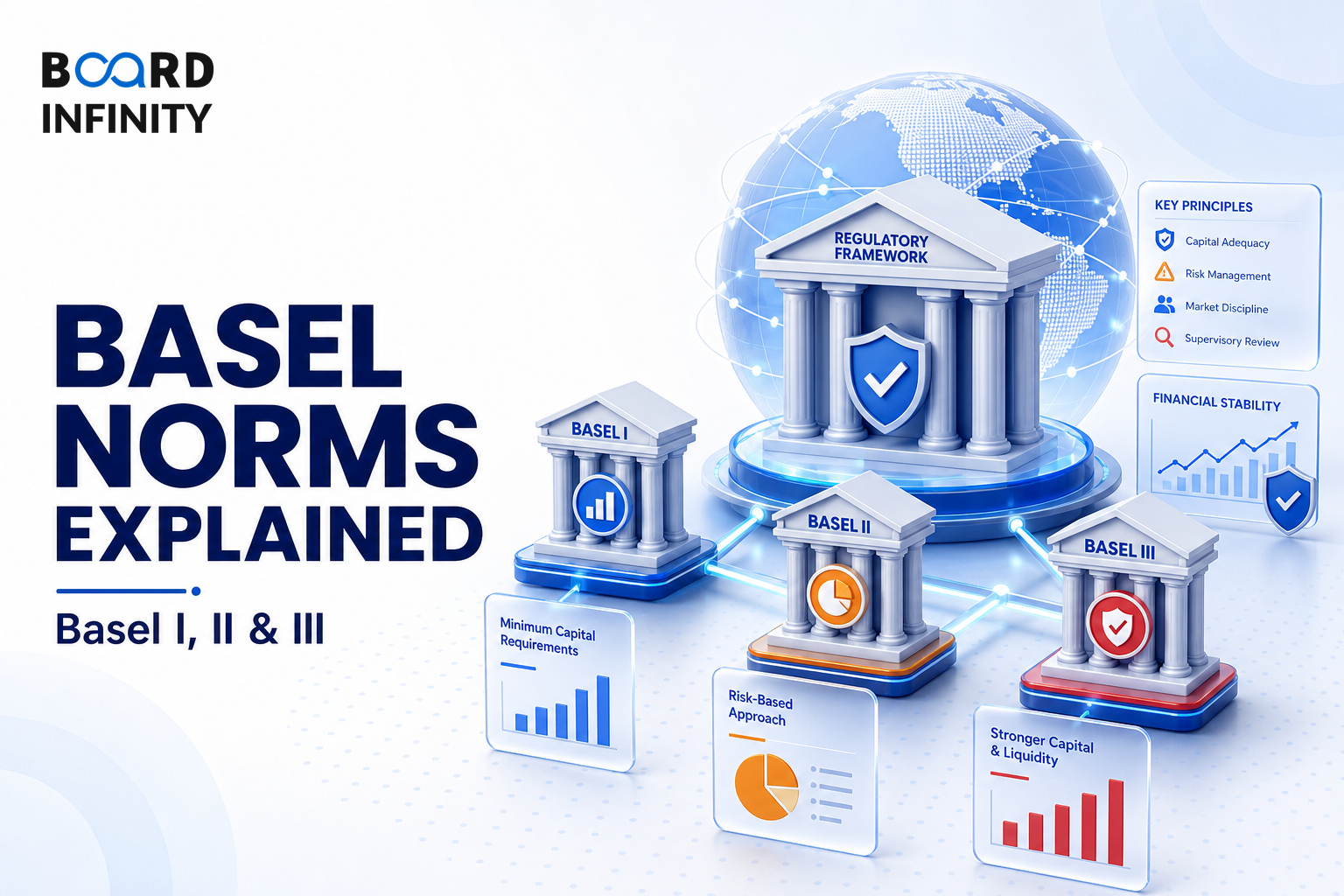
After Key Banking Metrics: NIM, CASA & GNPA, the next interview question is whether a bank has enough capital and liquidity to absorb stress. Basel Accords are international banking regulations designed by the Bank for International Settlements (BIS) to ensure global banks maintain adequate capital buffers. India implements Basel III through RBI guidelines, making Basel norms central to real banking analysis.
- Basel Accords are international banking regulations designed by the Bank for International Settlements (BIS) to ensure global banks maintain adequate capital buffers.
- India implements Basel III through RBI guidelines.
- CET1 Ratio is Core equity capital (paid-up + retained earnings) / Risk-Weighted Assets (RWA). Highest quality capital.
- Total Capital Adequacy Ratio (CAR) is Tier 1 + Tier 2 / RWA. Tier 2 includes subordinated debt (10+ years).
- LCR is High Quality Liquid Assets (HQLA) / 30-day net cash outflows. Ensures short-term liquidity.
- NSFR is Available Stable Funding / Required Stable Funding. Addresses medium-term liquidity.
- AT1 bonds absorb losses BEFORE equity in a resolution.
Basel Norms at a Glance
Basel norms work as capital and liquidity safety rules banks must meet. The key interview move is to connect the regulatory minimums with actual bank ratios, especially HDFC Bank FY24 and SBI FY24.
The Yes Bank AT1 write-off (March 2020, ₹8,415 Cr) shocked Indian bond markets - retail investors who bought these as "safe" were wiped out completely. SEBI subsequently restricted AT1 bond sales to HNIs and restricted minimum investment to ₹1 Crore for retail participation. The strategic "so what" is clear: AT1 bonds absorb losses BEFORE equity in a resolution.
Additional Tier 1 (AT1) bonds are perpetual, with write-down triggers if CET1 falls below 5.5-6.125%.
How Basel Capital Requirements Work
CET1 Ratio (Common Equity Tier 1) measures Core equity capital (paid-up + retained earnings) / Risk-Weighted Assets (RWA). It is the highest quality capital, and the RBI minimum is ≥7.5% (incl. CCB).
Tier 1 Capital Ratio is CET1 + Additional Tier 1 (AT1 bonds - perpetual, write-down/conversion triggers). The RBI minimum is ≥8.5%.
Total Capital Adequacy Ratio (CAR) is Tier 1 + Tier 2 / RWA. Tier 2 includes subordinated debt (10+ years), and the RBI minimum is ≥11.5% (incl. CCB 2.5%).
How Basel Liquidity Requirements Work
LCR (Liquidity Coverage Ratio) is High Quality Liquid Assets (HQLA) / 30-day net cash outflows. It ensures short-term liquidity, and the RBI minimum is ≥100%.
NSFR (Net Stable Funding Ratio) is Available Stable Funding / Required Stable Funding. It addresses medium-term liquidity, and the RBI minimum is ≥100%.
Leverage Ratio as a Backstop
Leverage Ratio is Tier 1 Capital / Total Exposures (on + off balance sheet). It is a non-risk-based backstop, and the RBI minimum is ≥3.5%.
In FY24, HDFC Bank was at ~8% and SBI was at ~5% on this ratio.
Reading HDFC Bank and SBI Through Basel Norms
HDFC Bank FY24 shows CET1 Ratio at 16.3%, Tier 1 Capital Ratio at 17.2%, Total Capital Adequacy Ratio (CAR) at 19.3%, LCR at ~120%, NSFR at >100%, and Leverage Ratio at ~8%.
SBI FY24 shows CET1 Ratio at 9.9%, Tier 1 Capital Ratio at 11.1%, Total Capital Adequacy Ratio (CAR) at 13.7%, LCR at ~130%, NSFR at >100%, and Leverage Ratio at ~5%.
In an interview, these numbers show how regulatory minimums appear in real banking analysis: capital ratios protect against losses, liquidity ratios protect against cash outflows, and leverage ratio acts as a non-risk-based backstop.
AT1 Bonds - Key Alert for India
Additional Tier 1 (AT1) bonds are perpetual, with write-down triggers if CET1 falls below 5.5-6.125%. The Yes Bank AT1 write-off (March 2020, ₹8,415 Cr) shocked Indian bond markets - retail investors who bought these as "safe" were wiped out completely.
SEBI subsequently restricted AT1 bond sales to HNIs and restricted minimum investment to ₹1 Crore for retail participation. Key interview point: AT1 bonds absorb losses BEFORE equity in a resolution.
Structuring a Basel Norms Explained (Basel I, II & III) Interview Answer
"Explain Basel norms and use HDFC Bank and SBI FY24 ratios to show how RBI minimums appear in real banking analysis."
Do not stop at quoting CAR. Strong answers separate CET1, Tier 1, Total CAR, LCR, NSFR, and Leverage Ratio, then anchor the answer to HDFC Bank FY24 and SBI FY24.
The most frequent error is treating AT1 bonds as safe fixed-income instruments. In a resolution, AT1 bonds absorb losses BEFORE equity, and the Yes Bank AT1 write-off showed why missing this point costs marks in banking interviews.
Conclusion
Basel norms are the capital and liquidity safety rules banks must meet, implemented in India through RBI guidelines. For interviews, combine the definitions with RBI minimums, HDFC Bank FY24 and SBI FY24 ratios, and the Yes Bank AT1 lesson.