
Applied: Building an Operations Strategy From a Business Plan
At 7:10 a.m., a retail store team is not “doing operations” in the abstract - they are executing yesterday’s business plan in steel racks, delivery slots, reorder points and staffing rosters. If the plan promises low prices, wide choice and fast availability, the operations system must decide which promise wins when all three cannot.
- Operations strategy converts a business plan into operating choices - capacity, process, make-buy, footprint, technology, people and metrics.
- Start with the customer promise, not with assets. Ask: cost, quality, speed, flexibility or reliability - what must operations make true?
- The core job is to convert revenue ambition into volume, variety, variability and service-level requirements.
- Every operating choice must show a trade-off: what you are choosing, what you are not choosing, and why.
- Use a one-page logic: business plan - operating requirements - design choices - capabilities - KPIs - governance.
- Strong interview answers include a small numeric sanity check on capacity, utilization, lead time or service level.
- The biggest mistake is jumping to “automation,” “outsourcing” or “warehouses” before defining the customer promise and operating trade-offs.
Big Picture: The Business Plan Must Narrow Into an Operating System
A business plan says where the company wants to win. Operations strategy says how the company will repeatedly deliver that win. The bridge is not a slogan - it is a disciplined translation from market ambition into operating requirements and choices.
Core Explanation: A Five-Step Way to Build the Strategy
Think of this as an applied conversion exercise. You are taking a plan written in market language - customers, revenue, segments, channels - and turning it into operations language - capacity, process, assets, suppliers, people, technology and performance measures.
If you have revised aligning operations with business strategy, this is the hands-on version: instead of saying “operations must support strategy,” you show exactly what support looks like.
Step 1: Decode the Business Plan
Do not begin with “we need a plant” or “we need an app.” Begin with the business model. A good operations strategy starts by extracting six pieces of information:
Step 2: Convert the Promise Into Competitive Priorities
Operations cannot maximize everything. A discount grocery chain, a premium eyewear brand and a 10-minute delivery platform need different systems because their customer promises differ. Use the classic competitive priorities - cost, quality, speed and flexibility - but rank them, do not merely list them. For a deeper revision, connect this to competitive priorities in operations strategy.
Step 3: Choose the Operating Model
The operating model is the architecture of execution. It answers: what process will we use, where will capacity sit, what will we own, what will we outsource, how will work flow, and what capabilities must be built?
Capacity is usually where vague answers collapse. If demand is uncertain, a lead, lag or match capacity strategy becomes a strategic choice, not an operations detail. Similarly, the make-buy-partner decision decides where the company keeps control and where it buys flexibility.
Step 4: Run a Small Numerical Sanity Check
Interviewers like candidates who can turn strategy into numbers. Use a simple capacity check to prove that your strategy is executable.
Worked example: Assume a D2C food brand plans 60,000 monthly orders. It operates 25 working days, 8 hours per day. Required throughput is:
Required orders per hour = 60,000 / (25 x 8) = 300 orders per hour.
If one packing line can process 180 orders per hour, two lines give 360 orders per hour. But at a target utilization of 80 percent, effective capacity is 360 x 0.80 = 288 orders per hour, which is below the requirement. The strategy choice is now visible: add a third line, extend shifts, outsource overflow, reduce order complexity or change the service promise.
This is exactly what an operations strategy is meant to reveal - not just whether growth is attractive, but whether the system can deliver it without breaking service or cost.
Step 5: Define Metrics That Match the Strategy
Metrics are not decoration. They are how you know whether the operating model is delivering the business plan. The “good” values below are directional interview heuristics; actual targets vary by sector, product complexity and service promise.
Definitions You Can Say in One Breath
- Operations strategy: the pattern of long-term operations choices that builds capabilities to deliver the business strategy.
- Business plan: a structured statement of target market, value proposition, revenue model, resources, risks and financial expectations.
- Operating model: the design of processes, assets, people, partners and systems that delivers the customer promise repeatedly.
- Trade-off: a deliberate choice to prioritize one performance dimension while accepting limits on another.
- Capability: an organizational ability that lets the firm perform an activity reliably better than competitors.
Case Study: DMart Turning a Low-Price Business Plan Into an Operating System
DMart shows how a simple retail promise - everyday value on essential purchases - becomes a disciplined operating system across assortment, sourcing, stores and cost control.
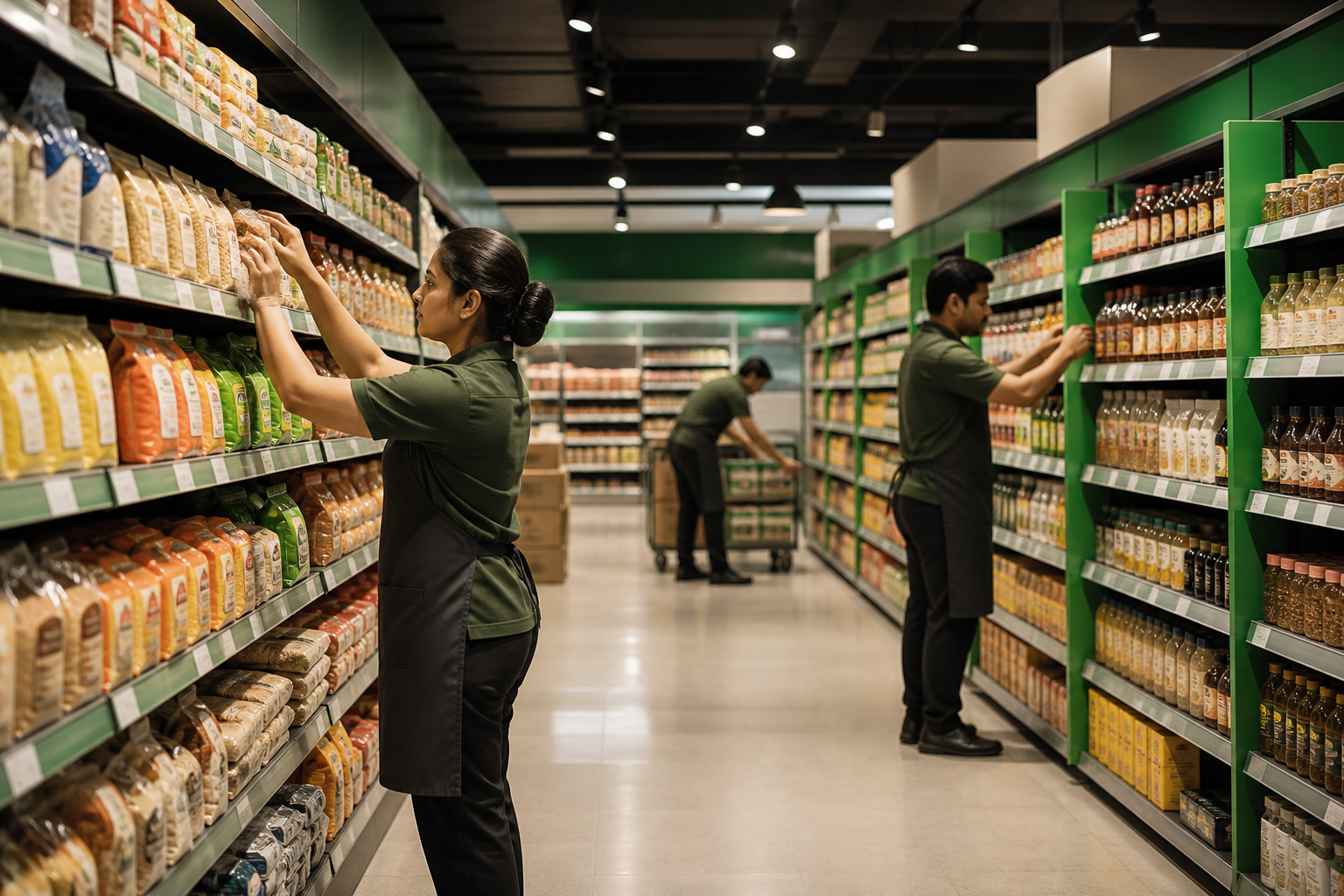
DMart, operated by Avenue Supermarts, is a useful Indian example because its strategy is not built on a flashy customer interface. The business plan is straightforward: serve value-conscious households with reliable availability of everyday grocery and household products at attractive prices. The operations challenge is much harder: make that promise profitable store after store.
The primary driver is operational focus around cost-efficient retailing. DMart avoids trying to be everything to everyone. Its supporting drivers reinforce that focus: disciplined assortment, procurement efficiency, controlled store economics, high store-level execution discipline, and a culture that treats cost leakage as a strategic threat rather than an accounting issue.
The lesson for interviews: do not explain DMart as “successful because it is low cost.” That is too shallow. The sharper answer is that low cost is the strategic outcome of multiple aligned operations choices - assortment discipline, procurement, store economics, inventory productivity and execution routines working together.
How AI Changes Building an Operations Strategy From a Business Plan
AI does not replace operations judgment. It makes the translation faster, more evidence-based and easier to stress-test. In 2026, three changes matter most.
- Faster scenario modelling: AI tools can convert a business plan into demand, capacity and cost scenarios. For example, you can test what happens if demand is seasonal, if supplier lead time increases, or if service-level expectations rise.
- Better operating-risk sensing: AI can scan customer reviews, delivery failures, complaint themes, stockout patterns and supplier delays to detect whether the operating model is breaking the customer promise.
- More dynamic make-buy-partner decisions: AI-assisted cost and risk models help compare in-house capacity, outsourcing, third-party logistics and hybrid models under different demand assumptions.
Student workflow: Load the business plan summary, competitor notes and your operations assumptions into NotebookLM. Ask it to generate: “What operating choices must this business make on capacity, process, sourcing, footprint and KPIs? Where are the trade-offs?” Then use ChatGPT or Claude to create a two-scenario capacity model and compare risks. If you want the dedicated revision path, use using AI to model operations strategy options after this lesson.
Interview Relevance
“A company has a business plan to launch a premium ready-to-cook food brand in eight Indian cities. How would you build its operations strategy?”
Use the sentence: “I will first translate the market promise into operating requirements, then choose the system that best fits the trade-offs.” It signals structure before you start solving.
Common Mistake
The single biggest mistake is recommending assets or tools too early - “build a warehouse,” “automate,” “outsource logistics” - without proving which customer promise and trade-off they support. This costs candidates because it sounds operational but not strategic. The one-line fix: start with the customer promise, convert it into operating requirements, then justify each design choice.
What to Revise Next
This is the final lesson in the course, so your natural next step is a capstone review: take one business plan - retail, D2C, manufacturing, logistics or food service - and build a one-page operations strategy covering customer promise, trade-offs, capacity, make-buy, footprint, process design, KPIs and risks.