
Make, Buy or Partner as a Strategic Choice
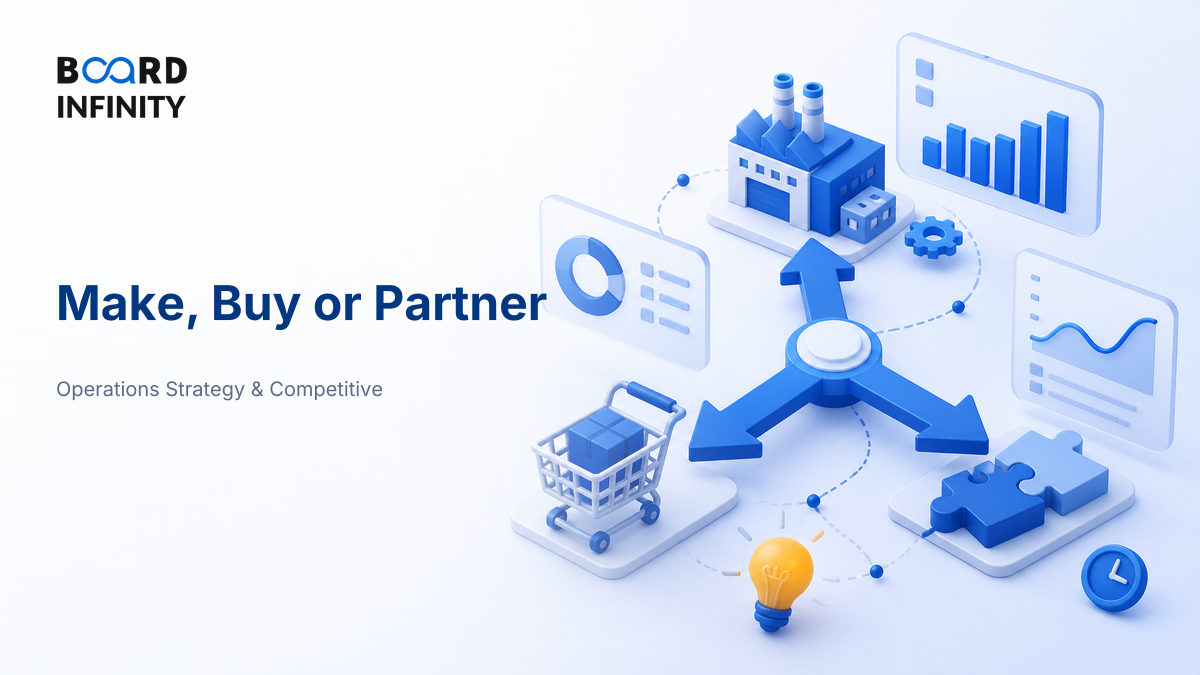
The biggest misconception is that “make, buy or partner” is just a procurement question. It is not. It is a strategy question disguised as an operations choice - because the wrong call can lock a company into high costs, weak control, supplier dependence, or slow innovation for years.
- Make when the activity is strategically critical, hard to specify, capability-building, or tightly linked to customer experience.
- Buy when the activity is standard, supplier markets are mature, scale sits outside the firm, and internal ownership adds little advantage.
- Partner when neither side can win alone - the firm needs shared investment, speed, ecosystem access, or complementary capability.
- The best answer balances cost, control, capability, risk, speed, and reversibility - not cost alone.
- Use a 2x2: strategic importance vs asset specificity. High-high usually points to make; low-low usually points to buy.
- Metrics matter: compare total cost of ownership, time-to-capability, quality performance, dependency risk, and switching cost.
- The trap: recommending outsourcing because it is “cheaper” without testing whether the activity creates advantage.
Big Picture: It Is a Capability Boundary Decision
A make-buy-partner decision defines the boundary of the firm: what must sit inside, what can sit outside, and what must be jointly governed. If operations must align with business strategy, this decision is one of the most practical places where that alignment shows up.
Core Explanation: The Three Choices and the Logic Behind Them
Think of the decision as choosing the right control model for an activity.
A make-buy-partner decision is the strategic choice of owning an activity, contracting it out, or co-creating it through an alliance.
1. Make: Own the Activity Internally
Make means the firm performs the activity itself - with its own people, assets, processes, technology and management control.
Choose make when the activity is close to competitive advantage. For example, a premium consumer-tech company may keep product design, user experience, core software, or proprietary algorithms in-house because these shape differentiation.
Make is strongest when:
2. Buy: Use the Market
Buy means the firm procures the activity, component, service, or capability from an external supplier using a contract.
Choose buy when supplier markets are mature and the activity does not create strategic uniqueness. This is why many companies buy payroll software, cloud infrastructure, packaging materials, commodity components, or routine facility services instead of building everything internally.
Buy is strongest when:
3. Partner: Share Capability and Governance
Partner means two or more firms jointly create value through an alliance, joint venture, platform arrangement, ecosystem tie-up, co-development, or long-term strategic contract.
Partnering sits between make and buy. It gives more influence than a simple purchase, but less full control than internal ownership. Use it when the firm needs access, speed, capital sharing, local knowledge, distribution, technology, or ecosystem effects.
Partner is strongest when:
The Consultant’s 2x2: Strategic Importance vs Asset Specificity
The cleanest interview framework is a 2x2. Ask two questions: Is this activity strategically important? and Does it require assets, knowledge, or processes specific to this firm?
Asset specificity means how customized an asset, process, tool, location, skill, or relationship is to a particular firm. A generic cloud service has low asset specificity. A production line customized for one EV battery architecture has high asset specificity.
The Six Tests Before You Decide
Use these six tests in sequence. They keep your answer practical and prevent the common “outsource equals save cost” mistake.
Metrics to Compare Make, Buy and Partner
There is no universal “good” number because the right threshold depends on industry, volatility and strategic importance. But a strong answer names the metrics and explains what good looks like relative to the alternatives.
Worked Example: Why the Cheapest Option Can Still Be Risky
Assume a company needs 100,000 units of a component per year. It is comparing make, buy and partner.
At 100,000 units, making looks best. But if demand falls to 50,000 units, the make option becomes ₹260 per unit because the fixed cost is spread over fewer units. The lesson: calculate cost at realistic demand scenarios, then layer in control, capability and risk.
Definitions You Should Be Able to Say Clearly
- Make: Performing an activity internally using the firm’s own assets, people, systems and management control.
- Buy: Contracting an external supplier to provide a product, service, process, or capability.
- Partner: Sharing value creation and governance with another organization through an alliance, joint venture, platform, or long-term collaboration.
- Asset specificity: The degree to which an asset or capability is customized to a particular firm, transaction, or use case.
- Total cost of ownership: The full lifecycle cost of an option, including purchase, operating, coordination, risk, quality and switching costs.
Case Study: Ather Energy’s Make-Buy-Partner Logic
Ather Energy shows why an EV company cannot simply “make everything” or “outsource everything”; it must decide which capabilities define the customer experience.

Situation: Electric two-wheelers are not just vehicles. They combine hardware, battery performance, charging experience, connected software, service reliability and consumer trust. For a company like Ather, the strategic question is not “Should we manufacture or outsource?” The sharper question is: Which parts of the EV experience must we control, and where should we use partners?
The move: Ather’s logic can be read as a portfolio of choices. It keeps tight control over the product experience and technology architecture that shape differentiation. It relies on suppliers for many components where external ecosystems are efficient. It also works through partners for financing, retail reach, charging locations, and ecosystem expansion where ownership of every asset would slow scaling.
Outcome or lesson: The primary driver is control over the customer-defining EV experience. Supporting drivers are supplier specialization, partner-enabled reach, capital discipline, and a learning loop from product usage and service feedback. That is exactly how strong make-buy-partner reasoning should sound: not one cause, but a system of choices.
Apple’s India manufacturing story also illustrates the logic: Apple retains control over product design, software, brand and quality standards, while assembly and manufacturing execution happen through specialized partners. The strategic so what: global firms often protect the sources of differentiation while partnering for scale, local execution and supply-chain flexibility.
How AI Changes Make, Buy or Partner as a Strategic Choice
AI changes this topic in a very practical way: it improves the quality and speed of comparison, but it does not remove the judgment call.
- AI improves supplier discovery and risk sensing. Teams can scan supplier websites, filings, certifications, news, sanctions lists, ESG indicators and delivery signals faster than manual sourcing teams. The human job becomes validating credibility and governance risk.
- AI makes scenario modelling easier. Instead of one static spreadsheet, managers can model demand swings, currency changes, quality failures, logistics delays, and capacity utilization. This is especially useful before committing to fixed assets.
- AI shifts what should be kept inside. If data, algorithms, customer insights, or process intelligence are the source of advantage, firms may make or tightly control those capabilities even while buying execution capacity outside.
Use ChatGPT or Claude to build a make-buy-partner decision memo: give it the business context, activity, demand uncertainty, supplier options, and strategic priorities. Then ask it to create a TCO table, risk register and recommendation. For deeper modelling practice, using AI to model operations strategy options.
Interview Relevance
“A consumer electronics company is launching a new smart device in India. Should it manufacture key components in-house, outsource to a supplier, or partner with an electronics manufacturing services firm?”
In interviews, do not say “outsource non-core activities” and stop. Explain what makes something non-core: low strategic impact, mature supplier market, low asset specificity, low switching cost, and limited learning value.
Common Mistake
The biggest mistake is treating make-buy-partner as a cost-only decision. It costs candidates because it ignores strategic control, learning, risk, supplier dependence and reversibility. One-line fix: Start with strategic importance, then compare economics and governance.