
The 'Red Flag' Behaviours That Lead to Case Interview Rejection
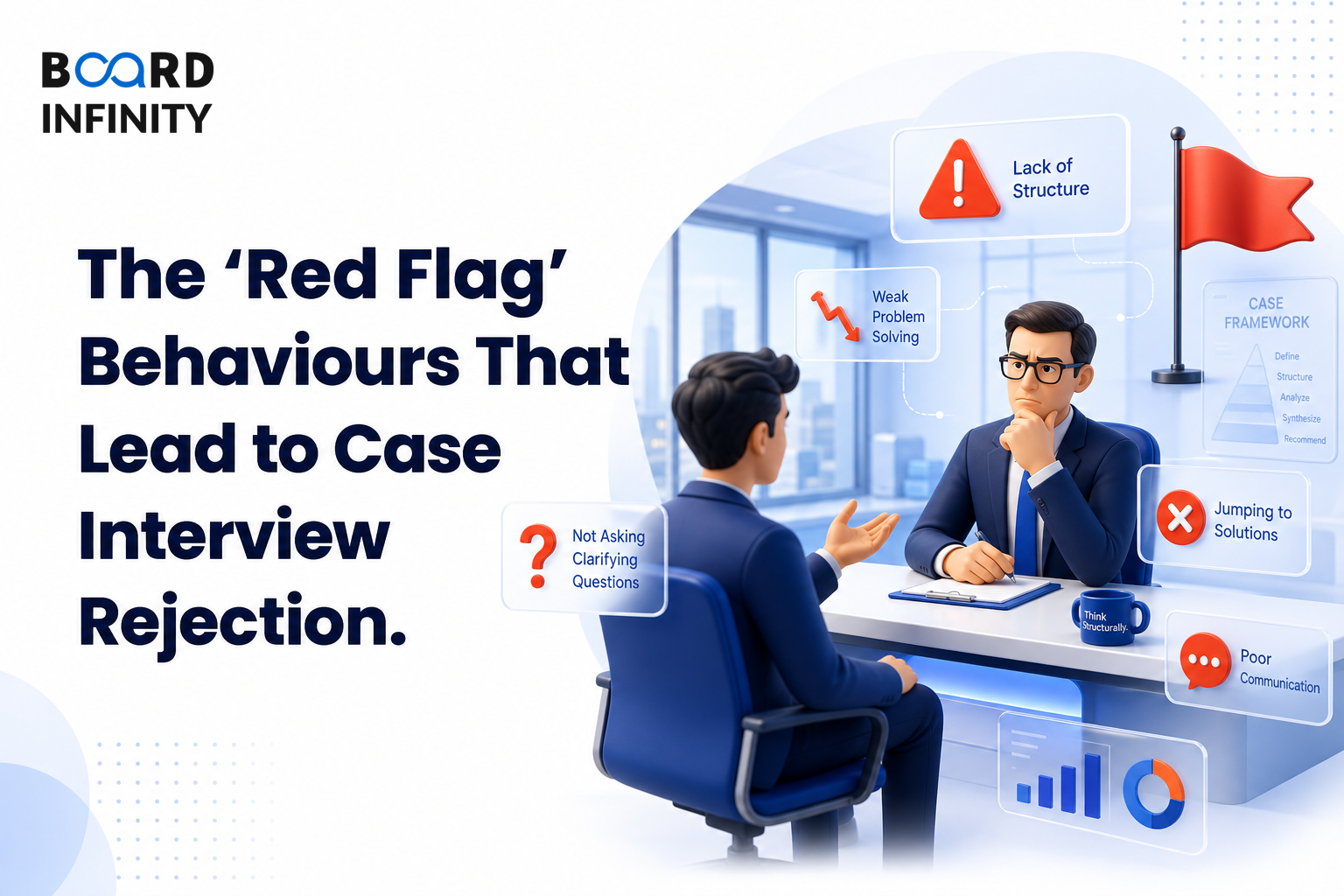
After understanding firm-by-firm evaluation focus across McKinsey, BCG, Bain, Deloitte, and Kearney, the next question is sharper: what behaviours make interviewers reject a candidate even when the framework looks good? Case interviews are not only about structure - they test whether you can think like a consultant, communicate like a client advisor, and turn analysis into action.
- Instant disqualifiers include memorised framework force-fit, zero hypothesis, silent math, ignoring hints, no 'so what', robotic communication, weak synthesis, and overconfidence.
- Think of it as a client meeting, not an exam: You're a junior consultant presenting to a Partner.
- Lead with hypothesis: 'My initial hypothesis is X. Let me test it by looking at these 3 areas.'
- Narrate your thinking: 'I'm choosing to explore cost first because the problem says revenues are stable.'
- Check in frequently: 'Does this direction make sense?' / 'Should I dive deeper here or move on?'
- After every data point you present in a case interview, ask yourself: 'If the CEO heard this, would they know what to DO next?'
The Big Picture
The rejection pattern is clear: candidates fail when they treat the case as a framework-recitation exam instead of a live client conversation. Strong candidates move from hypothesis to analysis to synthesis, while consistently explaining why each step matters.
Instant Disqualifiers - What Gets You Rejected Even with a Good Framework
These behaviours are red flags because they show the interviewer that the candidate may be structured on paper but not client-ready in practice.
The 'So What?' Drill - Data to Insight to Action
The biggest differentiator between an average analyst and a top consultant is the ability to move from data to insight to 'so what?'. Practice this translation for every finding.
After every data point you present in a case interview, ask yourself: 'If the CEO heard this, would they know what to DO next?' If not, you haven't gone far enough. Data without action is just trivia.
What to Do Differently: The Mindset Shift
The fix is not to memorise more frameworks. The fix is to change how you behave in the interview - from mechanical solving to hypothesis-led, client-ready communication.
Case Interview Flow Simulation
A case interview tests how you speak through a case, not just how you think through one. The interviewer is tracking how you transition between phases - smooth transitions signal experience.
Total interview time: 25-35 minutes per case.
Structuring a The 'Red Flag' Behaviours That Lead to Case Interview Rejection Interview Answer
"What gets a candidate rejected in a case interview even with a good framework, and what should they do differently?"
The #1 way candidates get this wrong is presenting numbers without interpreting what they mean. Data without action is just trivia.
The most frequent error is memorised framework force-fit: using a profitability tree for a market entry case. It costs points because it shows the candidate is exploring branches mechanically instead of leading with hypothesis, prioritising, and translating data into action.
Conclusion
Case interview rejection often comes from behaviours that make the answer feel mechanical: forced frameworks, silent math, missed hints, and weak synthesis. Replace them with hypothesis-led thinking, frequent check-ins, quantified impact, and a clear 'so what' after every finding.