
The Mindset Shift: Leading with 'So What' in Case Interviews
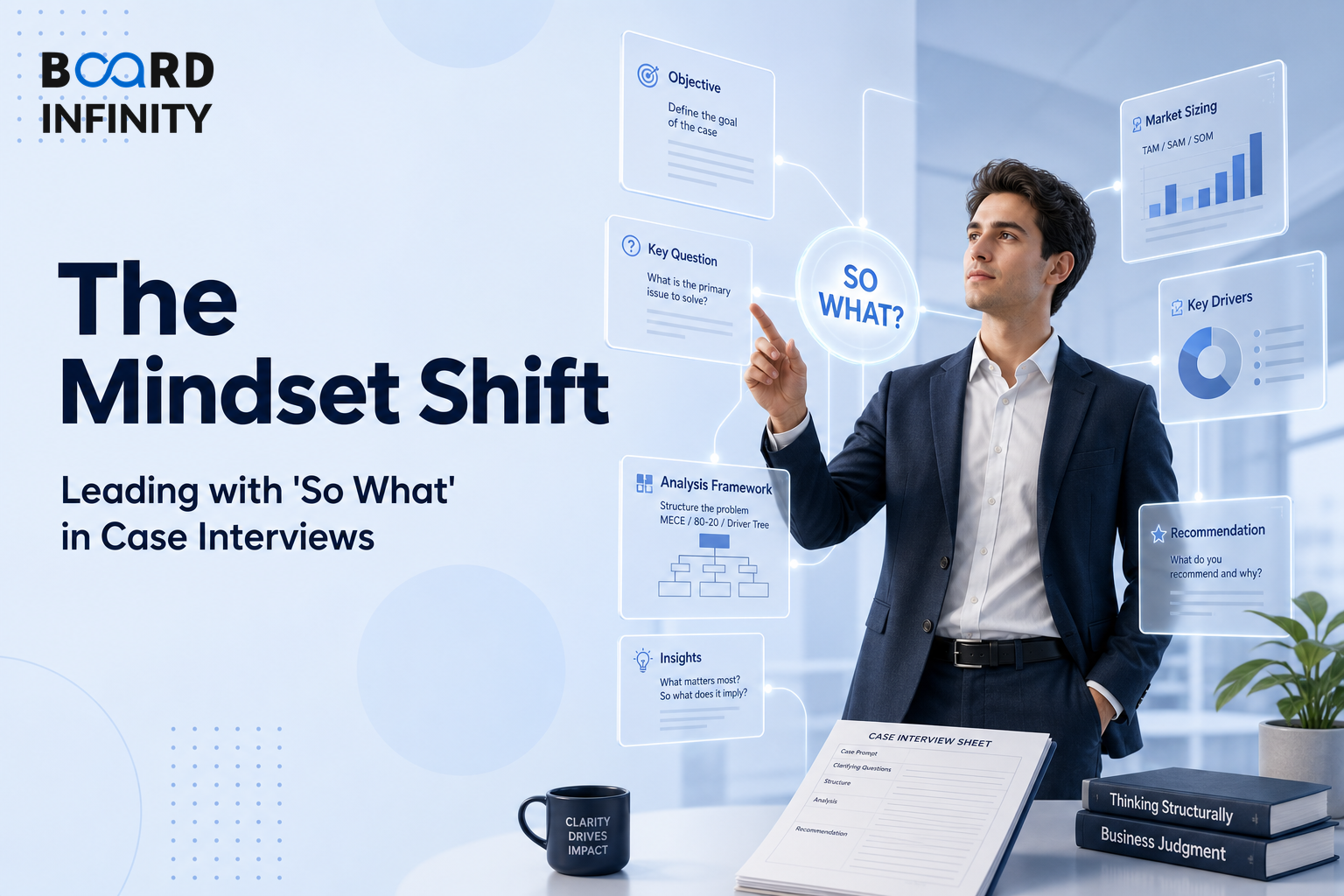
After understanding the red flag behaviours that lead to case interview rejection, the next question is what to do differently. The mindset shift is to treat the case as a client meeting, not an exam: every number must become an insight, and every insight must lead to a clear action. This matters because interviewers are not only checking whether you can calculate, but whether you can communicate like a consultant.
- Think of it as a client meeting, not an exam: You're a junior consultant presenting to a Partner.
- Lead with hypothesis: "My initial hypothesis is X. Let me test it by looking at these 3 areas."
- Narrate your thinking: "I'm choosing to explore cost first because the problem says revenues are stable."
- Check in frequently: "Does this direction make sense?" / "Should I dive deeper here or move on?"
- When stuck, say so: "I'm not sure about this assumption - can I get more data on X?"
- Always quantify impact: "This would save ₹200 Cr annually, which is ~15% of operating costs."
- The biggest differentiator between an average analyst and a top consultant is the ability to move from data to insight to "so what?".
The Big Picture: From Exam Answer to Client Recommendation
The shift is simple: stop solving silently for the "right" answer and start presenting like a junior consultant in a client meeting. The operating loop is data to insight to action, where each finding is translated into what it means for the client and what should happen next.
Firm-by-Firm Evaluation Focus
Interviewers evaluate the case differently across firms, but the mindset remains the same: communication, hypothesis-generation, feasibility, and quantitative rigour all matter alongside the framework.
Red Flags the Mindset Shift Fixes
These are instant disqualifiers that can get you rejected even with a good framework. The core pattern is that the candidate appears to be performing a rehearsed answer instead of thinking through a live client problem.
What to Do Differently: The Mindset Shift
The mindset shift is practical. It changes how you open the case, how you analyse, how you interact with the interviewer, and how you convert findings into client action.
After every data point you present in a case interview, ask yourself: "If the CEO heard this, would they know what to DO next?" If not, you haven't gone far enough. Data without action is just trivia.
The So What Drill: Data to Insight to Action
The biggest differentiator between an average analyst and a top consultant is the ability to move from data to insight to "so what?". Practice this translation for every finding.
Worked Example: Sales Fell 10% in Q3
Start with the raw data: sales fell 10% in Q3. The consulting insight is that competition is out-pricing us in rural markets where 60% of volume comes from. The action is to launch a sachet-based pricing strategy for Tier-3 towns and pilot it in 3 states within 90 days.
The learning is that the number alone is not enough. It becomes useful only when it explains what is happening and points to what the client should do next.
Structuring a The Mindset Shift Interview Answer
"How would you avoid the 'no so what' red flag in a live case interview?"
The #1 way candidates get this wrong is presenting numbers without interpreting what they mean. After each number, ask whether the CEO would know what to do next.
The most frequent error is "no so what": presenting numbers without interpreting what they mean. It costs points because data without action is just trivia, and weak synthesis ends with "so those are my findings" instead of a clear recommendation.
Conclusion
The mindset shift is to treat the case as a client meeting, not an exam. Lead with a hypothesis, narrate your thinking, check in frequently, and make every number lead to a clear action.