
Firm-by-Firm Evaluation Focus: McKinsey vs BCG vs Bain vs Deloitte vs Kearney
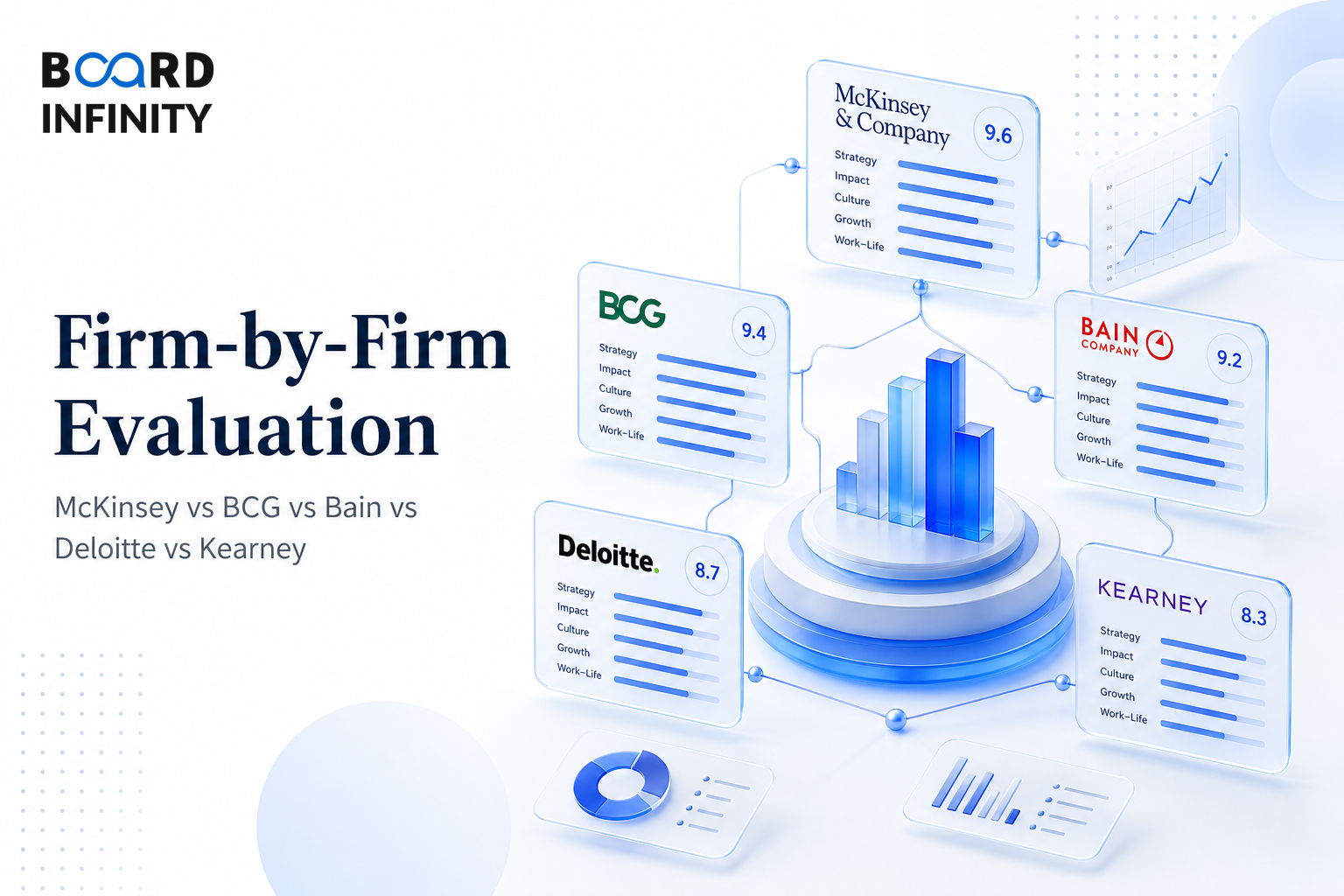
After seeing how top candidates differ from average candidates, the next question is what interviewers reject even when the framework looks good. Firm-by-firm evaluation focus matters because McKinsey, BCG, Bain, Deloitte, and Kearney do not weigh the case and behavioural portions in exactly the same way. The common thread is that interviewers are looking for consultant behaviours through the case flow - not memorised frameworks, silent analysis, or numbers without a clear so what.
- Every case interview is scored on problem structuring, analytical rigour, business judgement, communication clarity, synthesis ability, and coachability.
- McKinsey is ~70% case and ~30% behavioural through PEI, while BCG, Bain, Deloitte, and Kearney vary in how behavioural fit is woven in or separated.
- Instant disqualifiers include memorised framework force-fit, zero hypothesis, silent math, ignoring hints, no so what, robotic communication, weak synthesis, and overconfidence.
- The mindset shift is to think of it as a client meeting, not an exam: lead with hypothesis, narrate your thinking, check in frequently, say when stuck, and quantify impact.
- The biggest differentiator between an average analyst and a top consultant is the ability to move from data to insight to so what.
- The 5-phase case flow is CLARIFY, STRUCTURE, ANALYSE, SYNTHESISE, and RECOMMEND, with total interview time of 25-35 minutes per case.
Big Picture: From Scoring Criteria to Rejection Behaviours
Most candidates prepare for what they need to say. Top candidates prepare for what the interviewer is evaluating. Understanding the scoring criteria transforms your approach from memorising frameworks to demonstrating consulting readiness.
Every case interview is scored on these - explicitly at McKinsey, implicitly at BCG/Bain:
- Problem Structuring - Can you break an ambiguous problem into a MECE framework?
- Analytical Rigour - Can you do the math, interpret data, and draw insights?
- Business Judgement - Do your recommendations make practical business sense?
- Communication Clarity - Can you explain complex thinking simply and concisely?
- Synthesis Ability - Can you pull it all together into a clear recommendation?
- Coachability - Do you respond well to hints, pushback, and new information?
Instant Disqualifiers - What Gets You Rejected Even with a Good Framework
These behaviours lead to rejection because they make the candidate sound like someone solving an exam rather than a junior consultant presenting to a Partner.
- Memorised framework force-fit: Using a profitability tree for a market entry case
- Zero hypothesis: Exploring all branches equally instead of prioritising
- Silent math: Doing mental calculations silently for 2+ minutes without explaining
- Ignoring hints: When the interviewer redirects you, failing to follow the lead
- No 'so what': Presenting numbers without interpreting what they mean
- Robotic communication: Sounding rehearsed rather than having a genuine conversation
- Weak synthesis: Ending with 'so those are my findings' instead of a clear recommendation
- Overconfidence: Not acknowledging assumptions or limitations
What to Do Differently: The Mindset Shift
The better approach is not to sound more rehearsed. It is to sound more client-ready through the way you lead, explain, check in, and convert findings into action.
Firm-by-Firm Evaluation Focus
Firm case weight and behavioural weight differ, and each firm has a distinct evaluation focus. Use this to understand what the interviewer is likely to value, while still avoiding the same core red flag behaviours.
The 'So What?' Drill - Data to Insight to Action
The biggest differentiator between an average analyst and a top consultant is the ability to move from data to insight to 'so what?'. Practice this translation for every finding.
After every data point you present in a case interview, ask yourself: 'If the CEO heard this, would they know what to DO next?' If not, you haven't gone far enough. Data without action is just trivia.
Case Interview Flow Simulation
This teaches you how to speak through a case, not just how to think through one. Most books give you the framework - this gives you the exact script for each phase of a live case interview.
Total interview time: 25-35 minutes per case. The interviewer is tracking how you transition between phases - smooth transitions signal experience.
Structuring a Firm Interview Answer
"How would you adapt your case interview approach across McKinsey, BCG, Bain, Deloitte, and Kearney while avoiding the behaviours that lead to rejection?"
The #1 way candidates get this wrong is treating firm focus as a memorisation exercise. The table tells you emphasis, but the interview still rewards hypothesis-led thinking, explained analysis, coachability, and a clear recommendation.
The most frequent error is presenting a good-looking framework but then behaving like an exam taker: force-fitting, analysing silently, ignoring hints, and ending without a clear so what. This costs points because the interviewer cannot see a client-ready consultant who can move from data to insight to action.
Conclusion
Firm-by-firm evaluation focus helps you understand what each interviewer may emphasise, but rejection usually comes from non-consultant behaviours during the case flow. Lead with hypothesis, narrate your thinking, stay coachable, quantify impact, and make every finding answer the CEO's question: what should we do next?