
Case Study: Allocating a Rs 1 Crore Digital Budget
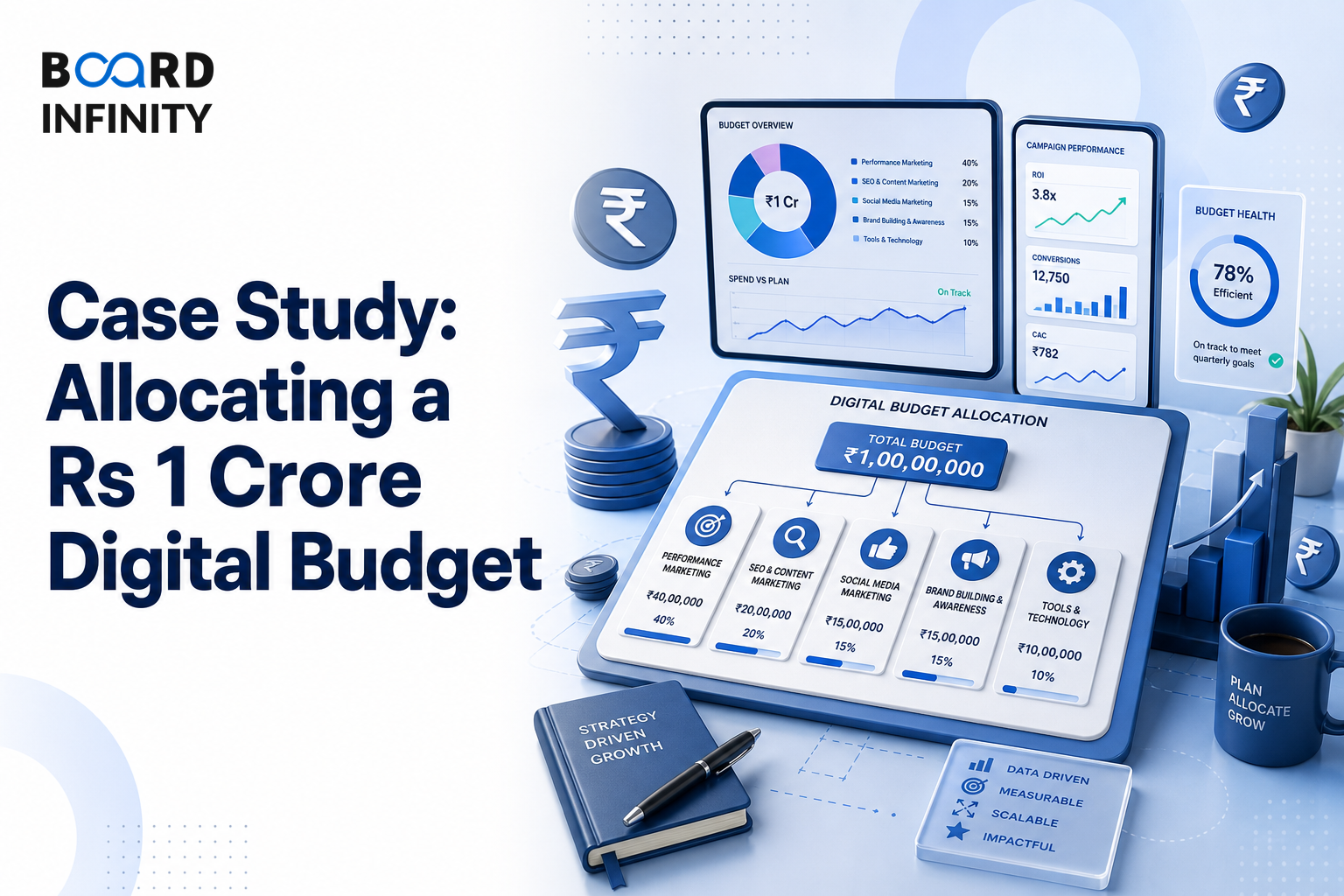
After repositioning a legacy brand as premium, the next interview challenge is more quantitative: how do you allocate a ₹1 Crore monthly digital budget when every channel plays a different funnel role? This case matters in interviews because it tests whether you can balance lead volume, lead quality, long sales cycles, attribution, and optimisation cadence instead of simply listing channels.
- The brief is for a mid-size EdTech company, think UpGrad/Scaler tier, ₹200 Cr ARR, with ₹1 Crore monthly digital budget.
- The product is 6-month career programs priced ₹1.5-3 lakhs, with High ACV (Average Contract Value), long sales cycle of 30-45 days.
- The funnel is Lead → Counsellor Call → Demo Session → Enrollment, with Lead to Enrollment conversion of ~3-5%.
- Unit Economics: LTV ≈ ₹2.5 lakhs including upsell, Target CPA ≈ ₹12,000-15,000, and Target CPL ≈ ₹400-600.
- The largest allocations are Meta Ads at ₹30L, Google Search at ₹25L, and YouTube Ads at ₹15L, with the rest split across LinkedIn, Influencer / Creator Partnerships, Retargeting, and SEO + Content.
- Optimisation should happen weekly, bi-weekly, monthly, and quarterly, ending in full-funnel attribution, blended CPA, ROAS, Marketing Mix Modelling refresh, and incrementality testing.
- EdTech digital budget questions test whether you understand the long sales cycle - you cannot optimise EdTech purely on last-click CPA.
Understanding the Business Context
The brief: You're the head of digital marketing for a mid-size EdTech company, think UpGrad/Scaler tier, ₹200 Cr ARR. You have ₹1 Crore monthly digital budget. How would you allocate it across channels?
Before jumping into the channel split, the key is to understand the business context: Product: 6-month career programs priced ₹1.5-3 lakhs. High ACV (Average Contract Value), long sales cycle (30-45 days). Funnel: Lead → Counsellor Call → Demo Session → Enrollment. Conversion: Lead to Enrollment = ~3-5%.
Channel Allocation Matrix
The channel allocation matrix shows how the ₹1 Crore monthly digital budget is split across funnel roles, expected CPL, and execution tactic.
Unit Economics: LTV ≈ ₹2.5 lakhs (including upsell). Target CPA ≈ ₹12,000-15,000. Target CPL ≈ ₹400-600.
How the Funnel Shapes the Allocation
The EdTech funnel is Lead → Counsellor Call → Demo Session → Enrollment. Because the conversion from Lead to Enrollment is ~3-5%, the allocation cannot be judged only by cheap leads; it has to be read alongside lead quality and the channel's role in the funnel.
Meta Ads (Facebook + Instagram) are allocated ₹30L for top-of-funnel lead gen, while Google Search gets ₹25L for high-intent capture. YouTube Ads support awareness + consideration, LinkedIn Ads target the professional segment, Influencer / Creator Partnerships build trust + social proof, Retargeting supports mid-to-bottom funnel conversion, and SEO + Content builds organic pipeline long-term.
Optimisation Cadence
Once the budget is live, optimisation has to follow a cadence. CPL means Cost Per Lead, CPA means Cost Per Acquisition, ROAS means Return on Ad Spend, CPC means Cost Per Click, CTR means Click-Through Rate, and Marketing Mix Modelling is used in the quarterly refresh.
Full-Funnel Attribution and Lead Quality
EdTech digital budget questions test whether you understand the long sales cycle - you can't optimise EdTech purely on last-click CPA because the lead-to-enrollment journey spans 30-45 days across multiple touchpoints.
Always mention multi-touch attribution and lead quality, not just lead volume. In this case, that is why the optimisation cadence includes CPL-to-enrollment conversion by channel, full-funnel attribution, blended CPA, ROAS by channel, and incrementality testing.
Applied Case Walkthrough
Situation: You're the head of digital marketing for a mid-size EdTech company, think UpGrad/Scaler tier, ₹200 Cr ARR, with ₹1 Crore monthly digital budget.
Problem: The product is 6-month career programs priced ₹1.5-3 lakhs, with High ACV and a long sales cycle of 30-45 days, so the budget has to support the full funnel from Lead to Enrollment.
Framework: Use Step 1: Understand the Business Context, Step 2: Channel Allocation Matrix, and Step 3: Optimisation Cadence.
Decision: Allocate the largest shares to Meta Ads at ₹30L, Google Search at ₹25L, and YouTube Ads at ₹15L, then support the funnel with LinkedIn Ads, Influencer / Creator Partnerships, Retargeting, and SEO + Content.
Learning: Always mention multi-touch attribution and lead quality because the lead-to-enrollment journey spans 30-45 days across multiple touchpoints.
Structuring a Case Study Interview Answer
"You're the head of digital marketing for a mid-size EdTech company (think UpGrad/Scaler tier, ₹200 Cr ARR). You have ₹1 Crore monthly digital budget. How would you allocate it across channels?"
The #1 way candidates get this wrong is by focusing on lead volume and last-click CPA while ignoring long sales cycle, multi-touch attribution, and lead quality.
Optimising EdTech purely on last-click CPA is the most frequent error. It costs points because the lead-to-enrollment journey spans 30-45 days across multiple touchpoints, so you must mention multi-touch attribution and lead quality, not just lead volume.
Conclusion
A strong ₹1 Crore EdTech digital budget answer starts with business context, maps spend to the full funnel, and then shows how you will optimise using lead quality, attribution, and cadence. The final takeaway: channel allocation is not just about cheaper CPL - it is about converting the right leads through a 30-45 day journey.