
Cost of Capital and WACC Explained for Corporate Finance Interviews
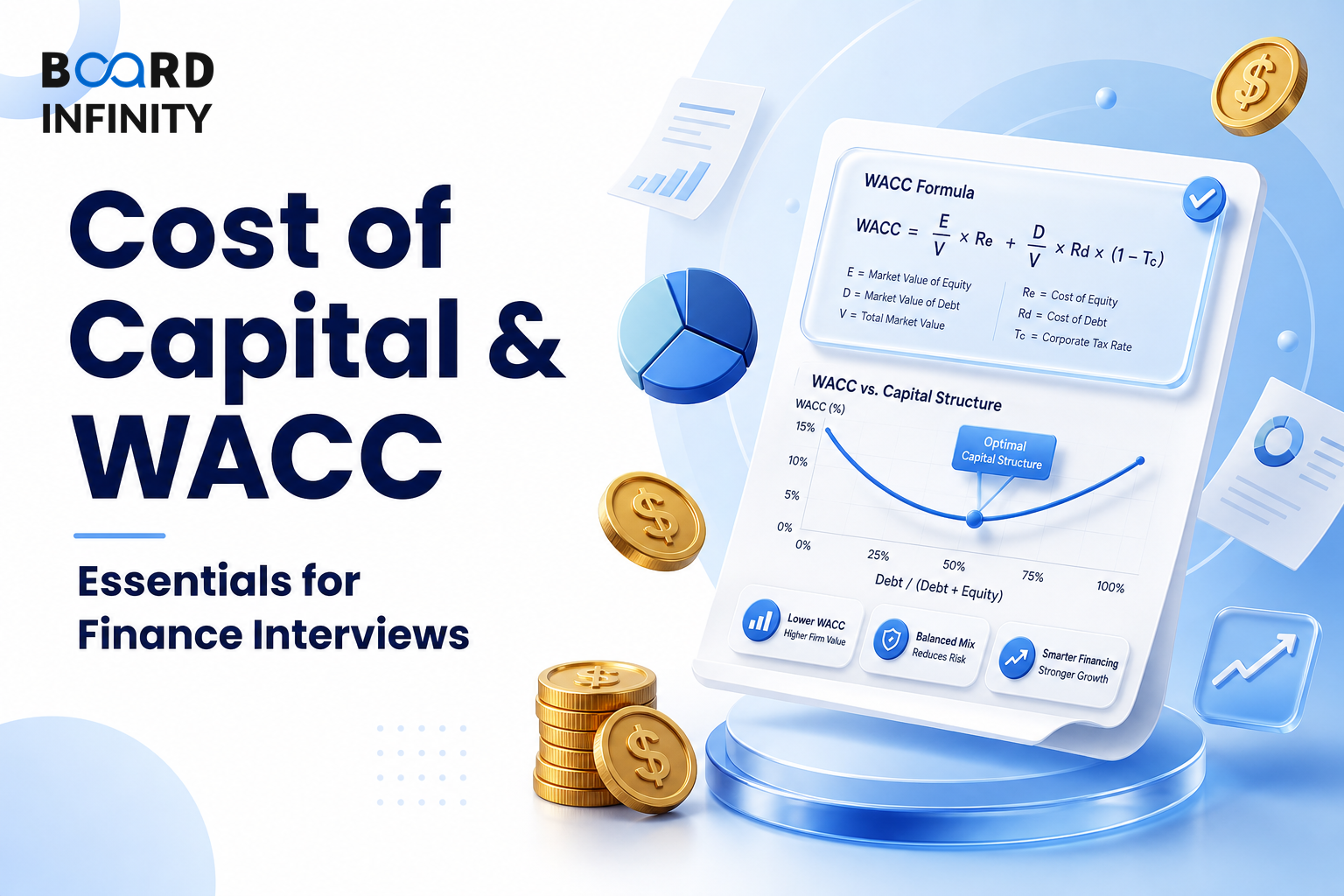
After Capital Budgeting: NPV, IRR & Payback, the next question is what discount rate to use. NPV assumes reinvestment at WACC, and WACC becomes the blended hurdle rate companies use for valuation and investment decisions. In interviews, this matters because candidates are expected to calculate cost of equity, after-tax cost of debt, capital weights, and explain why sector WACC differs across India-listed businesses.
- WACC = Ke × [E/(D+E)] + Kd × (1-T) × [D/(D+E)].
- Cost of Equity (Ke) via CAPM: Ke = Rf + β × (Rm - Rf).
- India: Rf = 10Y G-Sec yield (~7.0%), Market Risk Premium = 5.0-6.0%, β varies by sector.
- Cost of Debt (Kd) after tax: Kd(after-tax) = Kd × (1 - Tax Rate).
- India: Corporate tax rate = 22% (new regime) or 25-30% (old); effective rate ~25%.
- Example - TCS WACC: Ke = 7% + 0.65×5.5% = 10.6%; Near zero debt; WACC ≈ Ke ≈ 10.5-11%.
Big Picture: WACC as the Blended Hurdle Rate
Weighted Average Cost of Capital (WACC) combines the cost of equity and the after-tax cost of debt using the company's capital structure. It is the rate used to discount Free Cash Flow to Firm (FCFF) to arrive at enterprise value, because FCFF is cash available to all capital providers.
WACC = Ke × [E/(D+E)] + Kd × (1-T) × [D/(D+E)]. Ke = cost of equity; Kd = pre-tax debt cost; T = tax rate; E = market value of equity; D = market value of debt.
Example - TCS WACC: Ke = 7% + 0.65×5.5% = 10.6%; Near zero debt; WACC ≈ Ke ≈ 10.5-11%. The strategic implication is simple: for a near-zero debt company, WACC is driven almost entirely by cost of equity.
Cost of Equity Through CAPM
Capital Asset Pricing Model (CAPM) is used to calculate Cost of Equity (Ke). Cost of Equity (Ke) via CAPM: Ke = Rf + β × (Rm - Rf).
India: Rf = 10Y G-Sec yield (~7.0%), Market Risk Premium = 5.0-6.0%, β varies by sector. Rf assumption: 7.0% (10Y G-Sec), MRP: 5.5%, Tax Rate: 25%.
Rf assumption: 7.0% (10Y G-Sec), MRP: 5.5%, Tax Rate: 25%.
Cost of Debt After Tax
Cost of Debt (Kd) after tax: Kd(after-tax) = Kd × (1 - Tax Rate). India: Corporate tax rate = 22% (new regime) or 25-30% (old); effective rate ~25%.
The tax adjustment matters because WACC uses after-tax cost of debt, not pre-tax cost of debt.
WACC Worked Calculation
WACC calculation is tested verbally in every IB interview. Walk through this example until you can do it in under 90 seconds.
QUICK WACC CHECK (Ke=14%, Kd=8%, T=25%, D/E=0.5): D/E = 0.5 → D/(D+E) = 0.5/1.5 = 33.3%, E/(D+E) = 66.7%. Kd after-tax = 8% × 0.75 = 6.0%. WACC = 14.0% × 66.7% + 6.0% × 33.3% = 9.33% + 2.0% = 11.33%.
Sector Differences in WACC
β varies by sector, and the capital structure also changes the WACC estimate. IT Services like TCS and Infosys show 0.60-0.75 beta, N/A cost of debt because of no debt, and WACC of ~10.5-11%.
Private Banks like HDFC and Kotak show 0.80-1.00 beta, but deposits ≠ debt for CoC, so the estimate is 12-14% on a Ke-based basis. Telecom like Bharti Airtel shows 2-3x D/E and ~9-11% WACC, where high debt lowers WACC.
Structuring a Cost of Capital & WACC Explained Interview Answer
"How would you calculate WACC for an Indian company, and why does it differ across sectors?"
The fastest strong answer is to calculate Ke through CAPM, tax-adjust Kd, weight equity and debt correctly, and then explain why β varies by sector.
The most frequent error is using pre-tax cost of debt directly in WACC instead of Kd × (1 - Tax Rate). It also costs points to treat deposits as debt for cost of capital in banks, even though the sector table explicitly notes deposits ≠ debt for CoC.
Conclusion
WACC is the blended hurdle rate built from CAPM-based cost of equity, after-tax cost of debt, and capital structure weights. For interviews, anchor the answer in the formula, use India-specific assumptions like 10Y G-Sec yield, market risk premium, and tax rate, then explain sector differences through beta, debt, and tax impact.