
Working Capital Management Explained: Cash Conversion Cycle and Negative CCC
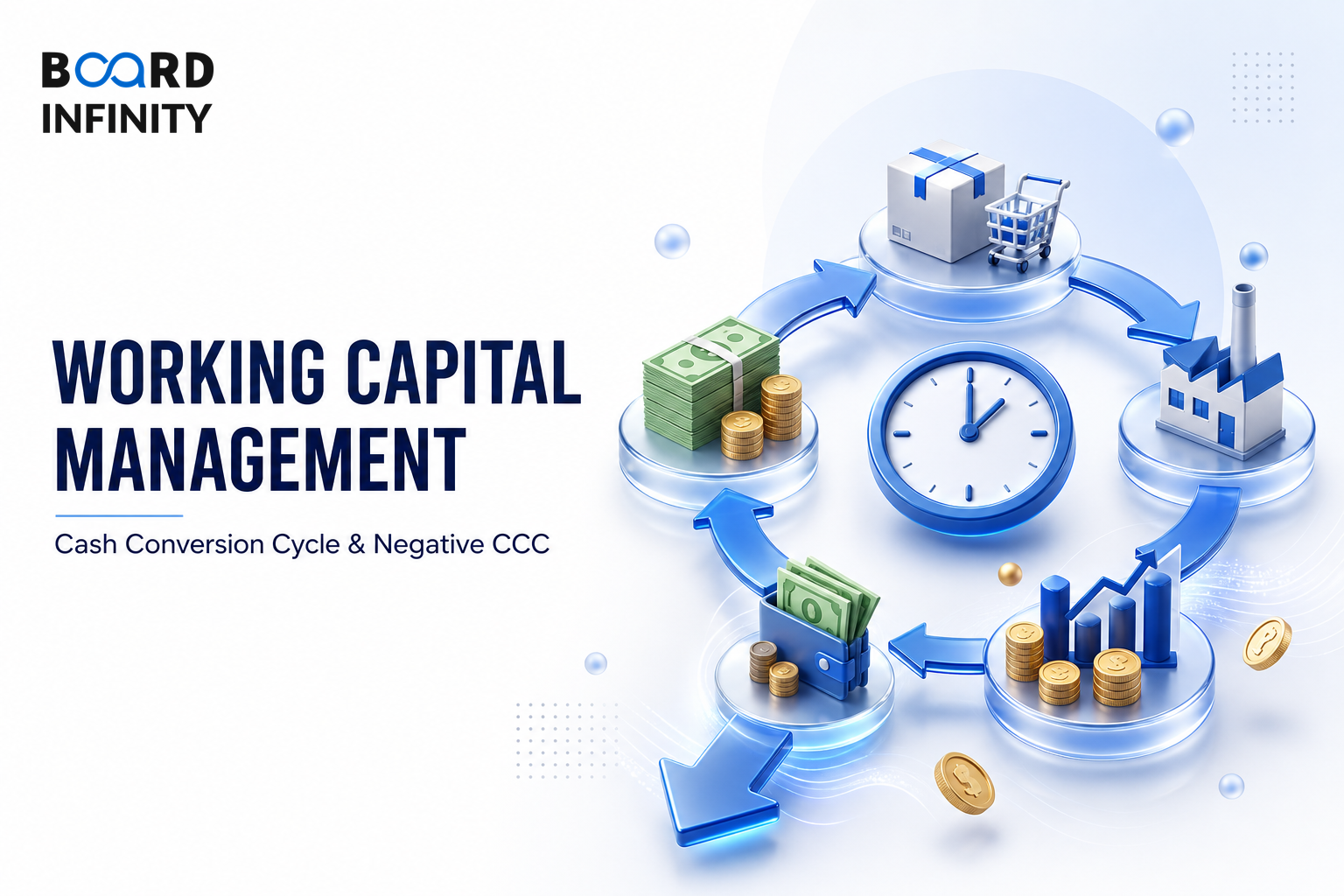
Dividend Policy Explained focuses on cash returned to shareholders; Working Capital Management Explained focuses on cash tied up in day-to-day operations. The interview lens is the Cash Conversion Cycle: how faster inventory turns, quicker collections, and delayed supplier payments can become a competitive moat.
- Cash Conversion Cycle (CCC) = Days Inventory Outstanding (DIO) + Days Sales Outstanding (DSO) - Days Payable Outstanding (DPO).
- Shorter CCC = less cash tied up = better efficiency.
- Negative CCC like DMart and Amazon = suppliers finance operations.
- DIO high = bad because it signals slow inventory.
- DSO high = risky because it signals slow collection.
- DPO high = good because it signals delayed payment.
- DMart collects cash from customers in 2 days but pays suppliers in 55+ days, effectively getting a ~53-day interest-free float from suppliers.
Big Picture: Cash Tied Up in Operations
Working capital management is easiest to frame through the Cash Conversion Cycle. Shorter CCC = less cash tied up = better efficiency. Negative CCC, like DMart and Amazon, means suppliers finance operations.
Cash Conversion Cycle (CCC) = Days Inventory Outstanding (DIO) + Days Sales Outstanding (DSO) - Days Payable Outstanding (DPO).
DMart's negative CCC is a key competitive moat: it collects cash from customers in 2 days but pays suppliers in 55+ days, effectively getting a ~53-day interest-free float from suppliers. This is why DMart can earn high Return on Capital Employed (ROCE) despite low gross margins (~14%).
How to Read DIO, DSO and DPO
Days Inventory Outstanding (DIO) measures inventory days using Inventory / (COGS/365), where COGS means Cost of Goods Sold. High DIO is bad because it indicates slow inventory.
Days Sales Outstanding (DSO) measures receivable days using Receivables / (Revenue/365). High DSO is risky because it indicates slow collection.
Days Payable Outstanding (DPO) measures payable days using Payables / (COGS/365). High DPO is good because it indicates delayed payment.
Why Negative CCC Can Become a Competitive Moat
Negative CCC is best, especially in retail. When a company collects cash before paying suppliers, suppliers effectively finance operations.
DMart shows the logic clearly: it collects cash from customers in 2 days but pays suppliers in 55+ days. That creates a ~53-day interest-free float from suppliers, which supports high ROCE despite low gross margins (~14%).
Sector Lens: IT Sector, Retail and FMCG
The same CCC framework reads differently by sector. IT Sector shows low inventory days of ~2-5 days but receivable days of 55-70 days. Retail (DMart) shows receivable days of ~2-5 days and payable days of ~55-65 days, producing ~-30 days CCC. FMCG (HUL) shows inventory days of ~25-35 days, receivable days of ~18-25 days, payable days of ~55-70 days, and ~-20 days CCC.
NBFC Lens: ALM Mismatch
For Non-Banking Financial Companies (NBFCs), the equivalent concept is the ALM (Asset-Liability Management) mismatch. Borrowing short-term to lend long-term creates liquidity risk, as seen in IL&FS and DHFL.
Structuring a Working Capital Management Explained Interview Answer
"How does the Cash Conversion Cycle explain DMart's working capital efficiency?"
Do not treat every high working capital number as bad. In the CCC framework, high DIO is bad and high DSO is risky, but high DPO is good because delayed payment reduces cash tied up.
The most frequent error is mixing up the signs of DIO, DSO and DPO. If you say high DPO is bad, you miss the core DMart and Amazon negative CCC logic: suppliers finance operations when payment is delayed.
Conclusion
Working capital management is about how much cash is tied up in operations. The Cash Conversion Cycle gives the clean interview structure: reduce DIO, reduce DSO, increase DPO, and understand why negative CCC can become a competitive moat.