
Dividend Policy, Buybacks and Capital Allocation Strategy
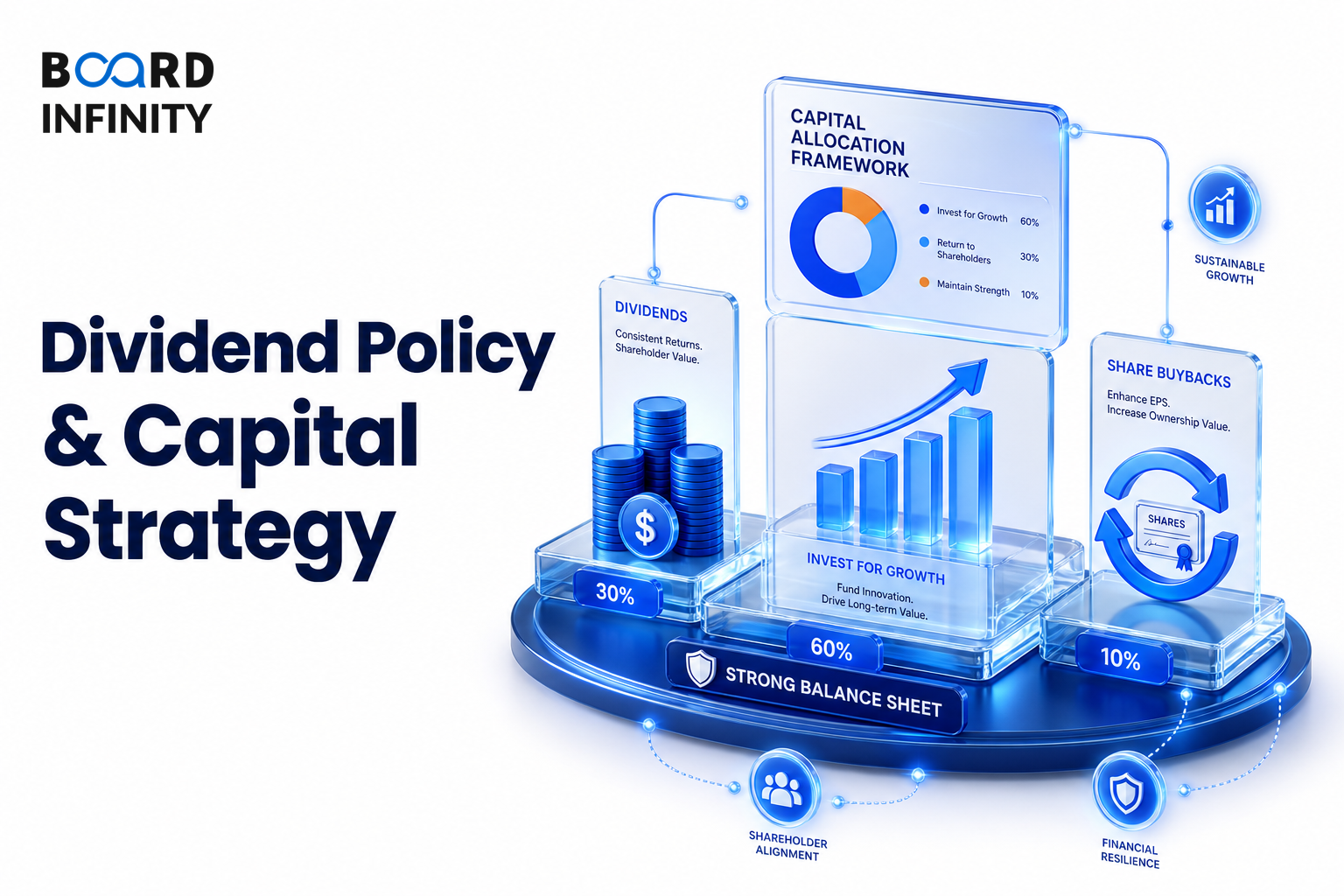
After learning Cost of Capital, Beta and the Capital Asset Pricing Model - the model used to estimate the expected return required by equity investors - the next CFO question is what to do with cash after the business has earned it. Dividend policy and buybacks are capital allocation choices: they decide whether surplus cash is returned regularly as income or selectively through share repurchases. In interviews, this topic matters because the best answer is not “dividend versus buyback” in isolation, but a CFO-style trade-off across tax efficiency, signalling, flexibility, ownership impact and investor expectations.
- Dividend policy is the company’s approach to distributing cash to shareholders, usually signalling stable and recurring cash flows.
- Buybacks return cash by repurchasing shares and typically signal that management believes the stock is undervalued.
- Post-2020 tax treatment changed the decision: from FY21, dividends are added to investor income and taxed at slab rate, up to 30% for HNI investors.
- Buybacks are treated through LTCG/STCG, making them more tax-efficient for many HNI investors compared with dividends.
- Dividends are sticky once declared, while buybacks are one-time and flexible, so corporates often prefer buyback flexibility.
- Dividends do not change share count, while buybacks reduce shares and can create EPS accretion, making them attractive to promoters.
- A CFO should prefer buybacks when stock trades below intrinsic value and there is surplus cash with no high-IRR capex; dividends fit income-seeking investor bases such as PSUs and ITC.
The Big Picture - A CFO’s Capital Allocation Choice
A Chief Financial Officer, or CFO, is the senior executive responsible for financial decisions such as capital allocation. In this topic, capital allocation means deciding whether surplus cash should be retained for projects, paid out as dividends or returned through buybacks.
Until FY20, companies paid 20% Dividend Distribution Tax, or DDT, and dividends were tax-free for investors. From FY21, dividends were added to investor income and taxed at slab rate, making buybacks more tax-efficient for HNI investors. The source notes that TCS and Infosys shifted heavily to buybacks post-DDT removal, which shows how tax rules can change capital allocation behaviour.
What Dividend Policy Means
Dividend policy is the company’s approach to paying part of its profits or surplus cash to shareholders. A dividend is a direct cash payout per share, such as ITC’s ₹6.50/share in FY24.
The strategic meaning of a dividend is stability. A regular dividend tells the market that the company expects recurring cash flows and is confident enough to make a visible payout. This is why dividend policy is not just a finance formula; it is also an investor communication tool.
The drawback is flexibility. Once a company declares and maintains a regular dividend, investors may start treating it as an expectation. Cutting or skipping a regular dividend can be read negatively, so dividend policy becomes “sticky” in many organisations.
From an investor-base angle, dividends are better suited when shareholders value regular income. The source specifically mentions income-seeking investor bases such as PSUs and ITC. In an interview, this means a dividend answer should not stop at “cash payout”; it should connect payout regularity with investor expectations and confidence in recurring cash flows.
What Buybacks Mean
Buyback means the company uses cash to repurchase its own shares. The source example is TCS’s ₹18,000 Cr buyback in FY23.
The strategic signal is different from a dividend. A buyback typically signals that management believes the stock is undervalued. In simple terms, if management thinks the current market price is below intrinsic value, buying back shares can be a strong capital allocation choice.
Buybacks also offer flexibility. They are one-time actions and do not create the same ongoing payout commitment as regular dividends. This is why the source says corporates prefer buyback flexibility.
There is also an ownership and earnings effect. A dividend does not change the number of shares, while a buyback reduces the number of shares. With fewer shares, Earnings Per Share, or EPS, can show accretion because the same earnings are spread across fewer shares; this is why the source notes that promoters prefer buybacks.
Tax Treatment After FY20 - Why the Preference Changed
The post-2020 tax change is central to this topic. Until FY20, companies paid 20% DDT, or Dividend Distribution Tax, and dividends were tax-free for investors. From FY21, dividends were added to investor income and taxed at the investor’s slab rate, up to 30% for HNI investors.
HNI means High Net Worth Individual, referring to wealthy investors who may fall into higher tax slabs. For them, a dividend became less attractive once it was taxed in their hands. By contrast, buybacks are treated through LTCG/STCG, meaning Long-Term Capital Gains or Short-Term Capital Gains, and the source describes them as more tax-efficient.
This is the main reason interviewers expect tax to appear in the answer. Without tax, the answer becomes too generic. With tax, the candidate can explain why TCS and Infosys shifted heavily to buybacks post-DDT removal and why HNI investors prefer buybacks.
Signalling - What the Market Reads Into the Decision
Both dividends and buybacks can be positive signals, but they signal different things. A regular dividend says the business is stable and expects recurring cash flows. A buyback says management sees value in its own stock and may believe the stock trades below intrinsic value.
The distinction matters because signalling changes the investor’s interpretation. If a company with an income-seeking investor base pays a regular dividend, the signal is confidence and continuity. If a company announces a buyback, the signal is often undervaluation and efficient use of surplus cash.
A strong interview answer should not say “buybacks are always better” or “dividends are always safer.” The better framing is: both are positive signals, but they target different investor expectations and different business situations.
Flexibility and Commitment
Flexibility is one of the most CFO-relevant differences. A dividend, especially a regular dividend, becomes sticky once declared. Investors may expect the payout to continue, so the company’s future freedom can reduce.
A buyback is different because it is one-time and carries no continuing commitment. That is why the source says corporates prefer buyback flexibility. A company can execute a buyback in a year when it has surplus cash, without promising that the same payout will repeat every year.
This point is useful in case interviews. If the prompt says the company has uncertain future cash flows but has surplus cash today, a buyback may fit better than creating a recurring dividend obligation. If the prompt says the company has predictable recurring cash flows and income-seeking investors, dividend policy may be more appropriate.
Ownership Effect and EPS Accretion
The ownership effect differs sharply. A dividend does not change the number of shares outstanding. Shareholders receive cash, but the share count remains the same.
A buyback reduces the number of shares. This can create EPS accretion because the same earnings are divided among fewer shares. EPS means Earnings Per Share, a profitability measure calculated as earnings divided by number of shares.
This is why promoters prefer buybacks in the source framework. Promoters are controlling or founding shareholders in many Indian companies, and a buyback can be attractive because it works through fewer shares and EPS accretion rather than a simple per-share cash payout.
Worked Example - TCS Buyback Through a CFO Lens
The key learning is that a CFO does not choose a buyback only because cash is available. The CFO must explain why the buyback is better than a dividend for that investor base, tax environment and signalling objective.
When a CFO Should Recommend a Dividend
A dividend is stronger when the investor base values predictable income. The source mentions PSUs and ITC in this context. For such companies, the dividend itself becomes part of the investment case because investors expect a recurring payout.
A dividend is also appropriate when management wants to signal confidence in recurring cash flows. Regular payout communicates that the business is stable enough to distribute cash without harming ongoing operations.
When a CFO Should Recommend a Buyback
A buyback is stronger when the stock trades below intrinsic value. Intrinsic value means the company’s estimated fundamental value based on the business, not just the current market price.
A buyback is also stronger when the company has surplus cash and no high-IRR capex. IRR means Internal Rate of Return, the expected return from a project or investment. If no high-return internal project is available, returning cash through a buyback can be a sensible capital allocation decision.
The third condition is management belief that the current price is low. This connects the buyback to signalling: management is effectively saying that buying its own shares is an attractive use of cash.
ITC’s ₹6.50/share dividend in FY24 fits the dividend side of the framework. In the source, dividend is linked with regular payout, stable business signalling and income-seeking investor bases such as ITC. The strategic point is that dividend policy can be used to reinforce confidence in recurring cash flows.
Structuring a Dividend Policy, Buybacks & Capital Allocation Strategy Interview Answer
"A mature company has surplus cash. Should the CFO recommend a dividend or a buyback?"
The strongest answers do not pick dividend or buyback immediately. First state the CFO decision criteria, then choose based on tax, signalling, flexibility, ownership effect and investor base.
The most frequent error is saying buybacks are always better because they are tax-efficient. That misses the investor expectation angle: dividends can be better for income-seeking investor bases and for signalling confidence in recurring cash flows.
Conclusion
Dividend policy and buybacks are not mechanical payout choices; they are CFO-level capital allocation signals. The best answer weighs tax efficiency, market signalling, flexibility, EPS impact and investor expectations before recommending the route that fits the company’s cash position and shareholder base.