
Valuation Fundamentals: DCF, WACC and Multiples
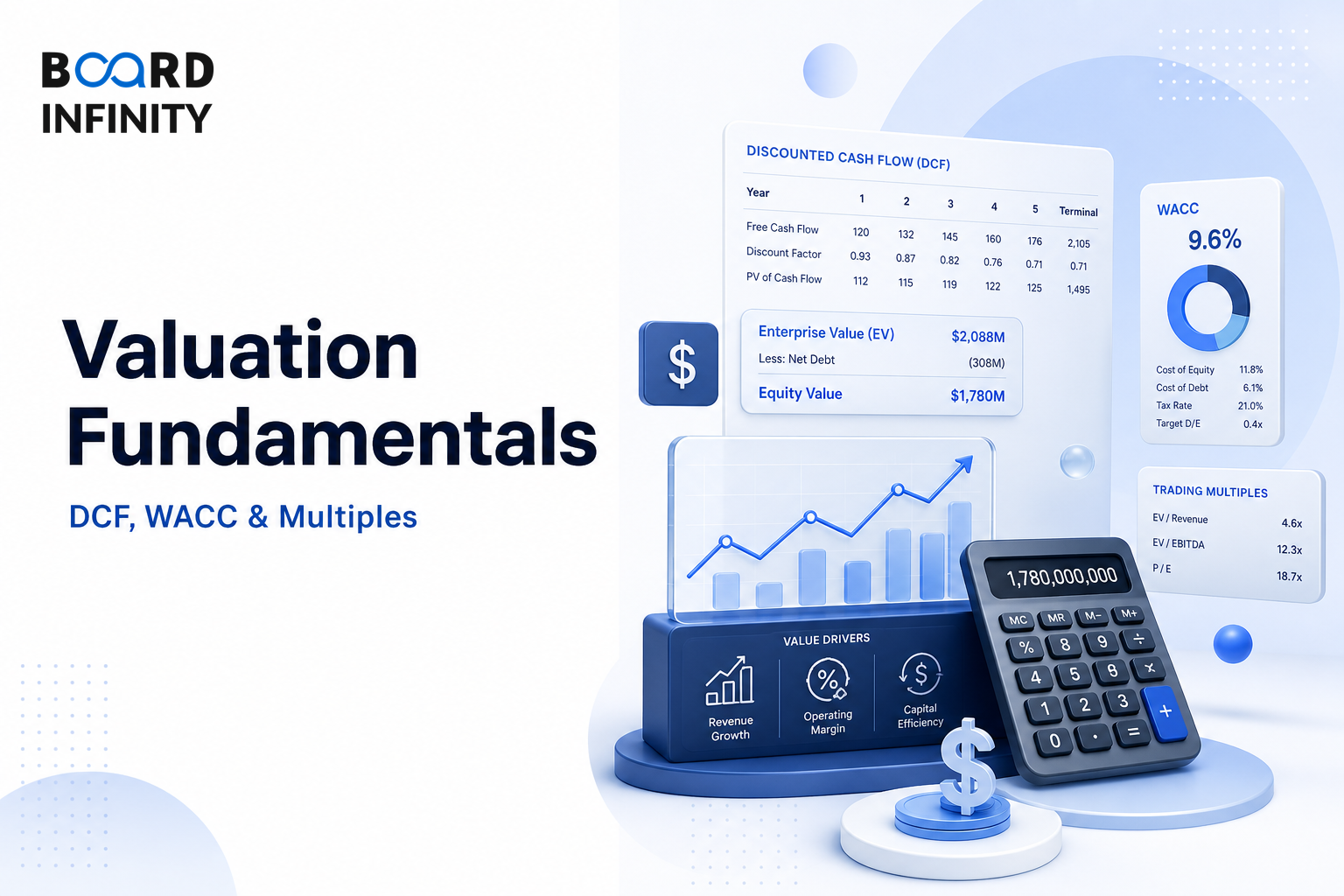
Valuation turns a company forecast into a defensible estimate of what the business and its equity are worth. In investment banking interviews, the DCF is tested because it forces you to connect operations, capital structure, risk, terminal value and share price in one clean story. This lesson frames valuation as a practical workflow: build free cash flow to firm, discount it using WACC, estimate terminal value, bridge enterprise value to equity value and present a range instead of a single number.
- DCF in one line: Equity Value = Sum of FCFF discounted at WACC + Terminal Value discounted at WACC - Net Debt.
- FCFF means Free Cash Flow to Firm: EBIT × (1-T) + D&A - ΔNet Working Capital - Capex.
- WACC blends the cost of equity and after-tax cost of debt using capital structure weights: Ke × E/(D+E) + Kd × (1-T) × D/(D+E).
- Terminal value should be computed using both Gordon Growth and Exit Multiple methods, then triangulated.
- Enterprise Value comes from the present value of forecast FCFF plus present value of terminal value; Equity Value equals Enterprise Value minus Net Debt.
- Sensitivity analysis varies WACC and terminal growth, producing a valuation range rather than a point estimate.
At a big-picture level, a DCF is not a formula you recite. It is a sequence of linked decisions where each step feeds the next one.
What a DCF Valuation Measures
A Discounted Cash Flow valuation, or DCF, values a business based on the present value of the cash flows it can generate for capital providers. In the source framework, the relevant cash flow is FCFF, or Free Cash Flow to Firm, because it is cash available to both debt and equity holders after reinvestment.
The DCF is especially important in interviews because every line has a reason. Revenue and margin drive operating profit, reinvestment reduces cash available, WACC reflects risk and capital structure, and terminal value captures value beyond the explicit forecast period.
EV = Σ [FCFₜ / (1+WACC)ᵗ] + [TV / (1+WACC)ⁿ] → Equity Value = EV - Net Debt.
Enterprise Value, or EV, is the value implied by discounted free cash flows before subtracting net debt. Equity Value is the value attributable to shareholders after subtracting net debt. That is why the DCF workflow must end with the bridge from EV to Equity Value.
Building FCFF from Net Income
FCFF stands for Free Cash Flow to Firm. It removes financing effects and captures the cash generated by operations after reinvestment in working capital and fixed assets. In interviews, this bridge matters because candidates often confuse accounting profit with cash flow.
The worked example starts from Net Income, also called PAT or Profit After Tax, and converts it into FCFF. The key adjustment is adding back after-tax interest because FCFF is pre-financing, meaning it is calculated before deciding how value is split between debt and equity holders.
FCFF = EBIT × (1-T) + D&A - ΔNWC - Capex. Using EBIT of ₹680 Cr: ₹680 × (1-0.25) + ₹90 - ₹40 - ₹120 = ₹440 Cr FCFF.
Both methods produce the same ₹440 Cr FCFF. The top-down build from EBIT is faster in an interview, while the bottom-up bridge from Net Income is useful when you need to reconcile to reported financials.
Calculating WACC
WACC stands for Weighted Average Cost of Capital. It is the discount rate used for FCFF because FCFF belongs to all capital providers, not only equity holders. The source formula weights the cost of equity and the after-tax cost of debt by the market value of equity and debt.
Cost of equity is calculated using CAPM, or the Capital Asset Pricing Model: Ke = Rf + β(Rm-Rf). Here, Rf is the risk-free rate, β measures stock sensitivity versus the market, and Rm-Rf is the market risk premium.
WACC = Ke × [E/(D+E)] + Kd × (1-T) × [D/(D+E)], where Ke = Rf + β(Rm-Rf).
The practical interview nuance is that the discount rate must match the cash flow. Since FCFF is pre-financing and available to both debt and equity holders, it is discounted at WACC. Mixing FCFF with a pure cost of equity would be a mismatch.
Estimating Terminal Value
Terminal Value captures the value of the company beyond the explicit forecast period. In many DCFs, it is a major part of Enterprise Value, so small changes in terminal growth or exit multiple can materially change the final valuation.
The source method is clear: always compute both terminal value methods and triangulate. Gordon Growth uses a perpetual growth assumption, while Exit Multiple uses a market multiple based on mature peer trading levels.
The critical nuance is that terminal value is not a plug number. If the Gordon Growth result and Exit Multiple result are far apart, that difference should be explained through assumptions rather than hidden in the model.
Worked Example: IndoMake Ltd DCF
Situation: IndoMake Ltd is an Indian mid-cap manufacturer with FY25E revenue of ₹2,000 Cr, WACC of 11.3%, terminal growth of 5.5%, 100 Cr shares outstanding and net debt of ₹500 Cr. The problem is to estimate intrinsic value per share using a 5-year DCF and then cross-check the terminal value with an exit multiple.
The decision from the Gordon Growth DCF is that IndoMake Ltd has an intrinsic value of about ₹48 per share. But the model should not stop there, because terminal value assumptions are sensitive and need cross-checking.
The learning is interview-critical: the right answer is not only the calculated ₹48/share. A stronger answer says the Gordon model gives EV of ₹5,317 Cr, the Exit Multiple method gives EV of approximately ₹4,557 Cr, and the result should be presented as a ₹41 - ₹48 share price range because the gap reflects uncertainty.
Sensitivity Analysis and Valuation Range
Sensitivity analysis stress-tests the two most sensitive DCF assumptions: WACC and terminal growth. This is typically presented as a football field or table so the interviewer can see downside, base case and upside instead of one fragile point estimate.
The table shows why a DCF is a range-based valuation tool. As WACC rises, present values fall. As terminal growth rises, terminal value increases. A polished candidate explains the directional logic before discussing the output.
Structuring a Valuation Fundamentals Interview Answer
"Walk me through a DCF."
The strongest answers keep the cash flow and discount rate consistent. Say explicitly that FCFF is unlevered cash flow available to all capital providers, so it should be discounted at WACC before subtracting net debt to reach equity value.
Conclusion
Valuation Fundamentals in an interview are about connecting the full DCF chain: FCFF, WACC, terminal value, Enterprise Value, Equity Value and sensitivity-backed range. If you can explain each step, calculate the core formulas and defend the assumptions, you move from memorising valuation to thinking like an analyst.
The most frequent error is presenting one exact DCF value as if it is the answer. That costs points because the source workflow clearly requires both Gordon Growth and Exit Multiple terminal value checks, followed by sensitivity analysis on WACC and terminal growth to present a valuation range.