
Employer-Specific Prep: Manufacturing, Commerce, Logistics & Consulting
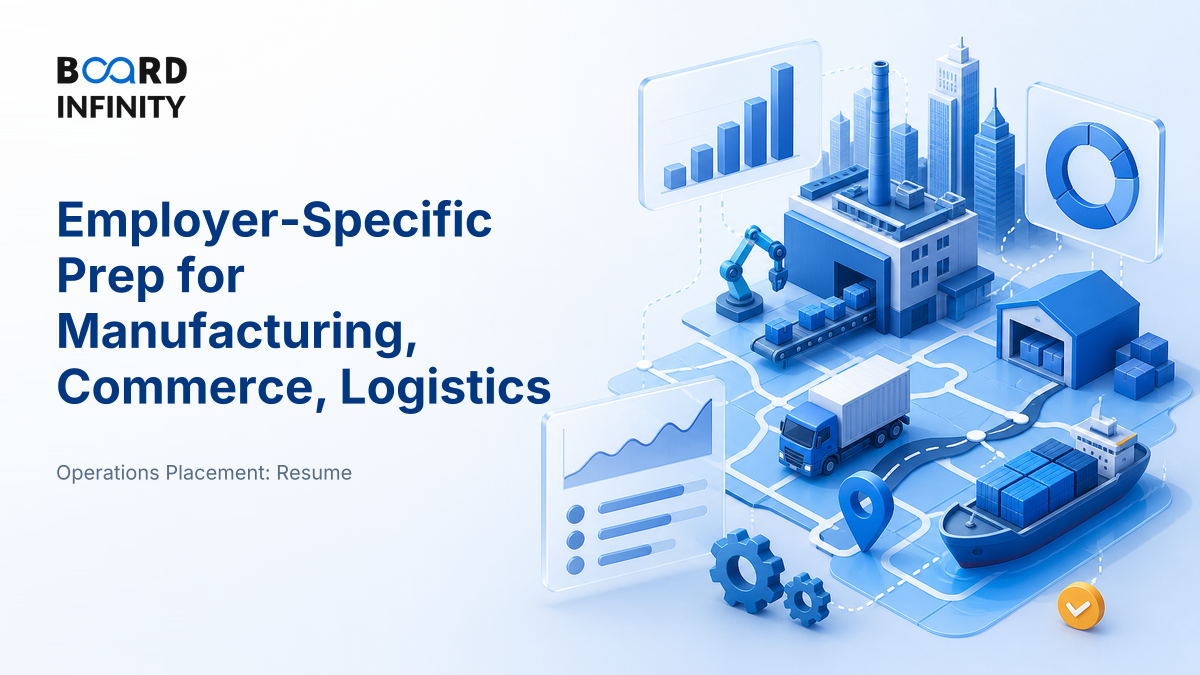
The same answer that sounds sharp in a consulting case room can sound vague on a factory floor. A plant leader listens for yield, bottlenecks and downtime; a logistics manager listens for service levels, route density and cost per shipment; a commerce recruiter listens for conversion, fulfilment and working capital.
- Employer-specific prep means tailoring your answers to the company's economic engine - how it makes money, serves customers and controls cost.
- Manufacturing prep should focus on capacity, quality, productivity, safety, maintenance, suppliers and cost of conversion.
- Commerce prep should focus on assortment, demand generation, conversion, fulfilment, returns, margins and customer retention.
- Logistics prep should focus on network design, service level, route density, capacity utilisation, delivery reliability and exception management.
- Consulting prep should focus on structured problem solving, hypothesis-led analysis, stakeholder communication and implementation impact.
- Your interview answer should begin with the employer lens, then move to metrics, trade-offs, examples and your role fit.
- The biggest mistake is preparing company facts but not translating them into the operating priorities of that employer.
Big Picture: Four Employers, Four Economic Engines
Do not prepare by memorising company profiles. Prepare by decoding the business model. Every employer type rewards a different mental map - what creates value, what destroys value, and which metrics reveal whether the system is healthy.
Core Explanation: How to Prepare for Each Employer Type
The best candidates sound different across sectors without pretending to be experts in all of them. They use the right vocabulary, ask the right diagnostic questions and connect their MBA learning to the employer's actual operating model.
1. Manufacturing Employers: Think Flow, Yield and Cost
Manufacturing companies convert materials, labour, machines and energy into finished goods. Your answers should show that you understand the factory as a system of constraints, variability and quality control.
2. Commerce Employers: Think Demand, Margin and Fulfilment
Commerce includes retail, e-commerce, D2C and marketplace businesses. Here, the challenge is not only selling more - it is selling profitably, fulfilling reliably and retaining customers without burning cash.
A strong commerce answer connects the front end and back end: traffic, conversion and basket size on one side; inventory availability, fulfilment cost and returns on the other.
3. Logistics Employers: Think Network, Service Level and Utilisation
Logistics companies sell reliability across a physical network. The core trade-off is usually speed versus cost, with complexity added by capacity peaks, failed deliveries, route planning and customer promises.
Your prep should cover first mile, middle mile, last mile, hub-and-spoke networks, fleet utilisation, delivery attempts, service-level agreements and exception handling.
4. Consulting Employers: Think Structure, Insight and Adoption
Consulting firms do not hire you only to know frameworks. They hire you to structure ambiguity, isolate drivers, quantify impact, communicate clearly and get stakeholders to act.
For operations consulting, the content may come from manufacturing, procurement, supply chain or logistics, but the interview expectation is different: diagnose fast, prioritise, estimate impact and build an implementation roadmap. If the role is transformation-heavy, revise agile and iterative delivery in operations projects because many consulting recommendations fail at execution, not analysis.
The Employer-Specific Prep Matrix
Use this matrix when you have one evening to prepare. Put the company in one box first; then decide what to revise, what examples to carry and what questions to ask.
Metrics to Carry Into the Interview
Metrics make your answers credible. But do not quote universal “good” numbers casually - benchmarks vary by industry, product, geography and operating model. A strong answer gives the formula, then says what direction of improvement matters for that employer.
Mini worked example: if a logistics team ships 10,000 orders in a week and 9,300 are delivered both on time and complete, OTIF = 9,300 / 10,000 = 93%. A good interview answer would not stop there; it would ask whether late orders came from line-haul delays, warehouse picking errors, stockouts or last-mile failures.
Definitions You Can Say in One Breath
- Employer-specific prep: tailoring your interview content to the company's business model, operating constraints, metrics and role expectations.
- Economic engine: the repeatable mechanism through which a company creates revenue, controls cost and protects margins.
- Operating constraint: the resource, process or policy that limits the system's output or service level.
- Service level: the promised reliability of fulfilment, usually expressed through availability, timeliness, completeness or response speed.
- Hypothesis-led problem solving: starting with a testable answer, then using analysis to prove, disprove or refine it.
Case Study: Blue Dart and the Logistics Employer Lens
Blue Dart shows why logistics prep must focus on network reliability, service promises and exception control - not just “delivery speed”.
Blue Dart operates in express air and integrated transportation and distribution in South Asia, and is part of DHL Group's global network according to Blue Dart's official company profile. That makes it a useful interview case because the business is not a simple “move parcel from A to B” operation. It is a promise business: customers pay for reliability, visibility and predictable service across locations.

Situation: Express logistics faces volatile demand, geography spread, weather disruptions, failed delivery attempts and tight customer expectations. In such a business, speed alone is not enough; one weak node can break the whole promise.
The move: The logistics lens is to design the network around reliability. That means hub-and-spoke flows, shipment tracking, capacity planning, standard operating procedures, service-level commitments and exception handling. The primary driver is network reliability; supporting drivers include route planning, shipment visibility, trained frontline execution, capacity buffers and customer communication.
Lesson for interviews: If you interview with a logistics employer, do not say “I will reduce delivery time” as a standalone goal. Say “I would improve OTIF by diagnosing where failures occur - pickup, sortation, line-haul, last mile or customer availability - and then balance speed, cost and reliability.” That sounds like someone who understands the business model.
How AI Changes Employer-Specific Prep
AI does not remove the need for business understanding. It raises the bar because every candidate can now summarise a company; the differentiator is whether you can turn that summary into sector-specific insight.
- Manufacturing prep becomes more data-led. AI is increasingly used for predictive maintenance, computer vision quality inspection, demand sensing and production scheduling. For interview prep, learn to connect AI to downtime reduction, defect detection and capacity utilisation - not just “automation”.
- Commerce and logistics prep becomes more predictive. AI improves demand forecasting, inventory allocation, route optimisation and customer promise accuracy. If this is your target area, revise using AI for inventory optimisation and replenishment because it connects algorithms to stockouts, excess inventory and service levels.
- Consulting prep becomes faster but more exposed. GenAI can draft issue trees, benchmark questions and interview hypotheses, but weak candidates accept generic output. Strong candidates pressure-test assumptions, quantify impact and adapt the structure to the client context.
Use NotebookLM or ChatGPT like a prep analyst: load the company annual report, job description and two recent business updates; ask for “top operating priorities by employer type, likely interview questions, relevant KPIs and two risks in this business model.” Then rewrite the output in your own words and add one example from your internship or project.
Interview Relevance
“You are interviewing with a manufacturing, commerce, logistics or consulting employer. How would you prepare differently for each, and how would your answer change?”
Before the interview, prepare one “same project, different framing” story. For manufacturing, frame it as process improvement; for commerce, as customer or margin impact; for logistics, as service reliability; for consulting, as structured problem solving.
Common Mistake
The single biggest mistake is giving a generic operations answer to every employer. It costs candidates because it signals shallow company understanding. The fix: start every answer with the employer's economic engine, then choose metrics and examples that match that engine.