
Plant and Site Visit Interviews: What to Observe
The first thing you notice inside a busy operations site is rarely the real problem. A shiny machine may hide a queue before it; a clean warehouse aisle may still have excess inventory; a team moving fast may still be fighting a badly designed process.
A strong site-visit answer is not "I saw automation." It is "I observed the flow, located the constraint, connected it to cost, quality, delivery or safety, and asked the right follow-up question."
- Observe the system, not the spectacle: track how material, information, people and decisions move from input to output.
- Use five lenses: safety, flow, inventory, quality and people. These reveal most operational strengths and weaknesses.
- Separate observation from inference: "WIP is piled before workstation 3" is observation; "workstation 3 may be the bottleneck" is inference.
- Look for constraints: queues, waiting, rework, idle labour, machine downtime and unclear handoffs show where performance leaks.
- Ask metrics-backed questions: cycle time, takt adherence, first-pass yield, OEE, inventory days and schedule adherence.
- Respect confidentiality: do not photograph, reveal client names, or ask for sensitive cost data unless invited.
- Interview answer formula: Observation - implication - question - metric - improvement idea.
Big Picture: A Site Visit Is a Live X-Ray of the Operating System
A plant, warehouse, branch, store or service centre is where strategy becomes physical. The layout reveals priorities. The queues reveal constraints. The boards reveal what managers track. The behaviour of people reveals whether the system is disciplined or dependent on firefighting.
Core Explanation: What to Observe During a Plant or Site Visit
The most useful mental model is simple: walk the flow. Start where input enters, follow how work is transformed, and end where output is handed to the customer or next process. Do not jump randomly from machine to machine.
Use these five lenses.
1. Safety: The Non-Negotiable First Signal
Safety is not a side observation. It tells you whether the organisation respects process discipline. Watch for PPE usage, marked walkways, machine guards, emergency exits, spill control, ergonomic strain and whether people bypass standard operating procedures under pressure.
A site with weak safety signals often has deeper operating issues: poor training, weak supervision, rushed schedules or bad layout.
2. Flow: How Work Moves
Flow means the movement of material, information and people through the process. Look for waiting, backtracking, long travel paths, pile-ups and repeated handling. If you see uneven workload across stations, revise line balancing and workstation design because that is often where interviewers expect you to connect observation to operations theory.
3. Inventory: What Is Waiting, Where and Why
Inventory is visible money. In a plant, observe raw material, work-in-process and finished goods. In a warehouse or dark store, observe shelf fullness, picking bins, stockouts, returns and ageing stock. If replenishment looks card-based, two-bin based or trigger-based, connect it to Kanban and pull-based replenishment.
4. Quality: Where Defects Are Caught
Do not just ask whether quality is good. Ask where quality is built into the process. Strong sites prevent defects early; weak sites inspect heavily at the end. Watch for rework areas, rejected material, testing stations, checklists, andon signals, calibration tags and whether operators own quality checks.
5. People and Management System: How the Site Learns
People are not merely labour. They are the operating system in motion. Observe skill levels, cross-training, supervisor span, shift handovers, visual boards, escalation rituals and whether improvement suggestions are visible. A quiet board with old data is a warning sign; a live board with actions and owners shows daily management discipline.
The Observation Checklist: What to Look For on the Floor
Observation vs Inference: The Distinction That Makes You Sound Mature
Interviewers reward candidates who do not overclaim. A strong candidate says, "I observed X; it may imply Y; I would validate it using metric Z." That is much better than declaring a problem after seeing it once.
Metrics to Track: 6 Numbers That Turn Observations Into Insight
You will not always get actual numbers during a visit. But you should know which numbers you would ask for and how to interpret them. In interviews, say: "I would validate my observation using these metrics."
Notice the pattern: no metric is meaningful alone. High utilisation can hurt flow if it creates queues. Low inventory can hurt service if replenishment is unreliable. Good operations thinking always balances cost, speed, quality, safety and service.
Definitions: Say These Cleanly in One Breath
- Plant or site visit: A structured observation of a live operating system to understand flow, constraints, controls and improvement opportunities.
- Gemba walk: A management walk to the actual place where work happens, to observe facts and ask process questions.
- Bottleneck: The process step whose capacity limits the output of the entire system.
- Takt time: The pace at which output must be produced to meet customer demand.
- WIP: Work-in-process inventory that has entered the process but is not yet finished.
- Visual management: Use of boards, signals, labels and displays to make performance and problems visible.
Blinkit: Reading a Quick-Commerce Site Like an Operations Thinker
Blinkit makes a useful site-visit case because its dark-store model forces you to observe speed, assortment, replenishment and last-mile coordination in one compact operating system.
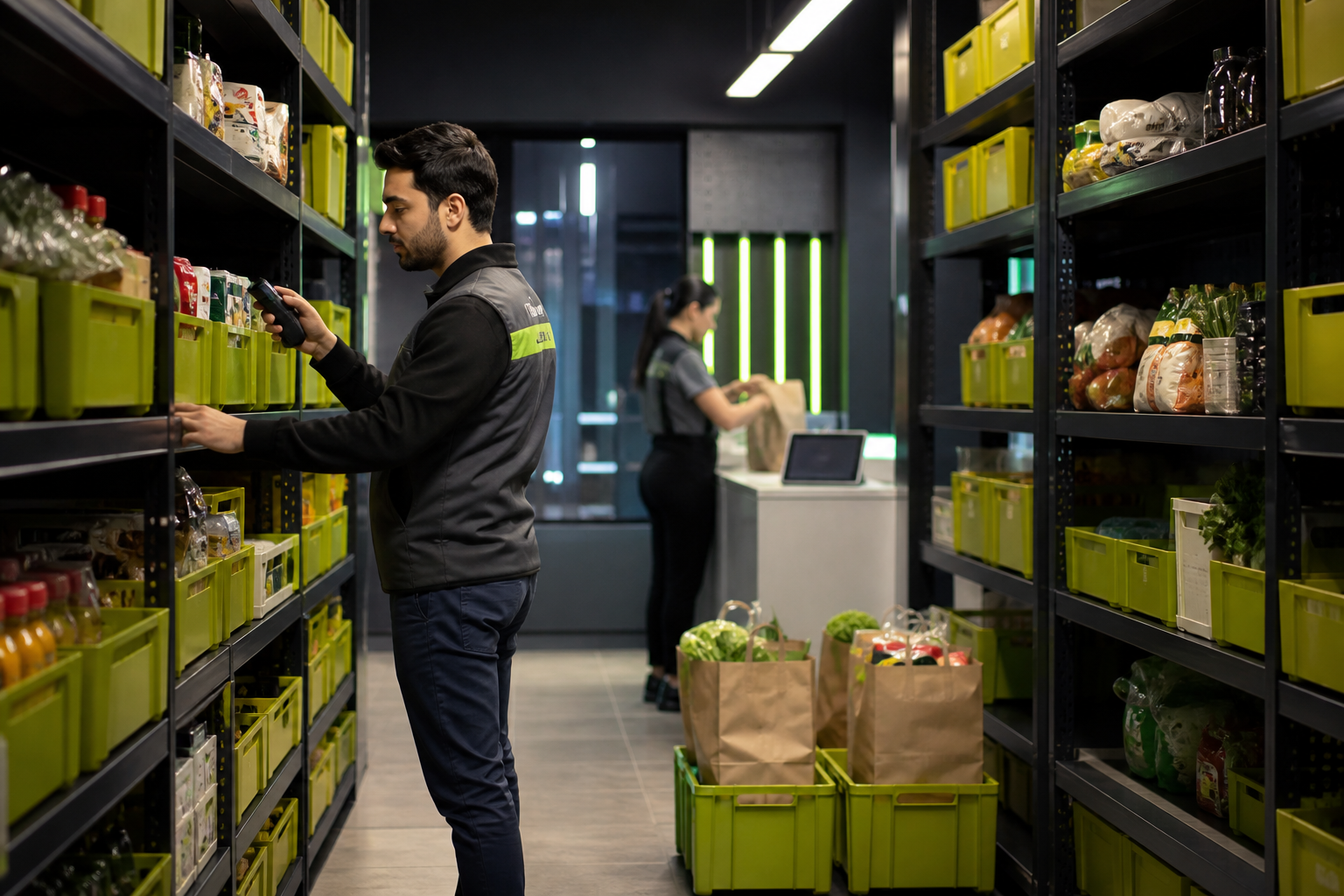
Imagine walking into a Blinkit-style dark store. The temptation is to say, "This business is fast because riders deliver quickly." That is an incomplete answer. The rider is only the final visible part of a tightly coordinated site system.
The primary driver is proximity to demand through micro-fulfilment sites located near dense customer clusters. But that works only because of supporting drivers: disciplined assortment, slotting of fast-moving items, real-time stock visibility, picker productivity, batching logic, replenishment frequency and dispatch coordination.
During a site visit, you would observe how orders enter the system, how pickers move, where packed orders wait, how substitutions are handled, and whether stockouts are visible at the shelf or hidden in the app. You would not reduce the model to "fast delivery." You would explain the operating system that makes fast delivery possible.
The lesson: a strong candidate identifies the operating model, not just the visible activity. For quick commerce, the win is not one factor; it is proximity as the core driver, supported by inventory accuracy, disciplined picking, routing logic and execution routines.
How AI Changes Plant and Site Visit Interviews
AI is changing what managers can observe, measure and predict inside operations sites. For interviews in 2026, you do not need to sound like a data scientist, but you should know where AI changes the site-visit conversation.
A practical student workflow: before an operations interview, load your company notes, the job description and any publicly available site information into ChatGPT or NotebookLM. Ask: "Create a site-visit observation checklist for this company across safety, flow, inventory, quality, people and technology. Add 10 interviewer follow-up questions." If the role touches supply chain, revise using AI for inventory optimisation and replenishment so you can connect floor observations to planning decisions.
Do not say AI will automatically fix operations. AI needs clean data, process discipline, sensor coverage and human adoption. A broken process digitised badly remains a broken process.
Interview Relevance
"Suppose we take you to one of our plants or fulfilment sites for 30 minutes. What would you observe, what questions would you ask, and how would you form a view on operational performance?"
Use this sentence in interviews: "I would not judge the site from a single visual cue; I would convert what I see into hypotheses and validate them through operating metrics."
Common Mistake
The biggest mistake is giving a tourist answer: "I will observe machines, workers and cleanliness." That costs candidates because it shows attention but not diagnosis. The fix: frame every observation as observation - implication - validation metric - improvement question.