
Line Balancing and Workstation Design
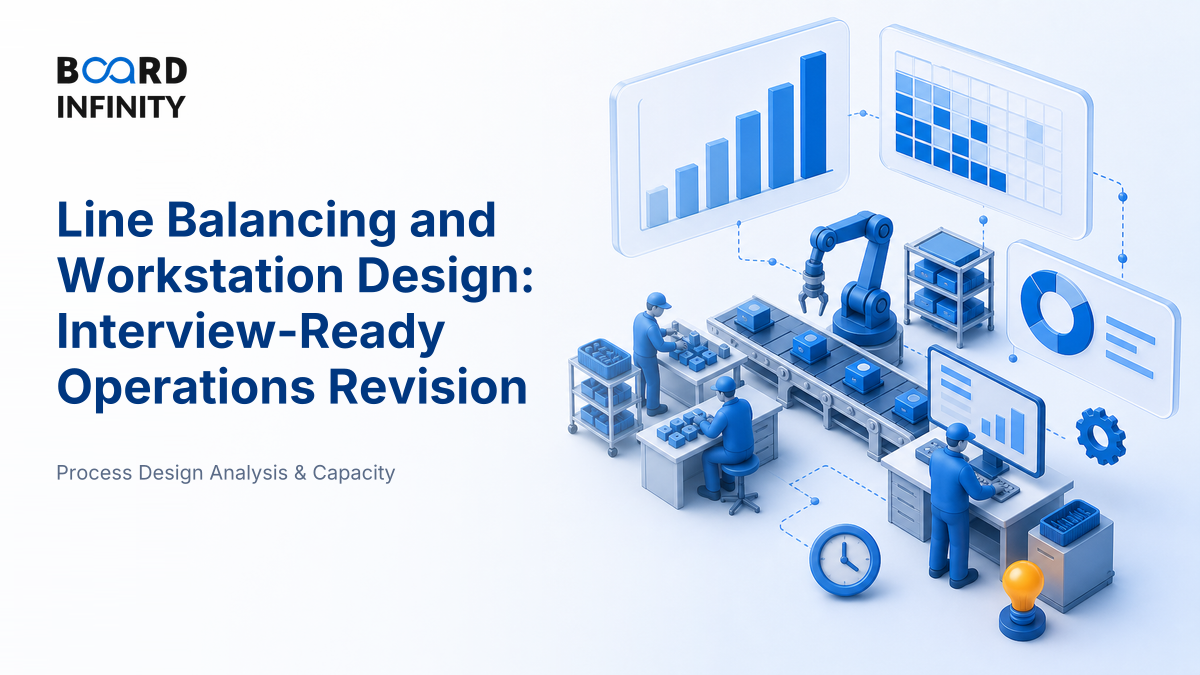
The biggest myth about line balancing is that a “good” line keeps every worker busy every second. Walk past a real assembly line and you will see the truth: one overloaded station silently sets the pace, while every other station either waits, piles up work-in-process, or rushes and creates defects.
Line balancing is not about maximum busyness. It is about matching work content to customer demand, station by station, without breaking precedence, safety, or quality.
- Line balancing allocates tasks across workstations so each station fits within the required cycle time or takt time.
- Takt time is the customer demand rhythm: available production time divided by demand.
- The bottleneck station is the station with the highest workload; it sets the line's output rate.
- Workstation design makes the assigned work safe, repeatable, ergonomic, visible, and mistake-resistant.
- The core math is simple: total work content, cycle time, theoretical minimum stations, line efficiency, idle time, and balance delay.
- Never balance only on averages; include precedence, variability, rework, changeovers, fatigue, and quality checks.
- In interviews, use this sequence: map tasks, calculate takt, find bottleneck, rebalance, redesign stations, measure results.
Big Picture: A Line Is Only as Fast as Its Slowest Station
Think of a production or service line as a chain of linked workstations. Even if four stations are excellent, one poorly loaded or badly designed workstation can reduce throughput, increase waiting, and create quality escapes. If you need a refresher on the difference between cycle time, takt time and lead time, revise Cycle Time, Takt Time & Lead Time Explained before doing the calculations below.
Core Explanation: How Line Balancing Actually Works
The big idea is simple: split total work into elemental tasks, respect the order in which tasks must happen, and group them into workstations so no station exceeds the allowed cycle time.
But the skill is in the details. A “balanced” line on paper can still fail if task times are wrong, operators reach too far, material arrives late, or quality inspection is placed too late in the process. That is why line balancing and workstation design must be treated together.
The Five-Step Line Balancing Method
The moment you start balancing, one question dominates: which station governs the whole line? That is usually the station with the largest assigned work content. For deeper bottleneck logic, revise Finding the Bottleneck and the Theory of Constraints.
A Small Worked Example
Suppose a small assembly line has five tasks with standard times:
- Task A: 40 seconds
- Task B: 30 seconds
- Task C: 50 seconds
- Task D: 20 seconds
- Task E: 40 seconds
Total work content = 40 + 30 + 50 + 20 + 40 = 180 seconds.
If the required cycle time is 60 seconds, the theoretical minimum number of workstations is:
Minimum stations = total task time / cycle time = 180 / 60 = 3 stations
A possible balance could be:
This first assignment fails because Station 2 takes 70 seconds, above the 60-second cycle time. A better balance is:
That also fails. If precedence allows no other grouping within 60 seconds, the practical answer is not “force 3 stations.” It may require 4 stations, task splitting, parallel help, method improvement, or a redesigned workstation. This is exactly where good candidates stand out: they do not worship the theoretical minimum when the real process cannot support it.
The Metrics You Must Know
Line balancing is a numbers topic. These are the metrics that make your answer credible.
Workstation Design: The Hidden Half of Line Balancing
A line can be mathematically balanced and still operationally poor. Workstation design asks: can a real person perform this work repeatedly, safely, at the planned pace, with minimal errors?
Good workstation design considers reach distance, tool placement, posture, lighting, material presentation, fixture design, visual instructions, mistake-proofing, scanning, and rework flow. In product layouts, this connects directly to the broader choice of line, cell, or process layout, which is why Layout Design: Process, Product & Cellular is the natural companion topic.
What a Good Workstation Must Deliver
Definitions You Can Say in One Breath
- Line balancing: assigning tasks to workstations so workload is even and each station meets the required cycle time.
- Workstation: a defined location where one operator, machine, or team performs assigned work on a unit.
- Takt time: the pace of production required to meet customer demand with available working time.
- Cycle time: the actual time between successive completed units leaving a process.
- Precedence constraint: a rule that one task must be completed before another task can begin.
- Balance delay: the percentage of available station time lost as idle time due to imperfect task allocation.
Case Study: Dixon Technologies and High-Mix Electronics Assembly
Dixon Technologies, an Indian electronics manufacturing services company, shows why line balancing matters most when product variants, testing steps and quality checks change frequently.
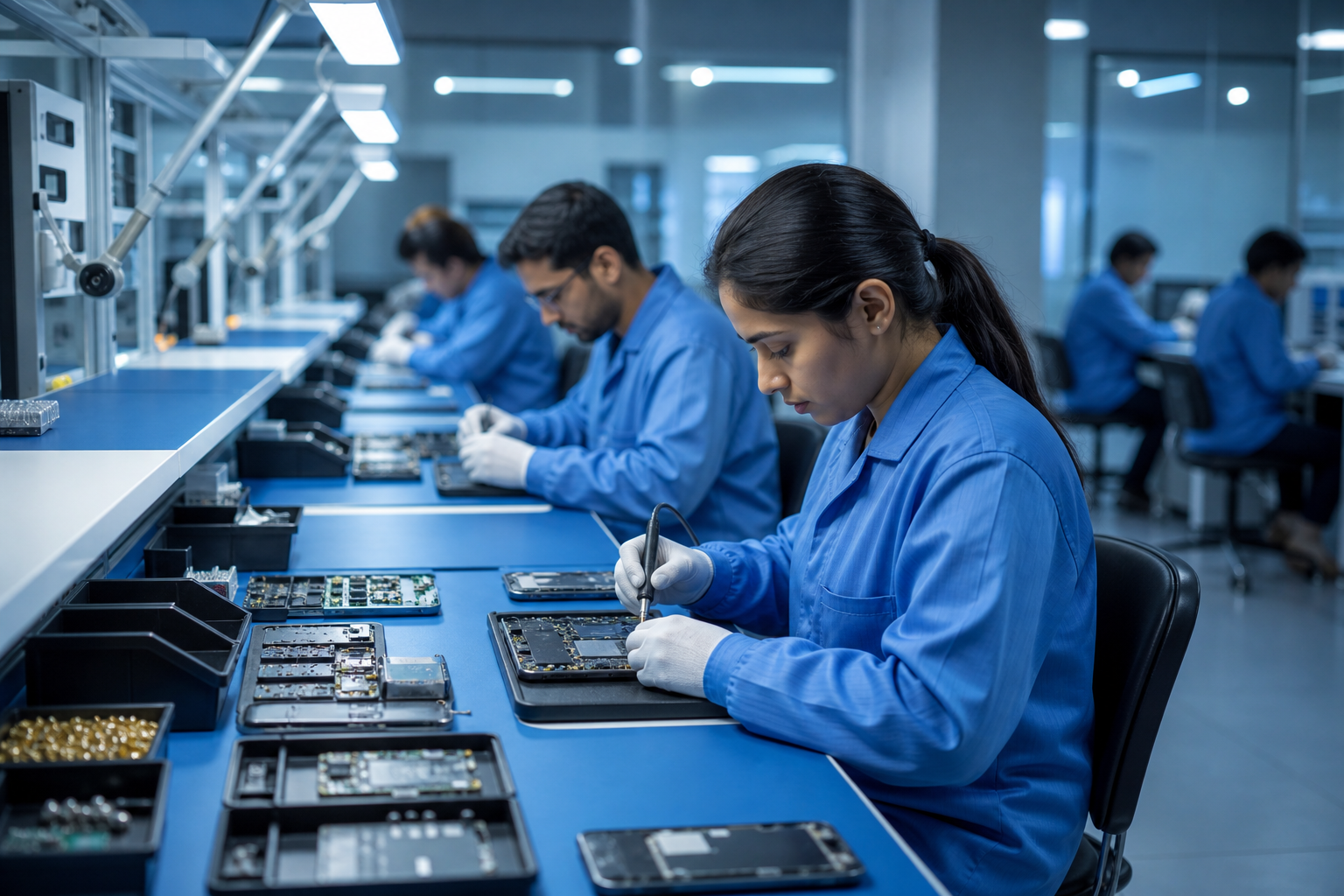
In electronics assembly, the line rarely has the luxury of one stable product forever. Model changes, component variations, software flashing, functional testing, visual inspection and packaging can all shift the workload from one station to another. For a company such as Dixon Technologies, the challenge is not simply “add more workers.” The challenge is to keep output, quality and flexibility together.
Situation: A high-mix electronics line faces changing product variants and uneven station workloads. Assembly may move smoothly until a testing, scanning, firmware, screw-tightening or inspection step takes longer than planned. That station becomes the governor of the entire line.
The move: The operations team would break work into elemental tasks, measure times, draw precedence relationships, and assign tasks to stations based on takt. But the primary driver is disciplined work content balancing. Supporting drivers include kitted material presentation, operator training, visual work instructions, ergonomic fixtures, separate rework handling and fast feedback from quality checks.
The lesson: In high-mix assembly, a line balance is not a laminated chart on the wall. It is a living standard that changes when product mix, demand, test time or operator skill changes.
So what: The case proves that line balancing works only when supported by workstation design, material flow, quality control and people capability. A single-cause answer like “they improve efficiency by adding labour” is too shallow for an operations interview.
How AI Changes Line Balancing and Workstation Design
AI is making line balancing more dynamic, especially in high-mix manufacturing, warehouses, dark stores and service operations.
- Computer vision time studies: With proper consent and privacy controls, video analytics can estimate task times, walking, reaching and waiting more consistently than manual stopwatch studies.
- Simulation-backed balancing: AI-assisted simulation can test different station assignments, staffing levels, buffer sizes and product-mix scenarios before changing the real line. This connects well with Using AI and Simulation to Test a Process Design.
- Adaptive work instructions: AI can help create variant-specific standard operating instructions, alert supervisors to stations drifting from standard time, and support faster operator training.
Use ChatGPT or Claude to practise a line balancing case: give it task times, precedence rules and demand, then ask it to calculate takt time, minimum stations, bottleneck station, line efficiency and two improvement options. Then ask it to challenge your answer like an operations interviewer.
Interview Relevance
A factory assembles a product through six tasks. Demand has increased, WIP is piling up before one station, and operators complain that the new line balance is unrealistic. How would you diagnose and improve the line?
Say this line in interviews: “I would not rebalance only by arithmetic; I would validate the new allocation against precedence, operator fatigue, quality risk and material availability.”
Common Mistake
The mistake: candidates calculate the theoretical minimum number of stations and stop there. Why it costs them: real lines are constrained by task order, variation, ergonomics, quality checks and rework. One-line fix: always move from math to feasibility - “Now I will test this balance against precedence, variability and workstation design.”