
Work Measurement, Standard Times & Productivity - Interview-Ready Guide
In a shirt factory, two sewing operators can both look busy, both work eight hours, and still produce very different output. The difference is often not motivation - it is whether the job has been measured, standardised, and staffed against a realistic time.
- Work measurement finds the time a qualified worker should take to complete a defined job using a defined method.
- Standard time = normal time plus allowances for fatigue, personal needs, and unavoidable delays.
- Normal time = observed time × performance rating factor.
- Productivity = output / input; in labour-heavy operations, output per labour hour is the quickest measure.
- Standard time is not just for costing - it drives staffing, capacity planning, incentives, line balancing, and bottleneck analysis.
- The best standards are method-based: first fix the process method, then measure time.
- Interview trap: do not confuse “working faster” with “being more productive.” Quality, fatigue, rework, and sustainability matter.
Big Picture: Standard Time Is the Bridge Between Work and Capacity
Work measurement turns messy human work into a planning number. Once you know how long a task should take, you can estimate capacity, set manpower, compare actual performance, price work, and redesign the process.
Think of standard time as the “unit economics” of operations. If marketing asks, “What is CAC per customer?”, operations asks, “How many standard minutes per unit?”
Core Explanation: From Observed Time to Productivity
The core logic is simple: observe the work, adjust for pace, add realistic allowances, and then compare output with input.
1. The Time Ladder
A manager should never jump from stopwatch reading to target output. The full ladder has four levels:
The basic formula is:
Normal Time = Observed Time × Performance Rating
Standard Time = Normal Time × (1 + Allowance %)
A packing task is observed at 42 seconds. The worker is rated at 110% pace, and the allowance is 15%.
Normal time = 42 × 1.10 = 46.2 seconds.
Standard time = 46.2 × 1.15 = 53.13 seconds.
In an 8-hour shift, theoretical output = 28,800 seconds / 53.13 = about 542 units, before considering setup, quality loss, absenteeism, and scheduling constraints.
2. Why the Method Must Come Before the Measurement
If the current method is poor, work measurement only makes bad work look scientific. First remove obvious waste: unnecessary walking, searching, waiting, rechecking, double handling, and awkward motion. Then measure the improved method.
This is why work measurement sits naturally after process mapping and value stream mapping, and before line balancing and workstation design. You map the work, measure the work, and then distribute the work intelligently.
3. Main Techniques of Work Measurement
Different operations need different techniques. A repetitive factory task and a hospital nurse’s day should not be measured in the same way.
4. Productivity: The Output-Input Lens
Productivity is not speed alone. It is the relationship between output and the resources consumed to produce it. In operations interviews, always attach productivity to a clear unit: units per labour hour, orders per rider hour, invoices per employee, or revenue per machine hour.
To read productivity properly, connect it with cycle time, takt time and lead time. A process can show high worker productivity but still create long lead time if work piles up before a bottleneck.
Key Metrics to Track
These are the six measures you should be ready to calculate or explain.
Definitions You Can Say in One Breath
- Work measurement: techniques used to establish the time a qualified worker needs for a defined job at a defined performance level.
- Observed time: the actual time recorded for a task or work element during a study.
- Normal time: observed time adjusted for the worker’s performance rating.
- Allowance: added time for fatigue, personal needs, and unavoidable delays.
- Standard time: normal time plus allowances for completing a task by the prescribed method.
- Productivity: output produced per unit of input consumed.
Case Study - Shahi Exports and Standard Minutes in Apparel Operations
Shahi Exports shows why standard time is powerful in labour-intensive manufacturing: sewing work becomes plannable only when each operation is converted into standard minutes.
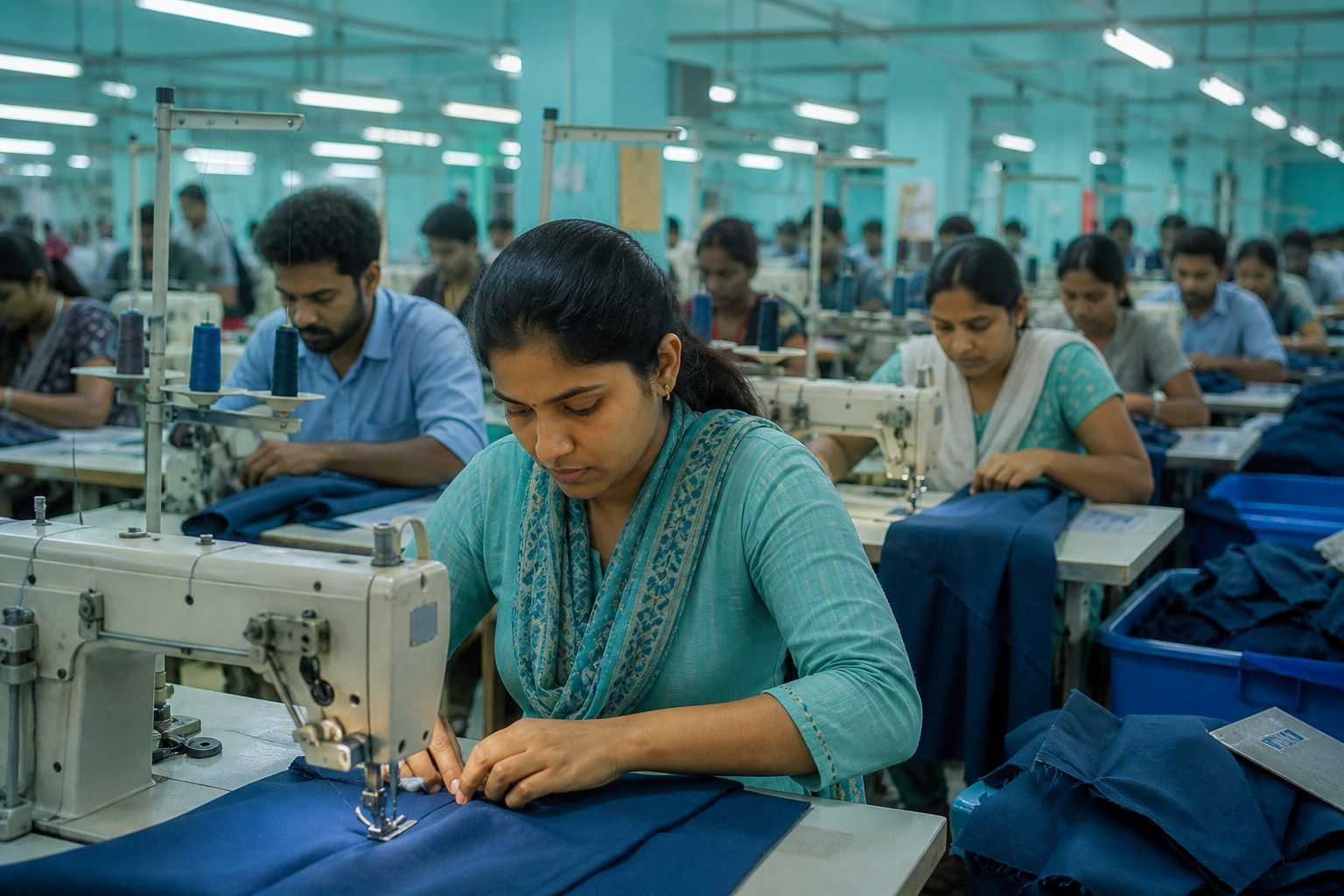
Apparel manufacturing is a perfect setting for work measurement. A shirt or trouser is not made in one step. It passes through many operations: cutting, bundling, sewing, checking, pressing, finishing, and packing. Within sewing itself, one garment may involve collar attachment, sleeve joining, side seam closing, buttoning, hemming, and inspection.
For an exporter such as Shahi Exports, the challenge is not merely producing more. The challenge is producing different styles, in different order quantities, with consistent quality and promised delivery. The primary driver is converting each operation into standard allowed minutes, often called SAM or SMV in the apparel industry. Once each operation has a standard minute value, planners can estimate manpower, balance sewing lines, calculate capacity, and identify where work will pile up.
The supporting drivers matter just as much: trained operators, clear method sheets, supervisor discipline, inline quality checks, WIP control, and line balancing. Without these, a standard time sheet becomes paperwork. With them, it becomes the factory’s operating language.
The lesson is interview-worthy: in labour-intensive operations, standard time is not a stopwatch number. It is the link between costing, capacity, delivery reliability, incentives, and continuous improvement.
How AI Changes Work Measurement, Standard Times & Productivity
AI does not remove the need for industrial engineering judgement. It changes how quickly you can observe, compare, and test work standards.
Student workflow: take a simple process video or written process description, load the notes into ChatGPT or Claude, and ask: “Break this job into work elements, suggest possible wastes, identify what data I need for a time study, and create a standard-time calculation template.” Then validate every suggestion with real observation - AI helps structure the study, but it does not replace the shop-floor truth.
If you want to see how AI tests a process before money is spent, revise using AI and simulation to test a process design after this topic.
Interview Relevance
“A warehouse packing team produces 480 orders in an 8-hour shift with 6 workers. How would you measure productivity and decide whether the team is efficient?”
Use this sentence in interviews: “Actual output tells me what happened; standard time tells me whether it should have happened.”
Common Mistake
The biggest mistake is treating productivity as “make people work faster.” That costs candidates because it ignores method, quality, fatigue, rework, and bottlenecks. The one-line fix: improve the method first, measure the fair standard next, then compare actual performance against that standard.
What to Revise Next
You now know how to convert work into standard time and productivity measures. The next step is to use those standards to find where the process is being constrained, why output is stuck, and which improvement will actually raise throughput.
Revise next: Debottlenecking a Real Process Step by Step