
Queueing, Waiting Lines & Service Capacity
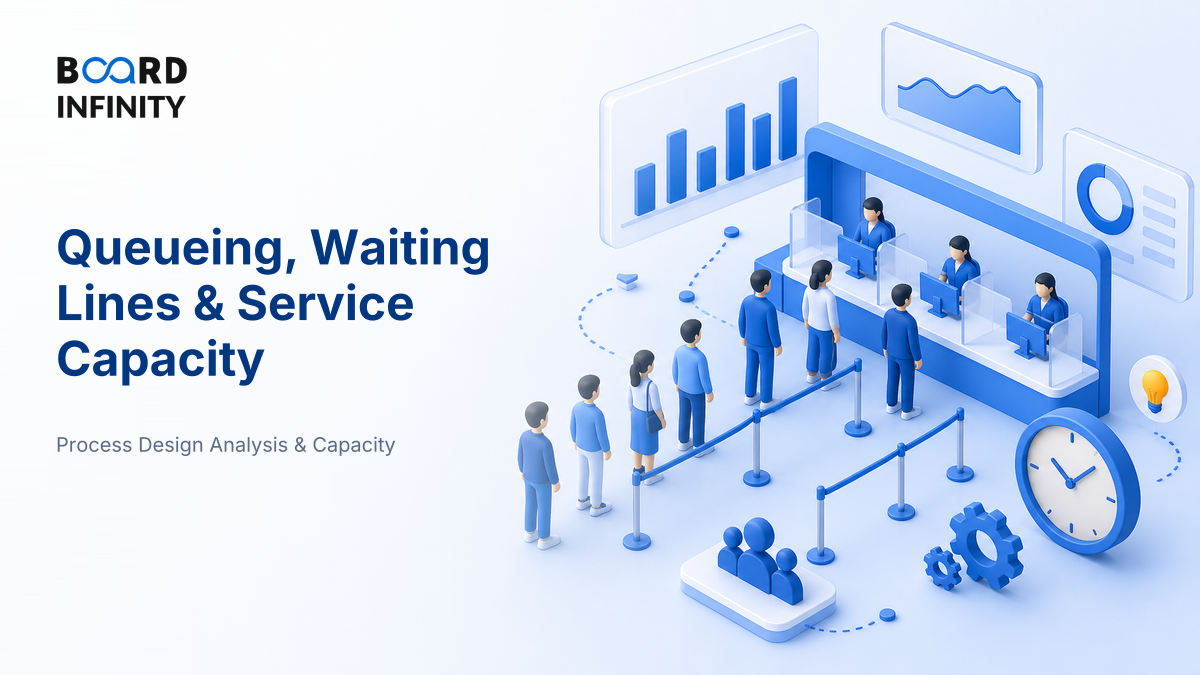
A hospital triage desk can look calm for twenty minutes - then three ambulances arrive together, one doctor gets pulled into an emergency, and the waiting room changes mood instantly. The problem is not only “too many patients”; it is a queueing system where arrivals, service time, priority rules and capacity stop matching for a short but costly window.
- Queueing studies how customers, jobs or units wait when arrival demand temporarily exceeds immediate service capacity.
- The core drivers are arrival rate, service rate, variability, number of servers and queue discipline.
- High utilisation is not automatically good - as utilisation approaches 100%, waiting time becomes unstable, especially when arrivals are variable.
- Little’s Law is the must-know relationship: average work-in-process = throughput rate × average flow time.
- Capacity decisions are trade-offs: more capacity reduces waiting but increases idle cost; less capacity saves cost but hurts service levels.
- Best fixes rarely mean “add people” first - smooth arrivals, reduce service-time variation, segment demand, redesign the queue, then add capacity where justified.
- In interviews, diagnose the queue before solving it: map arrivals, servers, bottleneck, queue rule, customer promise and KPI impact.
Big Picture - A Queue Is a Capacity Mismatch Made Visible
Think of a waiting line as a pressure gauge. It rises when demand arrives faster or more unevenly than the process can serve. The queue is the symptom; the design question is whether to control demand, increase capacity, reduce variability or change the waiting rule.
Core Explanation - The Five Pieces of Any Waiting Line
A queueing system has five moving parts. If you can identify them quickly, you can analyse almost any airport counter, call centre, dark store, hospital OPD, bank branch or production cell.
1. Arrival pattern
Arrival rate is the average number of customers or jobs entering per unit of time. In symbols, it is usually written as λ. But the average alone is not enough. Ten customers per hour arriving evenly is easy; ten customers arriving in two sudden bursts creates a queue.
2. Service process
Service rate is the average number of customers or jobs a server can complete per unit of time. In symbols, it is usually written as μ. Service time variability matters because one unusually long transaction can block everyone behind it.
3. Number of servers
A single-server queue is one doctor, one billing counter or one machine. A multi-server queue is several counters, agents or machines serving the same stream. Pooling demand across multiple servers often reduces waiting because idle capacity at one server can absorb demand from another line.
4. Queue discipline
Queue discipline is the rule for deciding who gets served next. Common rules are first-come-first-served, priority service, shortest-processing-time-first, appointments, reservations and emergency triage.
5. Customer behaviour
Real customers do not wait silently forever. They may balk when they see a long line, renege after joining, or switch channels. In services, waiting time is both an operations metric and a brand experience metric.
The Capacity Trap - Why 100% Utilisation Creates Long Waits
The most important queueing insight is counter-intuitive: a fully utilised service system is usually a bad service system. At 100% utilisation, there is no slack to absorb random arrivals, long service times or small disruptions.
This is why a premium hospital, airport lounge or wealth-management desk cannot be designed like a factory machine that must run flat out. The right utilisation target depends on variability and the promised service level.
Queueing Formulas You Must Be Able to Use
You do not need to derive queueing theory in an MBA interview, but you should be fluent with the basic relationships.
For a deeper mathematical reading of L = λW, revise Little's Law and Reading a Process Mathematically. For capacity vocabulary such as design capacity, effective capacity and utilisation, pair this with Capacity Measurement, Utilisation & Effective Capacity.
Worked Example - One Billing Counter
Assume a store billing counter receives 18 customers per hour. The cashier can serve 24 customers per hour on average. Treat this as a simple single-server example for quick interview math.
The interview takeaway is not the formula alone. It is the managerial insight: even before the counter is fully utilised, customers may experience waiting because randomness creates temporary overload.
Queueing Measures - What to Track Before You Redesign
Queueing cannot be managed by looking at the longest line you saw once. Track averages, variability and service promises together.
Notice the balance: operations wants utilisation and throughput; customers feel waiting time and service level. A good service-capacity design manages both.
Types of Waiting-Line Problems
Most queueing cases fall into a few recognisable patterns. Naming the pattern helps you choose the right intervention.
If the queue is caused by one constrained step, revise Finding the Bottleneck and the Theory of Constraints before recommending extra capacity.
The Managerial Playbook - How to Reduce Waiting Without Blindly Adding Capacity
Adding capacity is the most visible fix, but not always the smartest. The cleaner sequence is diagnose, stabilise and then invest.
Definitions
- Queueing system: Arrivals wait for service when demand temporarily exceeds immediately available service capacity.
- Service capacity: The maximum sustainable rate at which a process can complete work under normal conditions.
- Utilisation: The proportion of available service capacity that is actually used.
- Queue discipline: The rule that decides the order in which waiting customers or jobs are served.
- Service level: The percentage of demand served within a promised time or performance standard.
Case Study - IRCTC Tatkal: When Digital Capacity Meets Synchronized Demand
IRCTC's Tatkal booking experience is a powerful queueing lesson: when millions of users try to access a time-sensitive service together, the real challenge is not only server capacity but demand synchronization, fairness and service prioritisation.
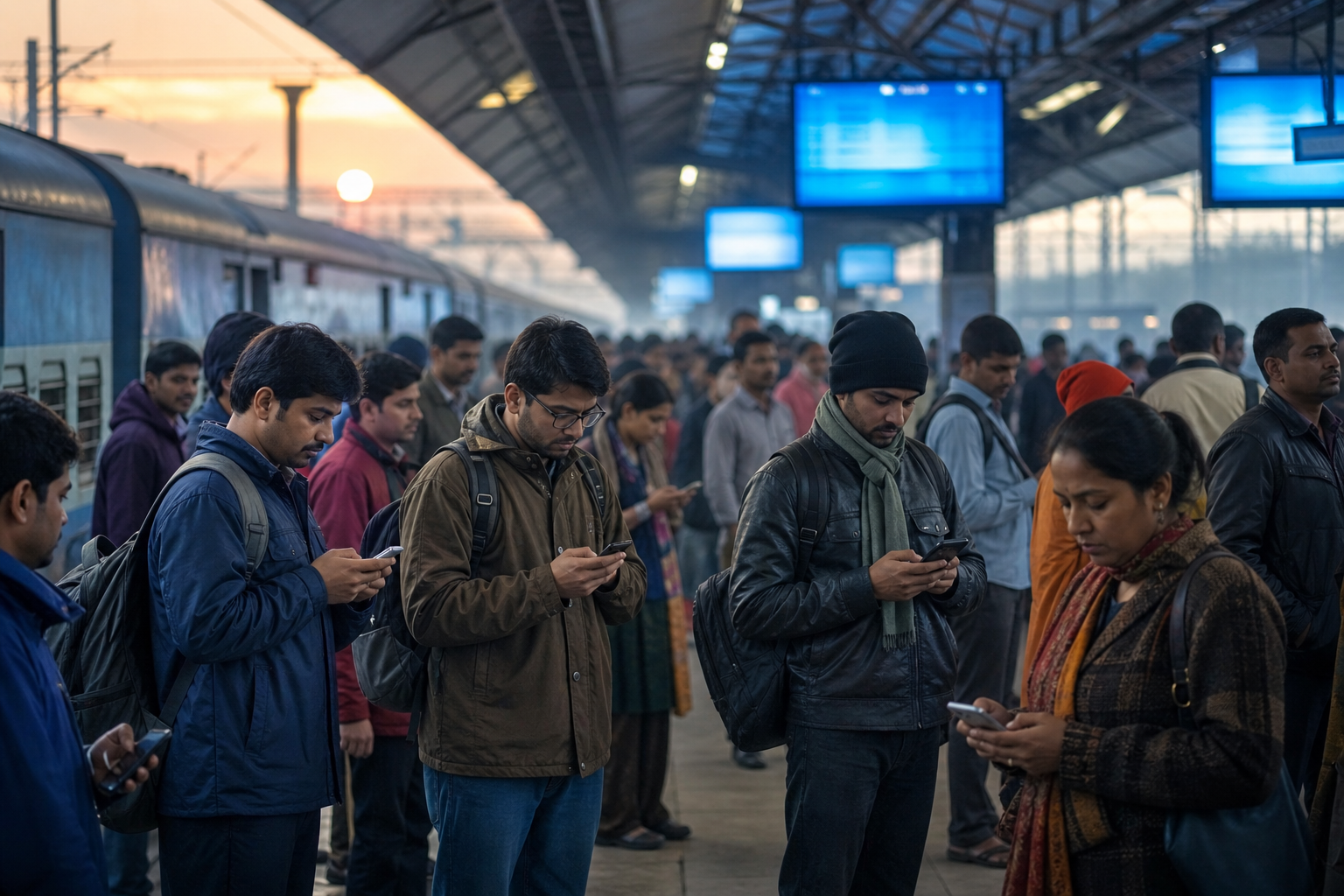
Situation. Tatkal railway booking creates a classic burst-arrival problem. Many users want limited inventory at the same opening window, so demand is highly synchronized rather than smoothly spread across the day.
The move. The queueing response is not one magic fix. The primary driver is controlled access to a scarce, time-sensitive service. Supporting drivers include user-session controls, booking rules, payment-time limits, waitlist/RAC mechanisms and channel capacity across web and app interfaces. Together, these mechanisms try to keep the system usable while allocating scarce seats under intense demand.
The lesson. Even digital services have queues. If demand arrives in a sharp spike and inventory is scarce, adding servers alone will not eliminate perceived waiting or disappointment. The stronger answer combines capacity, demand shaping, rule design, transparent status and fallback options.
So what: IRCTC shows that queueing is not a small counter problem. It is a strategic service-design problem where fairness, reliability and customer trust matter as much as raw throughput.
How AI Changes Queueing, Waiting Lines & Service Capacity
AI changes queueing by making capacity decisions more predictive, more dynamic and more personalised.
- Demand forecasting becomes granular. ML models can forecast arrivals by hour, location, channel, weather, promotion or event, helping managers staff for peaks instead of averages.
- Real-time capacity allocation improves. AI can recommend when to open extra counters, trigger callbacks, reroute tickets, assign riders, or shift work to a back-office team.
- Simulation becomes easier. Managers can test “what if we add one server?” or “what if we create a priority lane?” before changing the live process. For a deeper next step, revise Using AI and Simulation to Test a Process Design.
Use ChatGPT or Claude to build a queueing diagnosis table: paste a short process description, ask it to identify arrivals, servers, queue discipline, bottleneck, likely KPIs and three capacity options. Then challenge it with constraints such as “no extra hiring” or “must reduce waiting without hurting utilisation.”
Interview Relevance
“A bank branch has long queues during lunch hours but idle counters in the late afternoon. How would you analyse and solve this?”
Use the phrase: “I would not start by adding manpower. I would first check whether the queue is caused by peak arrivals, slow service, wrong priority rules or a bottleneck step.” That sounds managerial, not mechanical.
Common Mistake
The single biggest mistake is saying “increase capacity” without diagnosing why the queue exists. It costs candidates because it ignores variability, utilisation, queue discipline and customer behaviour. The one-line fix: first classify the queue, then choose whether to smooth demand, redesign service, change priority rules or add capacity.