
The Enterprise Value Bridge Explained
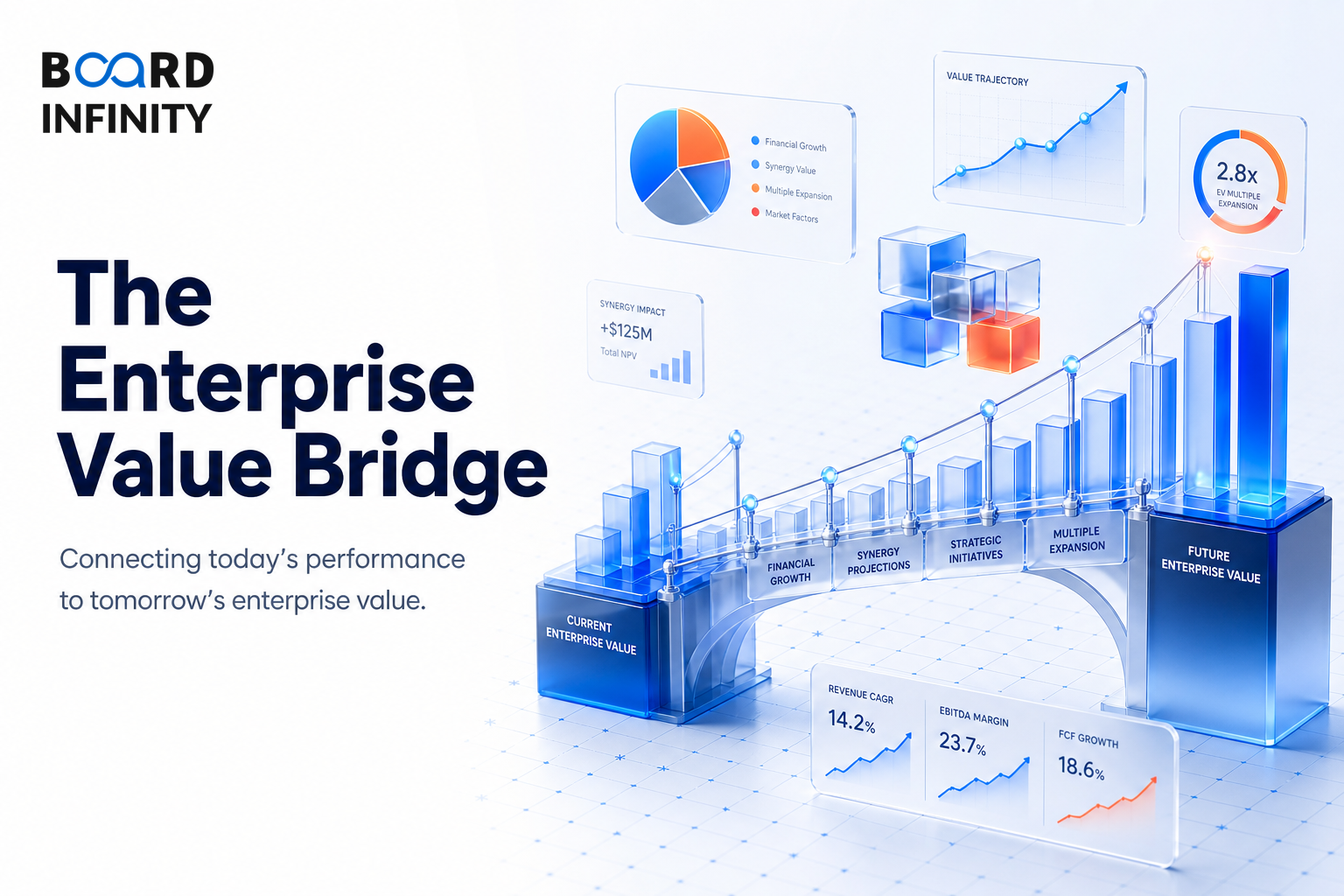
After ROE Decomposition & Benchmarking, the next valuation question is not just how efficiently a company generates returns, but what it would cost to own the full business. Enterprise Value (EV) answers that question by bridging from equity value to the true takeover cost of a business. In interviews, this matters because EV is the acquisition price, while equity value is only the shareholders' share.
- Enterprise Value (EV) is the total cost of acquiring a business - what you'd pay to own all the cash flows, serving all claimants.
- The bridge from equity value to EV is crucial for valuation.
- EV = Market Cap + Net Debt + Minority Interest + Preference Shares - Associates/Investments.
- Net Debt equals Total Debt minus Cash & Equivalents.
- For Reliance Industries, the FY24 approximate bridge moves from Market Capitalisation of ₹18,00,000 Cr to Enterprise Value of ~₹19,77,000 Cr.
- Minority Interest is important because it captures non-controlling interests in subs.
- Use EV for capital-structure-neutral comparisons such as EV/EBITDA and EV/Revenue; use Equity Value for per-share metrics such as P/E and P/B.
The Big Picture: From Equity Value to Enterprise Value
Enterprise Value (EV) is the total cost of acquiring a business - what you'd pay to own all the cash flows, serving all claimants. The bridge starts with Market Capitalisation, then adjusts for net financial obligations, non-controlling interests, preference capital, and value already captured through associates or investments.
EV = Market Cap + Net Debt + Minority Interest + Preference Shares - Associates/Investments
How the Enterprise Value Bridge Works
The bridge begins with Market Capitalisation, the equity market value. It then adds Total Debt because debt holders have a claim on the business, and subtracts Cash & Equivalents because an acquirer gets cash as part of the deal, reducing the effective purchase price.
That produces Net Debt, the net financial obligation. The bridge then adds Minority Interest, which represents non-controlling interests in subsidiaries, adds Preference Capital where relevant, and subtracts Value of Associates because these are stakes in non-consolidated entities.
Reliance Industries Worked Example
For Reliance Industries, Market Capitalisation is ₹18,00,000 Cr. Total Debt of ₹3,35,000 Cr is added, while Cash & Equivalents of ₹1,75,000 Cr are deducted, creating Net Debt of ₹1,60,000 Cr.
Minority Interest of ₹42,000 Cr is then added, Preference Capital is 0 because there is none at Reliance, and Value of Associates of ₹25,000 Cr is deducted. The final Enterprise Value is ~₹19,77,000 Cr, which represents the total cost to own Reliance.
Why the Adjustments Matter
Enterprise Value is the total value of the business to all capital providers: debt, equity, minority interest, less cash. Equity Value is the value attributable to only equity shareholders, calculated as EV minus Net Debt.
This distinction matters because EV is used for capital-structure-neutral comparisons such as EV/EBITDA and EV/Revenue, while Equity Value is used for per-share metrics such as P/E and P/B. In M&A and valuation discussions, the bridge prevents candidates from confusing the market value of equity with the cost of acquiring the whole business.
Common EV Bridge Checks
Structuring a The Enterprise Value Bridge Explained Interview Answer
"What is the difference between Enterprise Value and Equity Value?"
Do not stop at Market Cap. The strongest answers bridge from equity value to EV and explicitly adjust for Net Debt, Minority Interest, Preference Shares, and Associates/Investments.
The most frequent error is using gross debt instead of net debt. This overstates the effective acquisition cost because Cash & Equivalents should reduce the bridge before arriving at Enterprise Value.
Conclusion
Enterprise Value is the total cost of acquiring a business, not just the equity market value. The practical takeaway is simple: start with Market Capitalisation, move through Net Debt, Minority Interest, Preference Shares, and Associates/Investments, and then use the resulting EV for valuation comparisons and takeover-cost discussions.