
Unit Economics for Fintech Explained: LTV, CAC and Contribution Margin
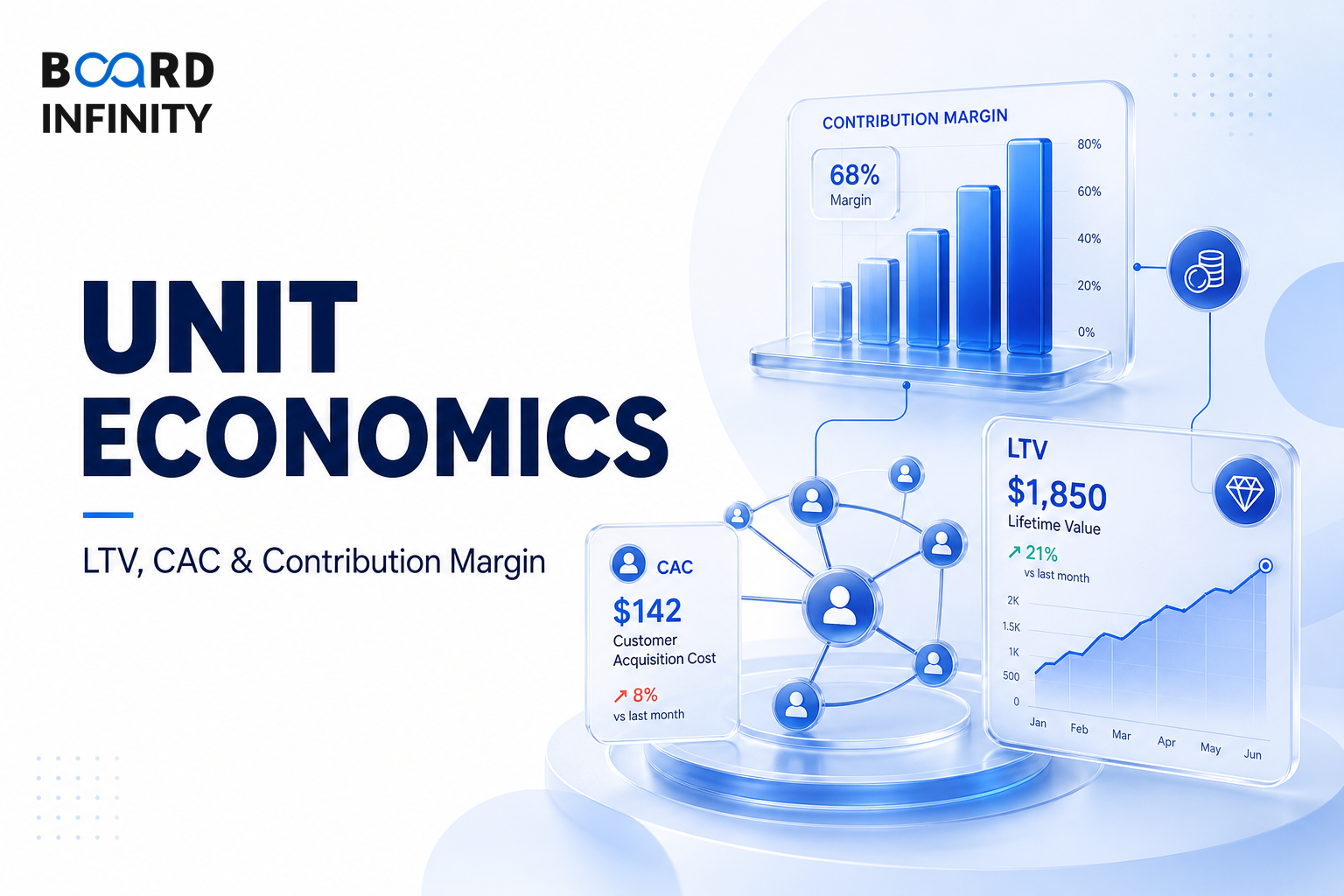
Working Capital and the Cash Conversion Cycle ask how efficiently cash moves through operations. Unit economics asks the next fintech finance question: whether each user or transaction creates value before celebrating top-line growth. For startup and fintech finance roles, unit economics matters MORE than traditional Profit and Loss (P&L); understanding Lifetime Value (LTV), Customer Acquisition Cost (CAC), and contribution margin is the entry-level filter for roles at PhonePe, Razorpay, Zepto, CRED, and similar companies.
- For startup and fintech finance roles, unit economics matters MORE than traditional P&L.
- Lifetime Value (LTV) = Average Revenue Per User (ARPU) × Gross Margin % × (1 / Monthly Churn Rate).
- Customer Acquisition Cost (CAC) = Total Sales & Marketing Spend / New Customers Acquired.
- LTV:CAC below 1x means destroying value; 3x - 5x is healthy; above 5x is excellent.
- In payments, effective CAC includes cashbacks and UPI transaction incentives.
- UPI payments are largely not directly monetisable by fintechs today, so LTV must include the value of adjacent product adoption.
- If LTV:CAC < 3x or payback > 18 months, probe whether the business model works at scale.
Why Unit Economics Matters in Fintech Finance
Unit economics is the core fintech finance interview filter because it tests whether growth creates value at the user or transaction level. The main building blocks are Lifetime Value (LTV), Customer Acquisition Cost (CAC), LTV:CAC Ratio, payback period, and contribution margin per transaction.
Unit economics matter more than top-line growth - the finance question is whether each user or transaction creates value after acquisition cost and variable cost.
PhonePe's moat is its 700 Mn users - the real monetisation comes from insurance cross-sell, mutual fund distribution, and lending products built on top of payment data. That is why LTV must include the value of adjacent product adoption.
Lifetime Value (LTV)
Lifetime Value (LTV) measures the total expected value generated by a customer. In fintech interview cases, LTV is used to test whether the revenue and margin generated by a user justify the cost of acquiring that user.
LTV = ARPU × Gross Margin % × (1 / Monthly Churn Rate)
Example - Paytm (illustrative): ARPU = ₹300/month; Gross Margin = 45%; Monthly Churn = 3%.
LTV = ₹300 × 0.45 × (1/0.03) = ₹300 × 0.45 × 33.3 = ₹4,500 per user.
Customer Acquisition Cost (CAC)
Customer Acquisition Cost (CAC) measures the cost of acquiring each new customer. For fintech companies, this matters because growth can look impressive while acquisition spends, cashbacks, and incentives silently weaken unit economics.
CAC = Total Sales & Marketing Spend / New Customers Acquired
Example - PhonePe (illustrative): If PhonePe spends ₹2,000 Cr on S&M and acquires 100 Mn new users - CAC = ₹2,000 Cr / 1,000 Mn users = ₹200 per user. Note: In payments, effective CAC includes cashbacks and UPI transaction incentives.
LTV:CAC Ratio
The LTV:CAC Ratio compares the value generated by a customer with the cost of acquiring that customer. It is the central viability threshold in a fintech interview because it converts growth into a value-creation question.
Contribution Margin per Transaction
Contribution margin per transaction tests whether each transaction is profitable after variable cost. This matters especially in fintech because payments volume can be large, but the transaction itself may not generate strong direct monetisation.
Fintech Insight
UPI payments are largely not directly monetisable by fintechs today (MDR = 0% on UPI by RBI directive). PhonePe's moat is its 700 Mn users - the real monetisation comes from insurance cross-sell, mutual fund distribution, and lending products built on top of payment data. That's why LTV must include the 'value of adjacent product adoption.'
Structuring a Unit Economics for Fintech Explained Interview Answer
"What is the LTV:CAC and payback period?"
Great answer: "Unit economics matter more than top-line growth - I'd focus on improving gross margin per transaction before accelerating CAC-heavy growth."
The most frequent error is celebrating user growth without checking LTV:CAC, payback period, and contribution margin per transaction. If LTV:CAC < 3x or payback > 18 months, probe whether the business model works at scale.
Conclusion
Unit economics is the fintech finance filter that proves whether growth creates value. Before celebrating scale, test LTV, CAC, LTV:CAC, payback period, and contribution margin per transaction.