
Working Capital and the Cash Conversion Cycle
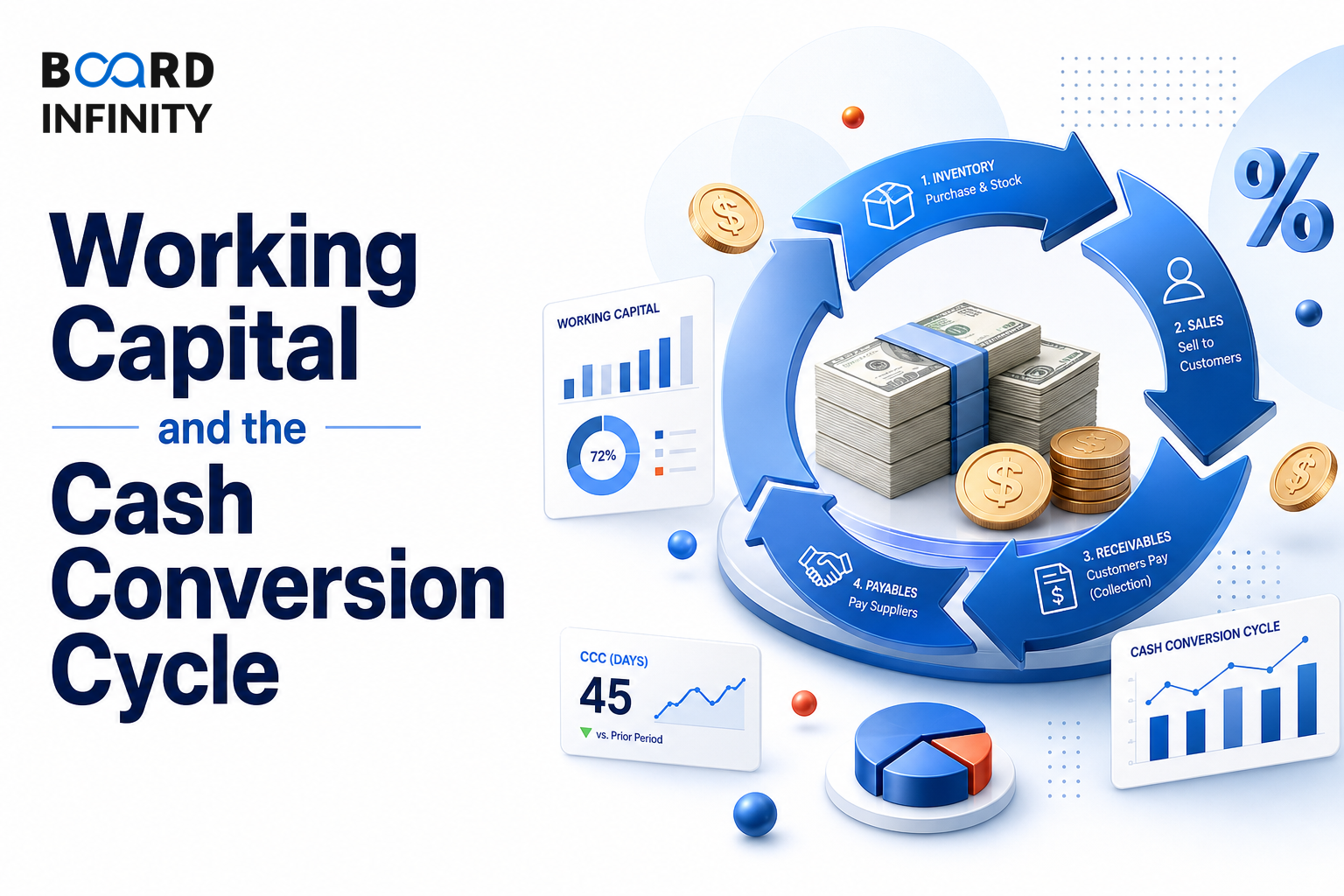
After Free Cash Flow: FCFF vs FCFE Explained, the next interview question is what drives cash generation inside operations. Working capital efficiency through the Cash Conversion Cycle shows how inventory, receivables, and payables directly affect cash generation and capital-light growth. In interviews, it helps you move beyond profit and explain how a business releases or traps cash.
- Cash Conversion Cycle (CCC) = Days Inventory Outstanding (DIO) + Days Sales Outstanding (DSO) - Days Payable Outstanding (DPO).
- DIO = Days Inventory Outstanding = (Inventory/COGS)×365.
- DSO = Days Sales Outstanding = (Receivables/Revenue)×365.
- DPO = Days Payable Outstanding = (Payables/COGS)×365.
- Negative CCC = company collects cash before paying suppliers, an ideal business model.
- Each day of improvement in CCC frees cash equal to Daily Revenue/365.
- Working capital efficiency is therefore a major lever for capital-light compounding.
How the Cash Conversion Cycle Fits Together
Cash Conversion Cycle (CCC) connects three operating levers: inventory, receivables, and payables. It measures whether cash is tied up in operations or released back into the business.
A shorter CCC means less cash is tied up. A negative CCC means the company collects cash before paying suppliers, which makes suppliers fund operations.
CCC = DIO + DSO - DPO. Where: DIO = Days Inventory Outstanding = (Inventory/COGS)×365; DSO = Days Sales Outstanding = (Receivables/Revenue)×365; DPO = Days Payable Outstanding = (Payables/COGS)×365.
Why it matters: Each day of improvement in CCC frees cash equal to Daily Revenue/365. For HUL with ₹62,000 Cr revenue: 1 day CCC improvement = ₹170 Cr cash released. Working capital efficiency is therefore a major lever for capital-light compounding.
Reading DIO, DSO, and DPO
Days Inventory Outstanding (DIO) shows how long inventory is held before it turns into sales. In the sector comparison, IT Services (TCS) has 0 DIO because it has minimal inventory, while Pharma (Sun Pharma) has 120 DIO, showing high inventory.
Days Sales Outstanding (DSO) shows how long collection takes after revenue is booked. TCS has 68 days DSO, while HUL has 8 days and Maruti has 5 days, showing faster collection in those models.
Days Payable Outstanding (DPO) shows how long the company takes to pay suppliers. Since CCC subtracts DPO, higher payable days can improve CCC when the business has bargaining power over vendors.
Negative CCC and Capital-Light Growth
Negative CCC = company collects cash before paying suppliers. This is an ideal business model because suppliers fund operations.
HUL has a CCC of -29 days, Maruti has -35 days, and Nykaa has -15 days. Their implications are suppliers fund ops, strong bargaining power over vendors, and a cash-positive online retail model.
Why CCC Matters in Financial Analysis
Each day of improvement in CCC frees cash equal to Daily Revenue/365. That makes CCC a practical bridge between working capital management and cash generation.
For HUL with ₹62,000 Cr revenue, 1 day CCC improvement = ₹170 Cr cash released. The learning is direct: improving inventory, receivables, or payables can release cash without needing external capital.
Structuring a Working Capital & the Cash Conversion Cycle Interview Answer
"How would you use the Cash Conversion Cycle to compare working capital efficiency across TCS, HUL, Maruti, Sun Pharma, L&T, and Nykaa?"
Do not just calculate CCC. Explain why a shorter or negative CCC releases cash, and connect the number to capital-light compounding.
The most frequent error is treating CCC as only a formula and missing the business model implication. A negative CCC is not automatically a red flag - it can mean the company collects cash before paying suppliers, which is an ideal business model.
Conclusion
Cash Conversion Cycle shows how inventory, receivables, and payables convert operating activity into cash. The core takeaway is simple: shorter CCC releases cash, negative CCC can let suppliers fund operations, and each day of improvement can become a major lever for capital-light compounding.