
Financial Ratio Analysis: Liquidity, Profitability and Leverage
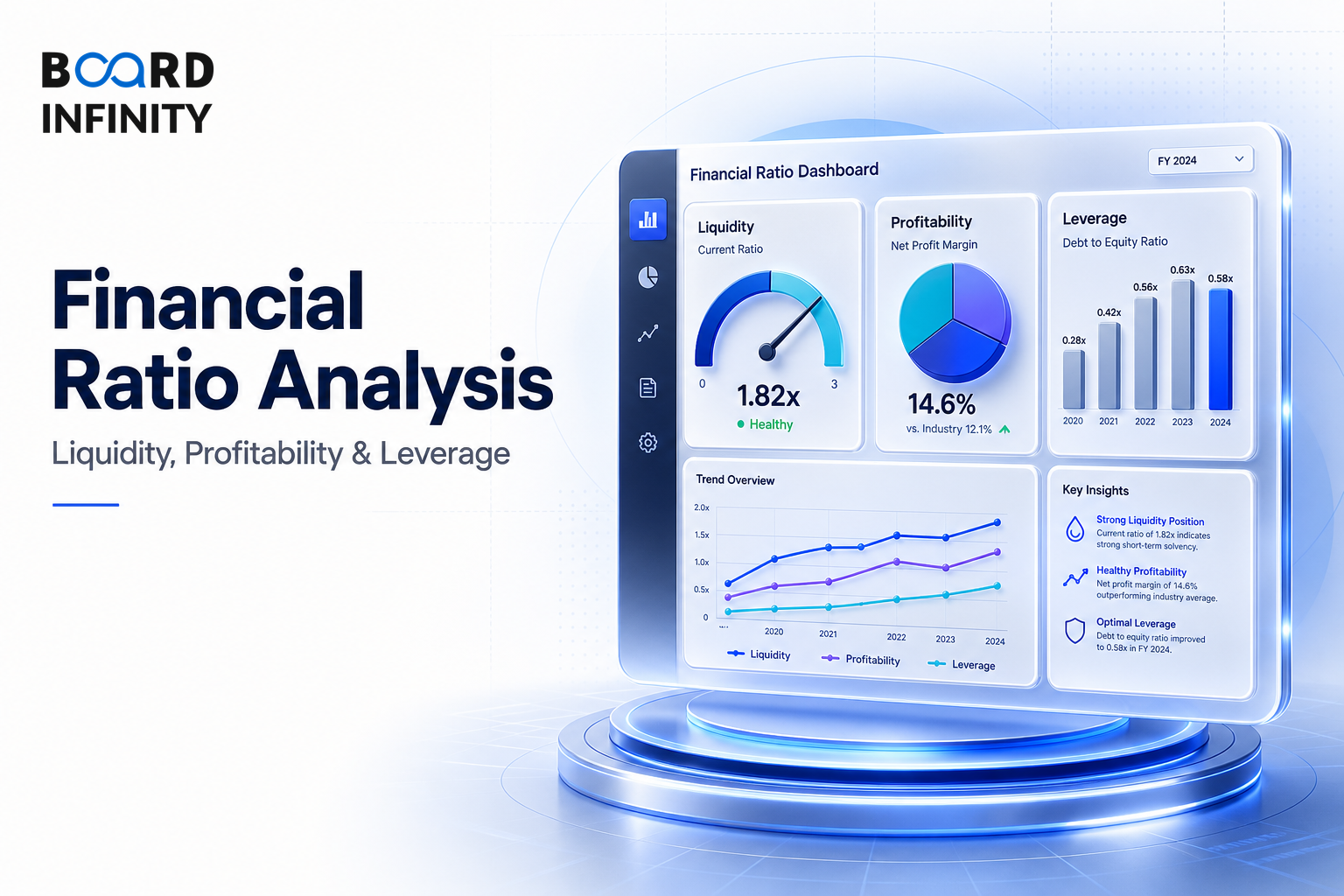
After reading the Cash Flow Statement, the next interview question is usually: how do you compare one company with another in a structured way? Financial ratio analysis answers that by compressing balance sheet, income statement and cash flow data into comparable metrics. It matters in finance interviews because it helps you judge liquidity, profitability, leverage and operating efficiency without getting lost in raw financial statements.
- Financial ratios convert financial statement numbers into meaningful metrics for comparison across companies, sectors and time periods.
- The four pillars are liquidity, profitability, leverage and efficiency, and each pillar answers a different business question.
- Liquidity ratios test short-term payment ability, but benchmarks differ by business model, with banks using different norms from manufacturing companies.
- Profitability ratios such as EBITDA margin, PAT margin, ROE, ROA and ROCE show how efficiently a company converts revenue, equity, assets and capital into profit.
- Leverage ratios such as Debt/Equity, Net Debt/EBITDA, Interest Coverage and DSCR help assess debt risk and repayment capacity.
- Efficiency ratios such as Asset Turnover, DIO, DSO, DPO and Cash Conversion Cycle show how quickly operations convert inventory and receivables back into cash.
- In interviews, never compare ratios blindly across sectors - always interpret them against sector benchmarks and the company's business model.
Big Picture: What Ratio Analysis Really Does
Ratio analysis is not about memorising formulas. It is a diagnostic toolkit that turns financial statements into answers: can the company pay, earn, borrow safely and run operations efficiently?
Financial ratios compress financial statement data into meaningful metrics for comparison across companies, sectors and time periods.
The four pillars below give you a complete interview map before you go into individual ratios.
Liquidity Ratios: Can the Company Pay Its Near-Term Obligations?
Liquidity means the ability of a company to meet short-term obligations using current assets, cash or operating cash flows. In practice, liquidity ratios are most useful when analysing working capital pressure, short-term solvency and the cash discipline of a business.
The nuance is that liquidity ratios are not interpreted the same way for every sector. The source benchmark shows a Current Ratio above 2x for manufacturing, but above 1x for banks, while HDFC Bank's FY24 current, quick and cash ratios are marked as not applicable because bank balance sheets are structured differently.
Current Ratio is broad because it includes all current assets. Quick Ratio is stricter because it removes inventory, which may not be converted to cash quickly. Cash Ratio is the most conservative because it only considers cash and equivalents.
The Operating CF Ratio links back to the Cash Flow Statement. Since it uses operating cash flow rather than accounting accruals, it is often a better signal of whether liquidity is supported by actual cash generation. In interviews, this is a strong way to show that you understand both financial statements and ratio analysis together.
Start with the ratio, compare it with the sector benchmark, check whether the business model makes the benchmark relevant, then confirm whether liquidity is supported by operating cash flow.
Profitability Ratios: How Well Does the Company Earn?
Profitability ratios measure how much profit a company generates from revenue, equity, assets or capital employed. These ratios are central in equity research, management consulting cases and finance interviews because they show whether a business is merely growing revenue or actually generating attractive returns.
Several terms matter here. EBITDA means earnings before interest, tax, depreciation and amortisation. EBIT means earnings before interest and tax. PAT means profit after tax. ROE is return on equity, ROA is return on assets and ROCE is return on capital employed.
The TCS FY24 numbers fit the Information Technology, or IT, benchmark range shown in the source: Gross Margin is 51.2% against the IT benchmark of 45-55%, EBITDA Margin is 25.0% against 22-28%, EBIT Margin is 23.1% against 20-26% and PAT Margin is 19.1% against 18-22%.
Asian Paints FY24 also needs to be interpreted against the right sector context. The source uses Fast-Moving Consumer Goods, or FMCG, benchmarks for margin comparison: Gross Margin is 42% against 40-55%, EBITDA Margin is 18.2% against 18-24% and PAT Margin is 13% against 10-16%.
The key interview nuance is that profitability is not one ratio. Margins show profit per rupee of revenue, while ROE, ROA and ROCE show returns generated on equity, assets and capital employed. A company may look strong on margins but still needs to be checked for capital efficiency.
Leverage Ratios: How Much Debt Risk Exists?
Leverage refers to the use of debt in a company's capital structure. Leverage ratios help assess whether debt is at a comfortable level, whether interest can be serviced and whether the company has enough cash generation to meet debt obligations.
The source gives FY24 comparisons for Reliance and TCS. This is a useful contrast because the same leverage framework can show two different balance sheet profiles without making a blanket judgement that one business is universally better.
D/E, or Debt/Equity, compares total debt with shareholders' equity. Net Debt/EBITDA asks how many years of EBITDA would be required to cover net debt, assuming other things remain comparable. ICR, or Interest Coverage Ratio, compares EBIT with interest expense. DSCR, or Debt Service Coverage Ratio, compares cash available for servicing debt with total debt service.
Reliance FY24 shows Debt/Equity of ~0.8x against the preferred benchmark of less than 2x, Net Debt/EBITDA of ~2.8x against the comfortable benchmark of less than 3x, Interest Coverage of ~5.2x against the strong benchmark of more than 5x and Debt/Assets of ~35% against the preferred benchmark of less than 50%.
TCS FY24 shows a very different leverage profile: Debt/Equity of ~0.01x, Net cash, Interest Coverage above 100x and negligible Debt/Assets. In a finance interview, the right conclusion is not just "TCS is better"; the stronger answer is that TCS has far lower leverage risk based on these ratios, while Reliance still sits around comfortable or preferred benchmark levels in the source.
Efficiency Ratios: How Quickly Do Operations Convert Into Cash?
Efficiency ratios, also called activity ratios, measure how effectively a company uses assets, inventory, receivables and payables. They connect operating performance with cash flow by showing how long cash stays tied up in the business cycle.
Here, the source compares Fast-Moving Consumer Goods and IT or services businesses. This distinction matters because inventory is central for retail and FMCG, while receivable cycles may matter more for services companies.
DIO means Days Inventory Outstanding, which measures how long inventory is held before sale. DSO means Days Sales Outstanding, which measures how long the company takes to collect payment after sale. DPO means Days Payable Outstanding, which measures how long the company takes to pay suppliers. COGS means cost of goods sold.
The Cash Conversion Cycle combines these operating timings as DIO + DSO - DPO. A shorter cycle typically means cash is tied up for fewer days. The source identifies DMart at ~5 days as best-in-class, while TCS is shown at ~2x Asset Turnover in IT/services and IT receivable days are shown as 50-70 days.
Worked Example: Comparing Companies Without Mixing Sectors
Assume an interviewer asks you to compare TCS and Asian Paints using FY24 profitability ratios. The problem is that one is benchmarked against IT ranges and the other against FMCG-style ranges, so a direct one-line comparison can mislead.
The learning is practical: ratios become powerful only when paired with the right benchmark. A candidate who says "TCS has better profitability because every number is higher" may miss the sector-context point, while a stronger candidate explains that both companies need to be assessed against the benchmarks relevant to their business model.
How to Use Ratio Analysis in Cases and Placements
In case interviews, ratio analysis is most useful when you need to diagnose performance quickly. If profits are falling, start with profitability ratios. If cash is tight, move to liquidity and efficiency. If a company is seeking a loan or facing debt pressure, use leverage ratios.
Question first, ratio second: identify whether the issue is liquidity, profitability, leverage or efficiency, then select the ratios that directly answer that business question.
A practical answer also acknowledges limitations. Ratios are compressed indicators, not full explanations. They tell you where to investigate, but the final judgement still depends on business model, sector benchmark and time-period comparison.
Structuring a Financial Ratio Analysis Interview Answer
"How would you use financial ratios to compare the financial health of TCS, Asian Paints and Reliance?"
The number one way candidates lose points is by reciting formulas without interpreting them. Always connect the ratio to a benchmark, a named company and a business implication.
The most frequent error is comparing ratios across sectors as if every benchmark is universal. This costs points because a bank, an IT services company, a retailer and a manufacturing-style business can have very different normal levels for liquidity, margins, leverage and working capital.
Conclusion
Financial ratio analysis is a practical toolkit for turning financial statements into comparable insights on liquidity, profitability, leverage and efficiency. The strongest interview answers use formulas, but they also use benchmarks, named FY24 evidence and sector context before making a judgement.