
Generalist versus Specialist: Choosing an HR Track
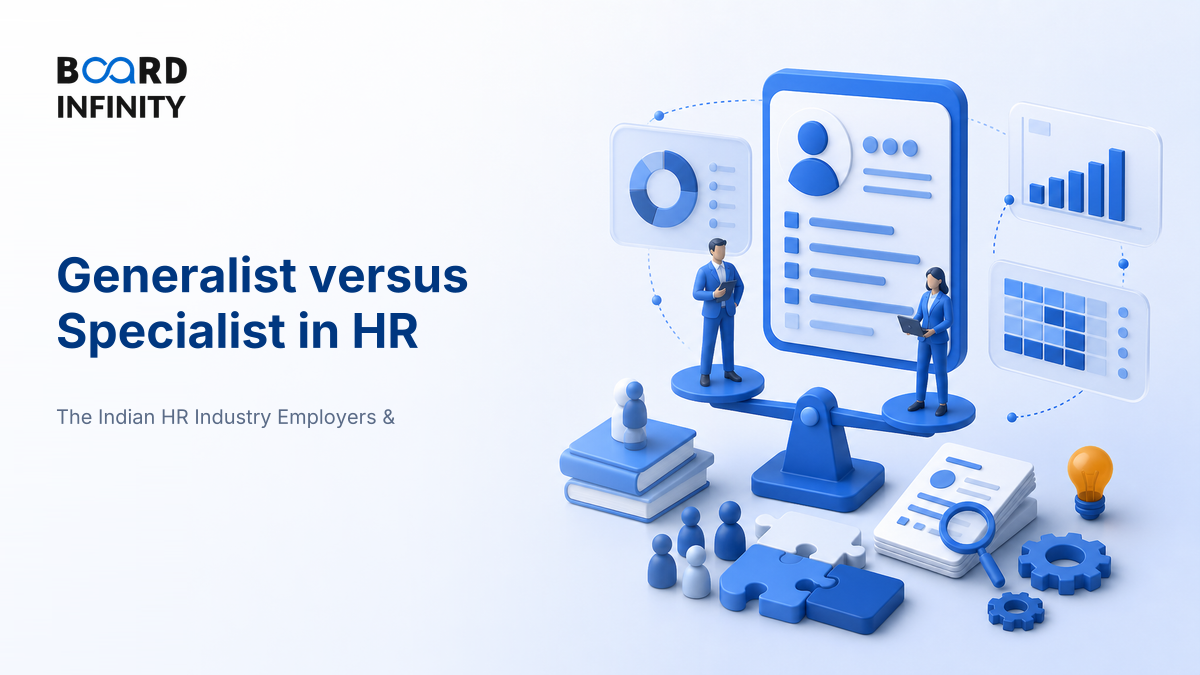
A fast-scaling company opens five new locations in a quarter, and suddenly HR is no longer “hiring people.” Someone must solve store staffing, manager capability, payroll accuracy, attrition, compliance, culture and leadership bandwidth - all at once.
That is where the generalist versus specialist choice becomes real: do you want to own the whole people system, or become the expert who solves one critical part better than anyone else?
- HR generalists work across the employee lifecycle - hiring, onboarding, performance, employee relations, policy and business partnering.
- HR specialists go deep in one domain - talent acquisition, compensation, L&D, HR analytics, employee relations, HR tech or OD.
- The right choice is not “people person versus data person.” It is breadth of ownership versus depth of expertise.
- Generalist roles suit students who enjoy ambiguity, stakeholder management, policy interpretation and business context.
- Specialist roles suit students who enjoy mastery, frameworks, analytics, domain expertise and repeatable excellence.
- The strongest careers are often T-shaped: broad HR judgement with one spike such as rewards, analytics, L&D or talent acquisition.
- In interviews, defend your track using evidence: internships, projects, metrics, role exposure and the company's business model.
Big Picture: Do Not Choose a Label, Choose a Problem Type
“Generalist” and “specialist” are not personality labels. They are two different ways HR creates business value. The generalist integrates many people decisions for a business unit; the specialist builds depth, standards and expertise in a high-impact HR domain.
Core Explanation: Generalist versus Specialist
An HR generalist handles multiple HR responsibilities across the employee lifecycle. In larger firms, the role may become an HR Business Partner, working closely with business leaders on workforce planning, performance, engagement and organization issues.
An HR specialist builds deep expertise in one HR domain. Common specialist tracks include talent acquisition, compensation and benefits, learning and development, organization development, HR analytics, HR operations, employee relations, industrial relations and DEI.
The Decision Framework: Choose by Work Energy, Not Job Title
A good track choice has three tests: what problems energize you, what skills you can prove, and what the target company actually needs. A campus answer that says “I like interacting with people” is too shallow; HR work is about business outcomes through people systems.
In an Indian manufacturing firm, a plant HR generalist may handle shift staffing, unions or workmen concerns, safety coordination, attendance discipline and supervisor capability. A compensation specialist in the same company may design grade structures, variable pay logic, benefits and pay equity checks. So what: both are HR, but one wins through local business judgement while the other wins through technical design and governance.
KPIs Both Tracks Must Speak Fluently
Even if you are not joining an analytics role, you should know the measures HR uses to prove impact. Treat the ranges below as interview-safe rules of thumb; the right benchmark varies sharply by industry, role type, geography and labour market.
A generalist uses these numbers to diagnose a business unit. A specialist uses them to improve one system - for example, a TA specialist reduces time to fill without damaging offer quality, while an L&D specialist improves capability with measurable transfer to work.
Definitions You Can Say in One Breath
Gary Dessler defines HRM as “the process of acquiring, training, appraising, and compensating employees, and of attending to their labor relations, health and safety, and fairness concerns.”
Case Study: Zepto and the HR Track Choice in Quick Commerce
Zepto shows why fast-scaling companies need both field HR generalists and HR specialists to turn growth into a repeatable people system.

Zepto operates in quick commerce, where customer promise depends on dense local operations, rapid fulfilment, frontline execution and technology working together. In such a model, HR cannot sit only at corporate headquarters. People issues show up daily in staffing, attendance, training, supervisor behaviour, safety, incentives and retention.
Situation: A quick-commerce business scaling across cities needs enough trained store and operations talent while also hiring technology, category, finance and leadership talent. The workforce mix is not one simple employee group; it includes corporate roles, store operations, city teams and partner ecosystems.
The move: The HR logic has to split by problem type. Field HR generalists or HRBPs stay close to city and store operations, while specialist teams build repeatable capability in talent acquisition, learning, HR operations, rewards and workforce analytics.
Outcome or lesson: The primary driver is fit between HR structure and operating complexity. Supporting drivers include standardized store role design, fast onboarding, manager training, HR service discipline, data visibility and compliance awareness. The lesson for students is clear: high-growth firms rarely want “only generalists” or “only specialists”; they need both, connected tightly.
Interview takeaway: If you discuss Zepto or any high-growth Indian firm, do not say “HR hires people.” Say HR designs the people system that allows the operating model to scale.
How AI Changes Generalist versus Specialist: Choosing an HR Track
1. Generalists become faster diagnosticians. AI tools can summarize employee feedback themes, draft policy explanations, compare attrition patterns and prepare manager conversation notes. The generalist still owns judgement, empathy and escalation; AI improves speed, not accountability.
2. Specialists become more technical. Talent acquisition uses AI screening support and talent intelligence; L&D uses personalized learning paths; rewards teams use compensation benchmarking tools; HR analytics teams use predictive models for attrition risk or workforce planning. The risk is bias, privacy misuse and false precision, especially under India's DPDP Act expectations around responsible data handling.
3. The best profile becomes T-shaped. A future-ready HR student should have broad HR understanding plus one AI-enabled spike - for example, people analytics, skills intelligence, HR tech implementation, compensation analytics or learning design.
Use NotebookLM: upload the company's annual report, careers page, job description and your HR project notes. Ask it to generate “likely people challenges for this company” and classify each as generalist, HRBP or specialist work. Then prepare a 60-second answer on why your chosen HR track fits those challenges.
Interview Relevance
“You are an MBA HR student. Would you prefer to start as an HR generalist, HRBP, or specialist? Why, and how does that fit our company?”
A strong answer sounds like this: “I want to start in an HRBP-oriented generalist role because I enjoy connecting talent, performance and manager capability to business outcomes. My internship on attrition analysis gave me comfort with data, but I want early exposure to real operating managers before later building depth in people analytics or rewards.”
Common Mistake
The biggest mistake is choosing a track using vague personality claims - “I like people, so generalist” or “I like numbers, so specialist.” It costs candidates because it sounds immature and disconnected from business impact. One-line fix: choose the track by problem type, prove it with evidence, and connect it to the employer's operating model.