
The HR Career Ladder and What Each Level Owns
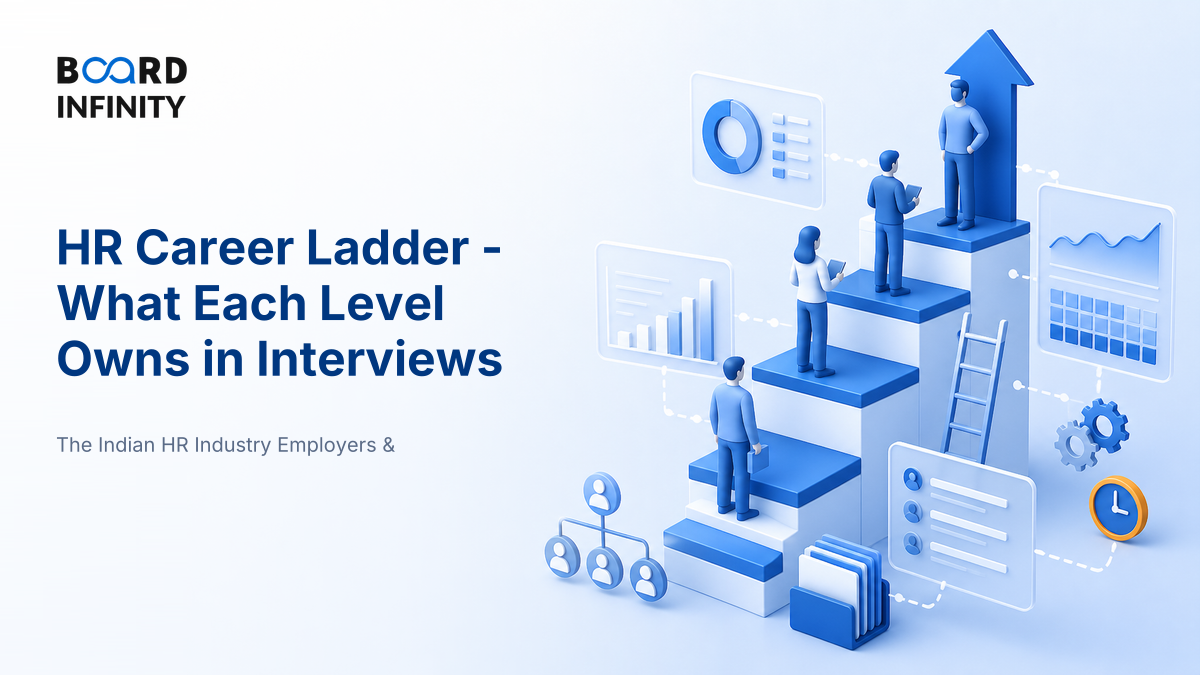
A retail store opens at 10 a.m., but the HR system behind it started much earlier: a recruiter filled the sales role, HR operations issued the offer letter, L&D trained the associate, the HRBP solved attrition patterns, and the CHRO decided whether the expansion model was people-scalable. That is the HR career ladder in action - not a list of titles, but a chain of ownership.
- The HR career ladder shows how HR work moves from execution to advisory ownership to enterprise strategy.
- Junior HR owns transactions: hiring coordination, onboarding, attendance, documentation, HRIS hygiene and employee queries.
- Mid-level HR owns processes and stakeholder support: recruitment delivery, employee relations, learning execution, engagement and compliance follow-through.
- Senior HR owns business outcomes: workforce planning, attrition reduction, capability building, succession, culture and change management.
- Specialists deepen expertise in one domain; HR generalists and HRBPs integrate multiple domains for business units.
- The CHRO owns the people strategy: leadership pipeline, organization design, culture, rewards philosophy, risk and board-level people governance.
- The best interview answer explains each level by decision rights, stakeholders, metrics and business impact - not by job title alone.
Big Picture - HR Maturity Rises as Ownership Widens
At the bottom of the ladder, HR makes sure work happens correctly and on time. At the top, HR decides how the organization gets the talent, capability and culture required to execute strategy.
Core Explanation - What Each HR Level Actually Owns
The easiest way to understand the HR ladder is to ask: What decision can this person make without escalating? Career growth in HR is not merely about managing more people. It is about owning more ambiguous problems, influencing more senior stakeholders and linking people decisions to business outcomes.
The Five Levels of the HR Career Ladder
Most companies use different titles, but the ownership pattern is surprisingly consistent. Use this map in interviews and adapt the titles to the company you are discussing.
Notice the movement: the first two levels are strong when they are accurate and responsive; the next two are strong when they solve business problems; the CHRO is strong when people strategy becomes a source of execution advantage.
Generalist, Specialist and HRBP - Do Not Mix Them Up
The same career ladder can split into different tracks. A specialist builds depth in one domain such as talent acquisition, compensation, learning, employee relations or HR analytics. A generalist manages the full employee lifecycle for a unit. An HRBP partners with business leaders and converts business priorities into people priorities.
Definitions You Should Be Able to Say Cleanly
Gary Dessler: Human resource management is the process of acquiring, training, appraising, and compensating employees, and attending to labor relations, health and safety, and fairness concerns.
Key HR Metrics by Career Level
If you mention ownership, be ready to mention measurement. Different HR levels track different metrics because they own different decisions.
Case Study - Lenskart: HR Ownership in a Fast Omnichannel Business
Lenskart shows why scaling HR requires multiple ownership layers: retail hiring, store training, manufacturing capability, tech talent and leadership systems cannot be managed as one generic HR task.

Situation: Lenskart is not just an eyewear retailer. It runs an omnichannel model involving stores, eye-testing capability, supply chain, manufacturing, customer support, technology and product teams. That creates a people problem with many workforce types: retail associates, optometrists, store managers, warehouse teams, manufacturing staff, engineers and corporate functions.
The move: A company like Lenskart needs HR ownership to be split by level. HR operations keeps joining, attendance, payroll inputs and employee records clean. Talent acquisition specialists handle high-volume frontline hiring as well as niche corporate hiring. L&D builds repeatable store and product training. HRBPs work with business leaders on store productivity, attrition pockets and capability gaps. Senior HR leadership aligns organization design and culture with expansion.
Outcome and lesson: The main driver is not simply “hiring more people.” The primary driver is designing clear HR ownership for a mixed workforce, supported by repeatable training, regional HR presence, specialist hiring capability and leadership alignment. The strategic lesson: as companies scale, HR must move from reactive service to layered ownership.
How AI Changes the HR Career Ladder
AI does not remove the HR ladder. It changes what each level must be good at.
Use NotebookLM: upload a company's annual report, careers page and recent news articles, then ask, “Map the likely HR career ladder in this company and generate five interview questions on what HR at each level would own.”
Interview Relevance
“Explain the HR career ladder. If you join as an HR trainee, how does your ownership change as you grow into an HRBP or HR head?”
If the interviewer asks “What does an HRBP do?”, do not answer “handles HR for a business.” Say: “An HRBP diagnoses people constraints behind business goals and coordinates hiring, capability, culture, performance and retention actions through HR specialists and managers.”
Common Mistake
The biggest mistake is describing the HR ladder as a promotion list: HR executive, HR manager, HR head. That sounds shallow because it misses ownership. Fix: for every level, state the decision owned, stakeholder served, metric tracked and business impact created.