
How to Read Any Deal: A Repeatable Teardown Template
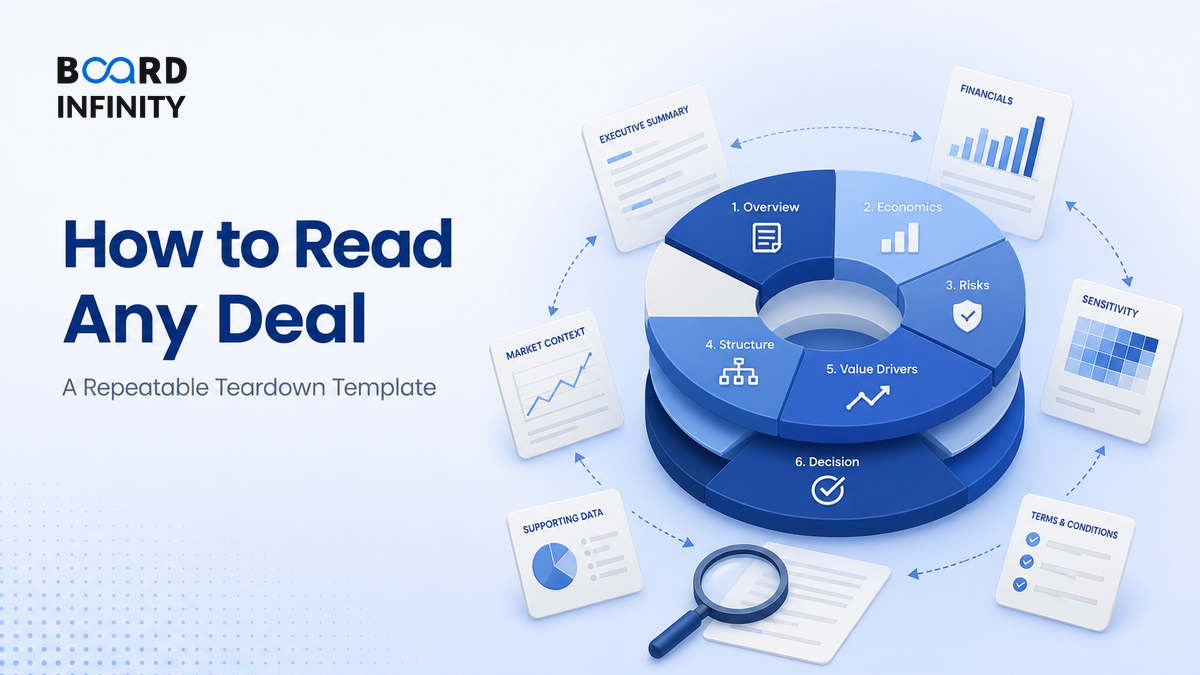
A stock exchange filing lands at 9:18 a.m.: one company is buying another, the purchase price is in crores, and the headline says “strategic acquisition.” By lunchtime, the market has already voted - but the real question is still unanswered: did the buyer just create value, or merely buy growth at an expensive price?
- Every deal is a hypothesis: “If we combine these assets, we can create more value than the price paid plus integration risk.”
- Read any deal in five lenses: facts, strategic logic, valuation, financing, execution risk.
- The strongest answers separate deal rationale from deal economics. A deal can be strategically logical and still overpriced.
- Synergies matter only when they are specific: revenue synergies, cost synergies, tax benefits, capability access or balance-sheet benefits.
- Track six metrics: premium paid, EV/EBITDA, accretion or dilution, ROIC versus WACC, net debt/EBITDA and synergy realization rate.
- Your final answer must give a verdict: value-creating, value-neutral, or value-destructive - with assumptions clearly stated.
The Big Picture: A Deal Is a Value-Creation Hypothesis
Do not start with “Company A acquired Company B.” Start with the economic claim beneath the announcement: the buyer believes ownership will make the asset more valuable than it was alone. Your job is to test that claim, not repeat the press release.
The Repeatable Deal Teardown Template
Use this template for mergers, acquisitions, IPOs, private equity investments, strategic investments, divestitures and joint ventures. The wording changes; the logic stays the same.
The most useful mental habit is to move from a wide fact base to a narrow verdict. Think of deal reading as a funnel: every layer filters noise and forces a sharper judgement.
The Seven Questions That Expose Any Deal
If you are short on time, answer these seven questions in order. They are deliberately simple because deal analysis fails when candidates jump into buzzwords before understanding the transaction.
The Deal Metrics That Actually Matter
Metrics are not a substitute for judgement, but they stop your answer from sounding vague. In interviews, use ranges carefully because “good” depends on sector, growth, risk and interest rates.
Worked Example: Is the Premium Defensible?
Suppose a buyer offers ₹130 per share for a target whose unaffected share price was ₹100. The target has EBITDA of ₹200 crore, and the enterprise value paid is ₹2,600 crore. The buyer expects annual after-tax synergies of ₹120 crore and has a WACC of 11 percent. This is a simplified teaching example, not a real company fact.
- Premium paid = ₹130 / ₹100 - 1 = 30 percent.
- EV/EBITDA = ₹2,600 crore / ₹200 crore = 13x.
- If comparable companies trade at 10x EBITDA, standalone value is approximately ₹200 crore x 10 = ₹2,000 crore.
- Simple synergy value = ₹120 crore / 11 percent = approximately ₹1,091 crore.
- Standalone value plus synergy value = ₹2,000 crore + ₹1,091 crore = ₹3,091 crore.
Verdict: the price can be defended only if the synergies are credible. Without synergies, the buyer is paying above peer value; with believable synergies, there is a value cushion of roughly ₹491 crore before integration costs and risk.
The Strategy-Value Matrix: Four Deal Archetypes
A deal is not automatically good because it “fits strategy.” The best deals sit in the top-right: high strategic fit and disciplined valuation. The danger zone is the top-left: strategically attractive but overpriced.
Definitions You Must Be Able to Say Cleanly
- Deal teardown: A structured analysis of a transaction to judge its strategic logic, economics, risks and value creation.
- Enterprise value: The value of a company’s operating business available to all capital providers.
- Synergy: Additional value created when two businesses together are worth more than they were separately.
- Accretion: A deal is accretive when the buyer’s earnings per share increases after the transaction.
- Dilution: A deal is dilutive when the buyer’s earnings per share decreases after the transaction.
- Strategic fit: The degree to which a target strengthens the buyer’s capabilities, market position or future advantage.
Porter’s classic strategy lens is useful here: strategy is “the creation of a unique and valuable position, involving a different set of activities.” In deal terms, the acquisition should strengthen that position - not merely add size.
Case Study: Reliance Retail’s Acquisition of METRO Cash & Carry India
Reliance Retail acquired METRO Cash & Carry India for a reported ₹2,850 crore, using the deal to deepen its B2B wholesale and merchant ecosystem.

Situation: India’s retail market is highly fragmented, with millions of kirana stores, small retailers, hotels, restaurants and caterers. Reliance Retail already had a large consumer-facing retail presence and digital commerce ambitions, but B2B wholesale depth is a different capability: assortment, bulk procurement, trade credit habits, fulfilment and merchant relationships matter.
The move: Reliance Retail acquired METRO Cash & Carry India, which operated 31 large-format stores across 21 cities and served a large base of business customers. The primary driver was to strengthen Reliance’s B2B grocery and merchant ecosystem. Supporting drivers included METRO’s store network, wholesale procurement know-how, kirana and HoReCa relationships, employee capability and potential integration with Reliance’s wider retail and digital commerce infrastructure.
The lesson: This deal is a good teardown example because the obvious asset - stores - is only part of the story. The deeper asset is an operating system for serving business customers. The deal creates value only if Reliance can integrate METRO’s B2B strengths without losing customer trust or execution focus.
So what: A shallow answer says “Reliance bought METRO for expansion.” A strong answer says “Reliance bought B2B wholesale capability and merchant access; the deal works if integration converts those assets into higher procurement efficiency, customer retention and profitable B2B growth.”
How AI Changes Deal Teardown
AI does not replace deal judgement, but it dramatically improves the speed of first-pass analysis if you use it with verification discipline.
- Document triage becomes faster: AI tools can summarize annual reports, investor presentations, exchange filings, call transcripts and regulatory orders to extract deal rationale, segment data, debt levels and management language.
- Comparable screening improves: AI-assisted search can quickly identify listed peers, precedent transactions and sector risks, but you must verify every number from original filings or credible databases.
- Risk extraction becomes sharper: LLMs can scan filings for integration risks, litigation, customer concentration, related-party issues and regulatory dependencies that students often miss.
Use NotebookLM or Claude to upload the buyer’s annual report, the target announcement and one sector note. Prompt: “Create a deal teardown with facts, strategic rationale, valuation questions, financing impact, execution risks and five likely interview questions. Flag every claim that needs source verification.” Never upload confidential data-room material into public AI tools.
Interview Relevance
“Pick any recent deal you followed and tell me whether it was value-creating or not.”
Use the phrase “The deal is strategically logical, but the value creation depends on price and execution.” It signals maturity because you are separating narrative from economics.
Common Mistake
The single biggest mistake is retelling the announcement instead of judging the deal. It costs candidates because it sounds like business-news recall, not management thinking. One-line fix: after the facts, always answer “who captures value, how much, and what could break?”
What to Revise Next
Now that you have the teardown template, apply it to two major Indian transactions where valuation, regulation and market learning matter deeply.