
IL&FS and the Non-Bank Liquidity Crisis: Anatomy of a Contagion
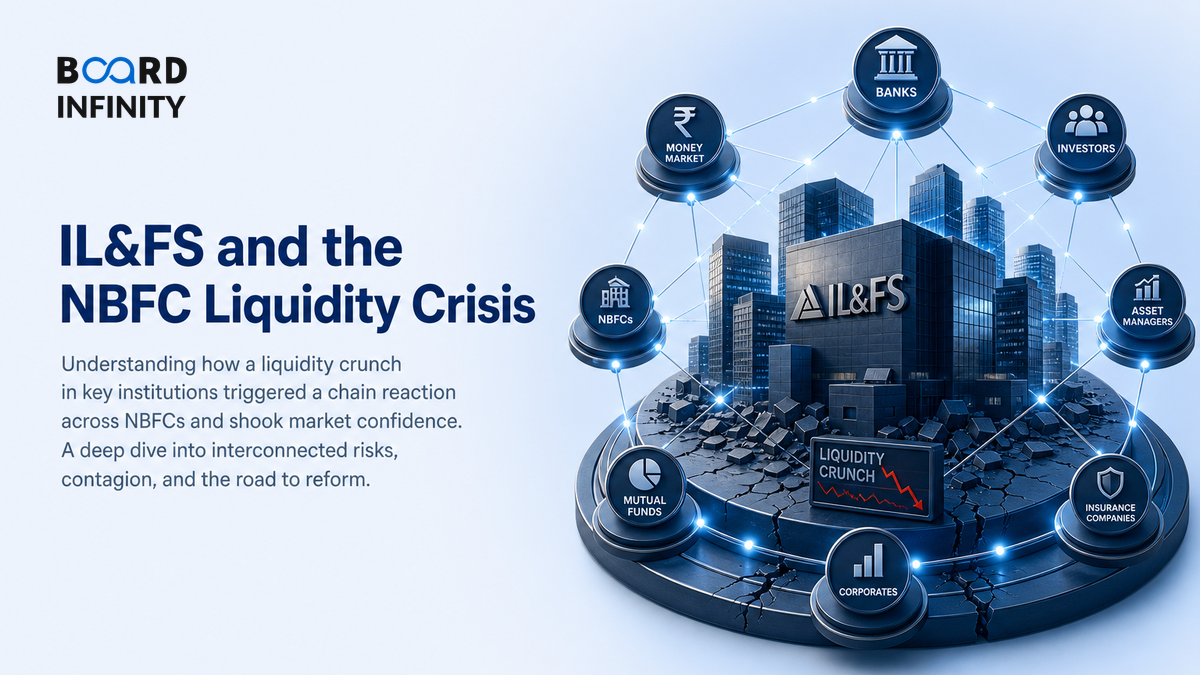
The biggest misconception about the IL&FS crisis is that it was simply a “bad loan” story. The real damage came from something more dangerous: lenders stopped trusting an entire funding model almost overnight.
- IL&FS defaulted in 2018 after years of funding long-gestation infrastructure assets with shorter-tenor borrowings.
- The crisis became systemic because many NBFCs depended on wholesale funding - commercial paper, NCDs, mutual funds and banks.
- Contagion happened through confidence, funding rollover, mark-to-market losses and forced deleveraging channels.
- The core weakness was asset-liability mismatch: long-term loans on the asset side, short-term repayment pressure on the liability side.
- Strong NBFCs survived by keeping liquidity buffers, diversified borrowing sources, granular secured loans and credible collections.
- For interviews, explain IL&FS as a liquidity contagion case, not just a corporate governance failure.
- The one metric to remember: LCR above 100% means the institution has enough high-quality liquid assets for a 30-day stress scenario.
The Big Picture: One Default Became a Trust Shock
IL&FS was an infrastructure finance group with complex subsidiaries, long-dated projects and heavy borrowing. When defaults surfaced in 2018, investors did not only ask, “Is IL&FS safe?” They asked, “Which other NBFC is hiding the same maturity mismatch?” That question turned a company-level default into a sector-level liquidity shock.
Core Explanation: Anatomy of the NBFC Liquidity Crisis
An NBFC crisis usually has two layers. The visible layer is missed payments. The hidden layer is the funding structure that makes missed payments contagious.
NBFCs borrow money and lend it onward. Unlike banks, they do not have the same large base of low-cost current and savings deposits. Many depend on market funding such as commercial paper, non-convertible debentures, bank loans, securitisation and mutual fund investments. That works when investors are confident. It becomes fragile when confidence breaks.
The Four Channels of Contagion
The crisis spread because IL&FS was not seen as an isolated borrower. It made investors question an entire category of financial assets.
Many Indian debt mutual funds held NBFC and infrastructure finance paper because it offered higher yields than safer instruments. After IL&FS, investors began scrutinising portfolio credit quality more closely, and SEBI later allowed side-pocketing so distressed securities could be separated from the main scheme portfolio. So what: the crisis proved that credit risk inside “debt” products can become a liquidity risk for investors.
Definitions You Must Be Able to Say Cleanly
- NBFC: A company whose principal business is financial activity, but which is not a bank.
- Liquidity risk: The risk of being unable to meet obligations when due without unacceptable losses.
- Asset-liability mismatch: A timing gap where liabilities mature before assets generate enough cash.
- Contagion: Stress transmission from one institution or market to others through exposure, pricing or confidence channels.
- Commercial paper: A short-term unsecured debt instrument used by companies to meet funding needs.
How to Diagnose an NBFC Liquidity Problem
In interviews, do not stop at “high debt.” Debt alone is not the issue. The question is whether cash inflows, funding access and asset quality can support that debt under stress.
Case Study: Cholamandalam Investment and Finance After the IL&FS Shock
Cholamandalam showed how a retail-focused NBFC could navigate a market-wide liquidity scare by relying on asset quality, diversified funding and collection discipline.

Situation: After IL&FS defaulted in 2018, investors became cautious about NBFCs that relied heavily on wholesale debt markets. Funding costs rose across the sector, and the market began separating stronger lenders from weaker ones.
The move: Cholamandalam’s resilience came chiefly from its granular secured lending book, especially vehicle and small business finance, where cash flows and collateral were easier to monitor than large infrastructure projects. This was supported by diversified borrowings, tighter liquidity management, parent-group credibility from the Murugappa Group and a strong focus on collections.
Outcome or lesson: The company still faced sector-wide funding pressure, but it was not seen in the same risk bucket as infrastructure-heavy or asset-quality-stressed lenders. The lesson is powerful: in a liquidity crisis, investors do not treat all NBFCs equally. They reward transparent assets, predictable collections, adequate capital and a liability profile that does not depend on one funding tap.
How AI Changes NBFC Liquidity Risk
AI does not remove liquidity risk, but it changes how early warning signals are detected and acted upon.
- Early-warning models: NBFCs can use machine learning to detect stress from repayment delays, bureau changes, bank-statement patterns, GST data and borrower cash-flow volatility before loans turn non-performing.
- Funding sentiment monitoring: LLMs can summarise rating actions, debt-market commentary, annual reports, concall transcripts and news to flag whether lenders are becoming cautious about a sector or company.
- Stress testing and ALM simulation: AI-assisted models can test scenarios such as “mutual funds stop rolling CP,” “cost of funds rises,” or “collections fall in one region” and show which maturity buckets break first.
Use NotebookLM: upload an NBFC annual report, investor presentation and recent rating rationale. Ask: “Map this NBFC’s liquidity risk using ALM gap, borrowing mix, asset quality and capital adequacy. Then generate five placement interview questions.”
Interview Relevance
“Explain how the IL&FS default created a liquidity crisis for NBFCs in India. Was it a solvency crisis, a liquidity crisis or both?”
If asked “Was it like Lehman?”, do not overclaim. Say both involved confidence contagion and funding freezes, but IL&FS was an Indian infrastructure-finance and NBFC-market shock with its own regulatory and market structure.
Common Mistake
Mistake: Saying “IL&FS failed because it had too much debt” and stopping there. That answer misses the mechanism. Fix: explain the chain - long-term infrastructure assets, short-term market borrowings, missed payments, investor fear, funding rollover freeze and sector-wide repricing.
What to Revise Next
Now move from NBFC contagion to two adjacent Indian financial-system stories: The Yes Bank Reconstruction and the Precedent It Set for bank resolution and depositor confidence, then Zerodha and the Economics of Discount Broking in India for how a very different financial-services model creates value without balance-sheet lending risk.