
Job Application Email: HR Writing Steps, Subjects & Samples
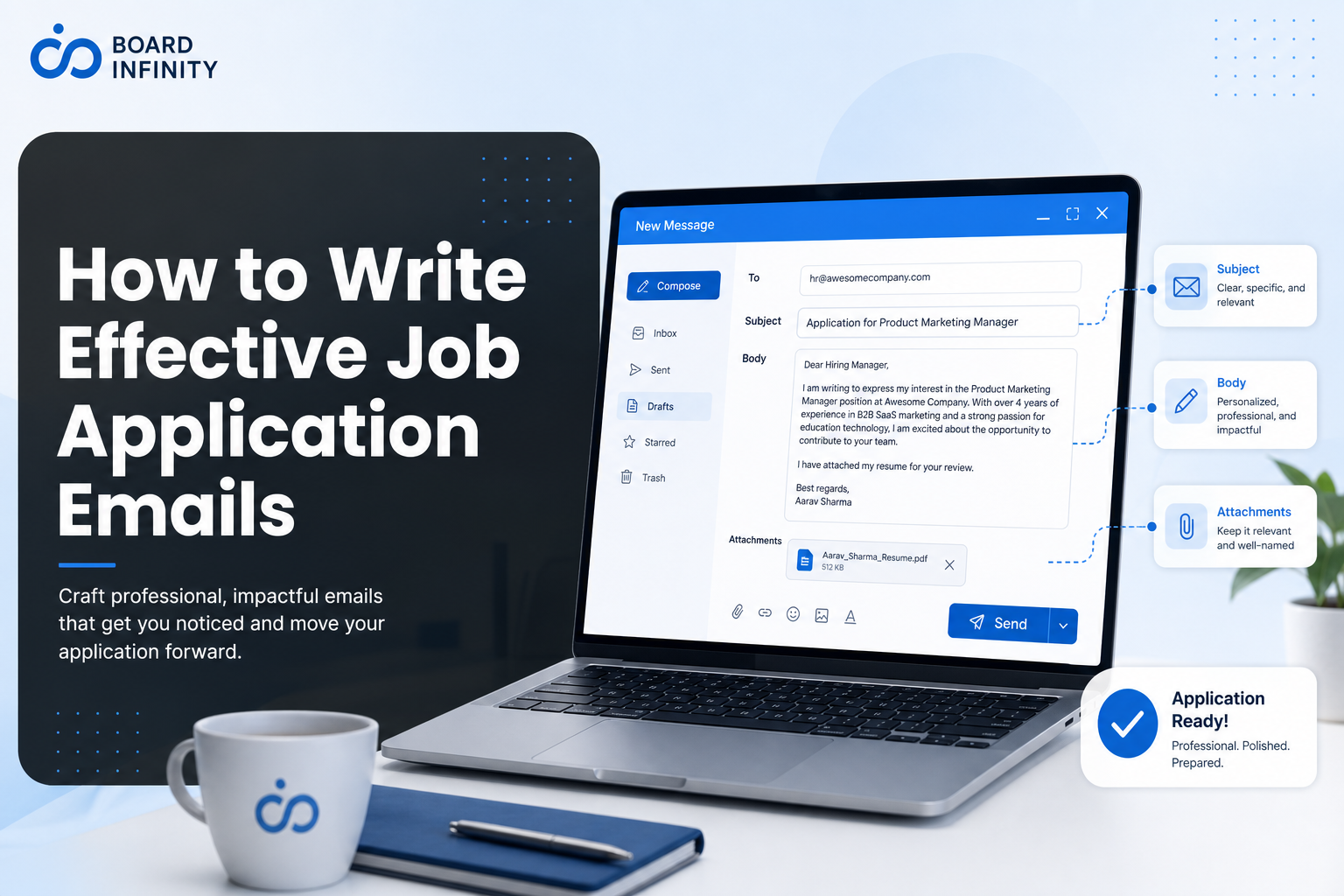
A job application email is a concise professional message sent to HR or a recruiter to express interest in a role and share your resume. It matters because your email often becomes the first screening signal before your resume is opened. After reading, you can write a clear, role-specific email that feels confident, relevant, and recruiter-friendly.
For intermediate and advanced candidates, the goal is not just correctness; it is positioning. A strong mail to HR for job opportunities connects the role, your evidence, and the next step in under a minute.
You will be able to choose the right subject line, structure your message, attach documents properly, personalise the email for a dream company, and use ready-to-edit samples for fresher, experienced, referral, and follow-up situations.
Who This Guide Is For
This guide is specifically designed for:
Core Concepts
A strong job application email has four jobs: reach the right inbox, make the role obvious, prove fit quickly, and make the next action easy. The format changes depending on whether you are replying to a posted vacancy, writing cold to HR, using a referral, applying as a fresher, or following up after submitting your resume.
1.Email Subject Lines
The email subject for job application should help HR understand the role, applicant name, and relevance before opening the email. Recruiters often scan crowded inboxes, so vague subjects such as “Job request” or “Resume” create extra work. A good subject line is specific, searchable, and aligned with the job posting. Use the role title exactly as published when available. If there is a job ID, include it. If you are referred, mention that only if the referrer has agreed.
Familiar example: “Application for Customer Success Associate, Riya Sharma, Bengaluru” is clearer than “Please find my CV”. Industry-specific example: “Application for Data Analyst, Risk Analytics, PAN Verification Products, Arjun Mehta” works well for a banking or fintech HR team because it signals both role and domain. For a SaaS company, “Product Marketing Manager, 5 Years B2B SaaS, Neha Iyer” gives HR the seniority and business context immediately.
2.Opening Context
The opening line should answer why you are writing and which opportunity you are targeting. HR should not have to guess whether you want an internship, full-time job, referral consideration, or general career guidance. If you are applying to a dream company, avoid emotional overstatement and replace it with specific reasons: product, mission, business area, technology, customer segment, or recent role fit.
Familiar example: “I am applying for the Business Analyst role listed on your careers page, and my recent work on UPI transaction dashboards matches the reporting responsibilities mentioned in the job description.” Industry-specific example: “I am writing to apply for the Clinical Operations Analyst role at your healthcare platform; my experience with patient appointment workflow analysis and SLA reporting aligns with the role requirements.” Both openings are stronger than “I want to work in your reputed company” because they give HR a clear role and a reason to continue reading.
3.Proof Of Fit
The middle of the email should prove fit with two or three relevant points, not repeat your entire resume. For advanced candidates, impact matters more than a long skill list. Use evidence such as revenue impact, cost reduction, process improvement, project scale, technical tools, stakeholder ownership, or domain knowledge. Freshers can use projects, internships, competitions, certifications, and measurable academic work.
Familiar example: a fresher applying to an e-commerce analyst role can mention, “Built a Python and SQL project analysing 50,000 product reviews to identify pricing and delivery complaints.” Industry-specific example: an experienced logistics candidate can write, “Managed route optimisation reporting across 18 city hubs and reduced manual exception tracking by 30% through dashboard automation.” The second line is not just a responsibility; it gives scope and result. That is what makes HR more likely to forward your profile to the hiring manager.
4.Attachments And Links
Your attachment strategy should make it easy for HR to open, save, and forward your profile. Attach your resume as a PDF unless the employer asks for another format. Use a clean file name such as “Ananya_Rao_Product_Analyst_Resume.pdf”. If you include a portfolio, GitHub, LinkedIn, Behance, Kaggle, or writing sample, place the link in the email body and ensure it is accessible without login issues.
Familiar example: a designer applying to a food-tech company can attach a resume and add one portfolio link showing mobile checkout redesigns. Industry-specific example: a cybersecurity applicant can attach a resume and include a GitHub or report link showing a vulnerability assessment lab, while avoiding confidential client data. Gmail allows attachments up to 25 MB; if your portfolio is heavier, use a clean cloud link with view permission enabled instead of sending large zipped files.
4.Call To Action
The closing lines should guide HR toward the next step without sounding pushy. A good call to action asks for consideration, offers availability, and shows readiness to share more information. Do not demand a reply, ask for salary details in the first application email unless instructed, or over-explain your personal circumstances. Your closing should be polite, confident, and brief.
Familiar example: “I would be glad to discuss how my operations analytics experience can support your marketplace team. I am available for a conversation this week.” Industry-specific example: “I would appreciate the opportunity to discuss how my experience in ed-tech funnel analysis and cohort reporting can support your growth team.” These closings work because they give HR a reason to schedule a conversation and maintain a professional tone.
5.Tone And Personalisation
Personalisation means showing that the email was written for this company and role, not mass-sent to hundreds of inboxes. Mention one relevant detail: product line, market, team, job requirement, domain, recent public initiative, or customer problem. Keep the tone professional even if the company culture feels casual. HR ko application kaise likhe can be understood simply: write with respect, clarity, and role-specific evidence.
Familiar example: for an ed-tech company, write, “Your focus on outcome-based learning for working professionals matches my experience in learner engagement analytics.” Industry-specific example: for a B2B cloud security firm, write, “The role’s focus on SOC workflows matches my previous work on alert triage dashboards and incident reporting.” Both lines are personalised, but neither uses flattery. That balance matters when writing to a dream company.
Best Email Format
Use this structure when you are unsure how to write a job application email. It works for most roles and can be adapted for freshers, experienced professionals, and career switchers.
- Subject: Role name, your name, and one key fit or job ID.
- Greeting: Use the HR name if known; otherwise use “Dear Hiring Team” or “Dear HR Team”.
- Opening: State the role and where you found it or why you are reaching out.
- Fit summary: Add 2 to 3 role-relevant proof points.
- Company connection: Mention one specific reason the company or team fits your career goal.
- Attachment note: Mention the resume and any relevant portfolio link.
- Call to action: Request consideration and offer availability.
- Signature: Include full name, phone number, email, LinkedIn, and portfolio if relevant.
1.Sample For Posted Role
Use this when you are applying to a specific opening from the company careers page, LinkedIn, Naukri, Instahyre, or a recruiter post.
Subject: Application for Product Analyst, Kavya Menon, SQL and Growth Analytics

Dear HR Team,

I am writing to apply for the Product Analyst role listed on your careers page. My experience in SQL-based funnel analysis, cohort reporting, and A/B test interpretation aligns closely with the responsibilities mentioned in the job description.

In my current role, I analyse user journeys for a subscription product and work with product managers to identify drop-offs, retention patterns, and experiment outcomes. I have also built dashboards that reduced weekly manual reporting effort for the growth team.

I am particularly interested in your company because of its focus on customer-first product decisions and data-backed experimentation. I have attached my resume for your review and would be glad to discuss how my experience can contribute to the team.

Thank you for your time and consideration.

Regards,
Kavya Menon
Phone: 98XXXXXXXX
Email: kavya.menon@email.com
LinkedIn: linkedin.com/in/kavyamenon
2.Sample Cold Email
Use this when there is no active job post but you want HR to consider your profile for a relevant team.
Subject: Application for Future Data Analyst Roles, Aman Verma, Fintech Analytics

Dear Ms. Shah,

I hope you are doing well. I am reaching out to explore suitable Data Analyst opportunities with your analytics or risk team.

I have 3 years of experience in fintech analytics, with hands-on work in SQL, Python, Power BI, and transaction monitoring dashboards. My recent work involved analysing payment failure patterns and improving reporting visibility for operations and risk stakeholders.

Your company’s work in digital financial services is closely aligned with my experience and long-term career direction. I have attached my resume and would appreciate it if you could consider my profile for current or upcoming roles, or forward it to the relevant recruiter.

Thank you for your time.

Regards,
Aman Verma
Phone: 99XXXXXXXX
Email: aman.verma@email.com
LinkedIn: linkedin.com/in/amanverma
3.Sample Referral Email
Use this only after the referrer has agreed that you can mention their name.
Subject: Referred Application for UX Researcher, Meera Nair, Referred by Rahul Sinha

Dear HR Team,

I am applying for the UX Researcher role and was referred by Rahul Sinha from your product team. He suggested that my experience in user interviews, usability testing, and research synthesis may be relevant for the role.

Over the past 4 years, I have led qualitative research for mobile-first consumer products, including onboarding studies, feature discovery research, and post-launch usability reviews. My work has helped product teams prioritise changes based on user behaviour and customer feedback.

I have attached my resume and included my portfolio link below for your review. I would be happy to discuss how my research experience can support your product team.

Regards,
Meera Nair
Phone: 97XXXXXXXX
Email: meera.nair@email.com
Portfolio: meera-uxportfolio.com
LinkedIn: linkedin.com/in/meeranair
4.Sample Fresher Email
Use this if you have limited work experience but strong projects, internships, coursework, or certifications.
Subject: Application for Software Engineer Intern, Rohan Kulkarni, Java and Spring Boot Projects

Dear Hiring Team,

I am a final-year B.Tech student applying for the Software Engineer Intern role. I have built academic and personal projects using Java, Spring Boot, REST APIs, MySQL, and Git.

My recent project was an appointment booking system with role-based login, doctor availability management, and booking confirmation workflows. I also completed a web development internship where I worked on API testing and bug fixes for internal tools.

I am interested in your engineering team because of its focus on scalable digital products and practical problem-solving. I have attached my resume and would be grateful for the opportunity to interview for this role.

Regards,
Rohan Kulkarni
Phone: 96XXXXXXXX
Email: rohan.kulkarni@email.com
GitHub: github.com/rohankulkarni
LinkedIn: linkedin.com/in/rohankulkarni
5.Sample Follow-Up Email
Use this after 5 to 10 business days if the job post did not specify a timeline. For detailed follow-up phrasing, use How to Write a Follow-up email after a Job Interview? when the follow-up is after an interview rather than after an application.
Subject: Follow-Up on Application for Marketing Manager, Priya Desai

Dear HR Team,

I hope you are doing well. I am following up on my application for the Marketing Manager role, submitted on 8 March 2026.

I remain very interested in the opportunity and believe my experience in performance marketing, campaign analytics, and cross-channel acquisition would be relevant to the team. Please let me know if any additional information is required from my side.

Thank you for your time and consideration.

Regards,
Priya Desai
Phone: 95XXXXXXXX
Email: priya.desai@email.com
LinkedIn: linkedin.com/in/priyadesai
Common Mistakes
Most weak application emails fail because they are unclear, too long, or too generic. Avoid these mistakes before sending your application to HR:
Learning Path
Use this path to move from a basic HR email to a polished application strategy for competitive roles and dream companies.
Frequently Asked Questions
What is a job application email?
A job application email is a professional message sent to HR, a recruiter, or a hiring team to apply for a specific role or request consideration for relevant openings. It usually includes the role name, a short fit summary, resume attachment, and a polite request for the next step.
How to write a job application email to HR?
Start with a specific subject line, greet the HR team professionally, mention the role, summarise your most relevant skills or achievements, and attach your resume. Close by thanking the recruiter and offering availability for a discussion.
What is the best email subject for job application?
The best subject line includes the role, your name, and a key identifier such as job ID, experience, or referral. Example: “Application for Business Analyst, Sneha Rao, Job ID BA204” or “Referred Application for Backend Engineer, Mohit Jain”.
Should I write a cover letter inside the email?
Do not paste a long cover letter unless the employer asks for it. The email body should be a short cover note with the strongest role-specific points, while the resume and formal cover letter can be attached if required.
Hr ko application kaise likhe professionally?
Professional HR application writing means using a clear subject, respectful greeting, exact role name, short skill summary, resume attachment, and polite closing. Avoid emotional requests and focus on how your skills match the company’s requirement.
Can I send the same email to multiple companies?
You can reuse the structure, but you should not send the same content without changes. Edit the role title, company-specific line, proof points, and subject line for every application.
When should I follow up after sending an application?
Wait 5 to 10 business days unless the job post gives a specific response timeline. A follow-up should be brief, polite, and connected to the original application date and role.
What should I attach with the email?
Attach your updated resume as a PDF unless the employer asks for another format. Add portfolio, GitHub, LinkedIn, writing samples, or case studies only when they strengthen your application and the links are accessible.
Interview Preparation
Job application emails are not usually tested like technical questions, but they directly affect HR screening and interview shortlisting. Recruiters look for clarity, relevance, professionalism, and consistency between your email, resume, and interview answers.
Conceptual Questions
- Why does the subject line matter in a job application email? It helps HR identify the role, applicant, and priority quickly. A specific subject also makes the email searchable when recruiters shortlist or forward profiles internally.
- What is the difference between a job application email and a cover letter? A job application email is usually shorter and acts as the message carrying your resume. A cover letter is a fuller document that explains motivation, fit, and achievements in more detail.
- Why should the email be customised for each company? Customisation shows that you understand the role and are not mass-applying blindly. Even one relevant line about the product, team, or job requirement can improve credibility.
- What makes an application email professional? A professional email is clear, concise, respectful, role-specific, and free from spelling errors. It also uses proper attachments, a clean signature, and a practical call to action.
Applied Questions
- How would you write to HR if there is no job opening listed? Send a cold application email naming the function you are targeting, summarising your strongest fit, and requesting consideration for current or upcoming roles. Do not ask HR to find “any job” for you.
- How should a fresher compensate for lack of experience? A fresher should highlight projects, internships, tools, certifications, competitions, and problem-solving ability. The email should connect these proof points to the role requirements.
- How should an experienced candidate show impact? Use measurable outcomes such as revenue growth, cost savings, automation, process improvement, team ownership, or scale. Avoid listing only tools without business context.
- How do you follow up without sounding impatient? Wait a reasonable period, refer to the role and application date, restate interest in one sentence, and ask if more information is needed. Keep the follow-up shorter than the original email.
Key Takeaways
A strong job application email has a specific subject line, a direct opening, 2 to 3 proof points, clean attachments, and a polite call to action. The best emails are short enough for HR to scan quickly but specific enough to show genuine fit for the role and company.
For interviews and HR screening, the most tested points are clarity of role interest, evidence of fit, reason for applying to the company, resume consistency, and professional follow-up behaviour. Your email should support the same story you will tell in the interview.
If you're considering additional support, working with a native reflective essay writer can also help refine your writing style and ensure your email leaves a lasting impression.