
AI Governance in the Indian Financial Ecosystem
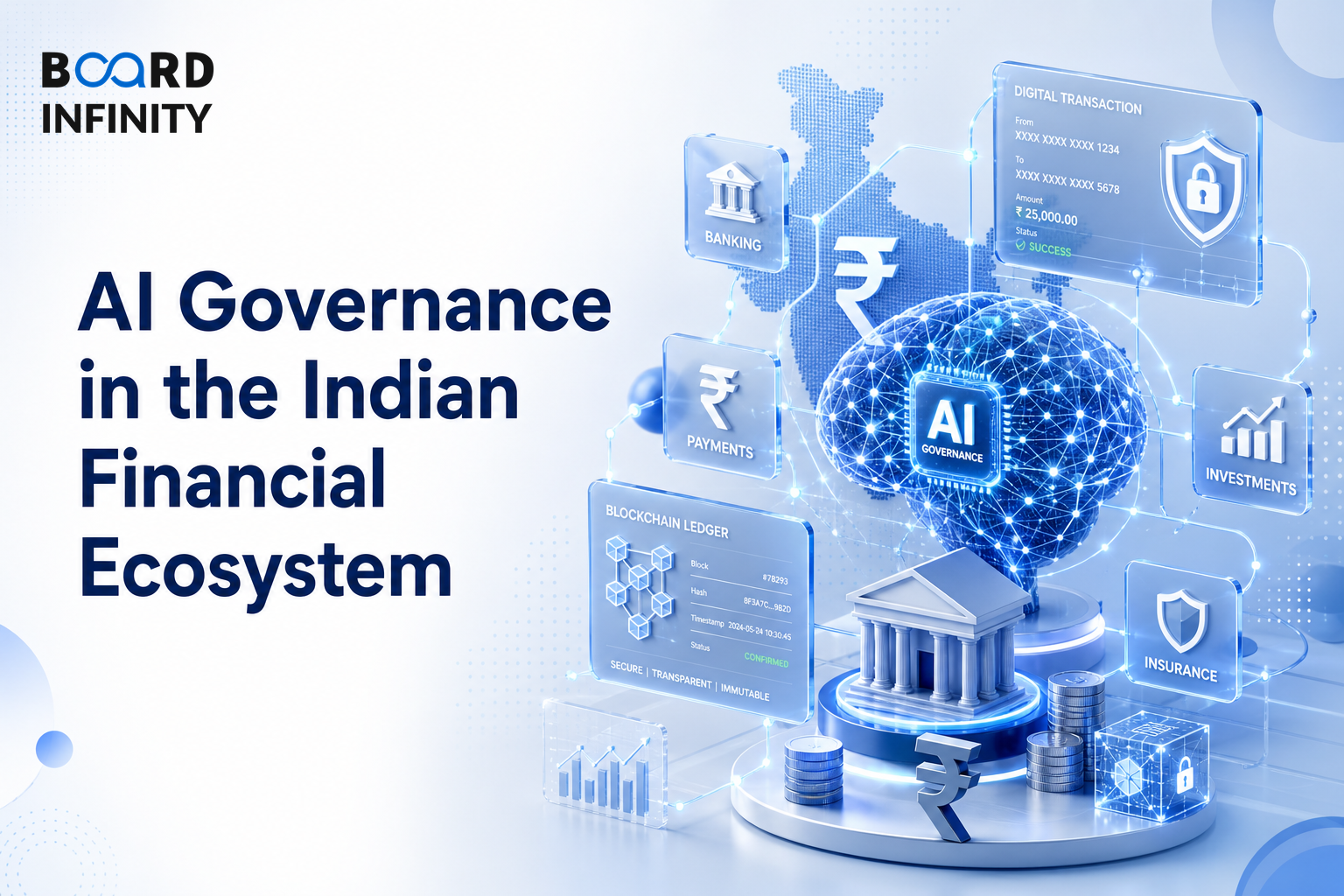
Artificial Intelligence is no longer a side experiment in Indian finance. The Reserve Bank of India, Securities and Exchange Board of India, National Payments Corporation of India, BSE, NSE, HDFC Bank and Zerodha are all using or governing AI in ways that affect credit, trading, payments, fraud detection and investor protection. For interviews, this topic matters because it tests whether you can connect technology adoption with regulation, market integrity and practical business risk.
- India’s financial AI ecosystem is best understood as four layers: regulators, exchanges, payment infrastructure and market-facing banks or fintech platforms.
- RBI has focused on AI in finance through its Report on Currency & Finance 2022-23 and draft AI governance guidelines for banks covering model risk management and explainability.
- SEBI has regulated algorithmic trading since 2008 and its 2023 circular requires SEBI registered Investment Advisers using AI to disclose their methodology.
- NPCI uses machine learning for real-time UPI fraud detection across 14 billion+ monthly transactions and reports a UPI fraud rate below 0.002%.
- BSE and NSE use AI for market surveillance, risk management and natural language processing of corporate announcements to detect manipulation and unusual patterns.
- HDFC Bank’s EVA chatbot and MSME loan underwriting, and Zerodha’s Nudge system, show how AI is being used for customer service, credit speed and retail risk warnings.
- A strong interview answer should balance adoption with caution: AI improves speed and surveillance, but it also creates model risk, explainability and governance questions.
At a big-picture level, the Indian financial ecosystem is not one AI story. It is a layered system where different institutions use AI for different jobs, and regulators set guardrails around explainability, disclosure and surveillance.
Context: AI Is Being Adopted, But Not Without Guardrails
Artificial Intelligence, or AI, means systems that perform tasks requiring human-like judgement, such as pattern detection, language understanding or decision support. In finance, AI is used in areas such as fraud detection, credit underwriting, algorithmic trading surveillance, customer service and investor warning systems.
The source shows a clear pattern: Indian institutions are not merely adopting AI for efficiency. They are also building governance around it. The same ecosystem that uses machine learning to screen UPI transactions also expects banks to document model risk and expects AI-based advisers to disclose methodology.
RBI: AI Governance for Banks
RBI, the Reserve Bank of India, appears in the source as the central institution framing AI governance for banking. Its Report on Currency & Finance 2022-23 was devoted to AI in finance, and it also issued draft guidelines on AI governance for banks.
The key governance ideas are model risk management and explainability. Model risk management means documenting how an AI model works, where it can fail and how it is monitored. Explainability means that an institution should be able to explain why a model reached a decision, especially in sensitive use cases such as credit decisions.
This matters in interviews because banking AI cannot be discussed only as automation. If an AI model affects loan approval, turnaround time or credit access, the bank needs controls around accuracy, fairness, documentation and explainability.
RBI’s AI focus is visible in its Report on Currency & Finance 2022-23 and in draft guidelines on AI governance for banks. The practical impact is that banks using AI in credit decisions must document model risk and support explainability, so the strategic point is that speed in lending must be matched with accountable decision-making.
SEBI: AI in Markets, Advisory and Surveillance
SEBI, the Securities and Exchange Board of India, is the capital markets regulator. The source highlights three important AI-related areas: algorithmic trading regulation since 2008, the 2023 circular on AI-based advisory, and AI-enabled surveillance through the Integrated Market Surveillance System, or IMSS.
Algorithmic trading means using computer programs to place trades based on predefined rules. The source states that 50%+ NSE volumes are algorithm-driven, so market regulation must account for speed, automation and unusual trading behaviour.
SEBI’s 2023 circular on AI-based advisory is also important. SEBI registered Investment Advisers using AI must disclose their methodology. In interview terms, this shows that AI can support advisory, but investors need to understand the basis on which recommendations are being generated.
Machine learning, or ML, is a branch of AI where systems learn patterns from data. In SEBI’s surveillance context, ML helps flag unusual trading patterns that may require further investigation. The nuance is important: AI flags risk signals, but the governance value comes from how the institution investigates, documents and acts on those signals.
NPCI: AI at UPI Scale
NPCI, the National Payments Corporation of India, is central to India’s payment infrastructure. The source says NPCI uses ML for real-time UPI fraud detection, screening 14 billion+ monthly transactions. UPI, or Unified Payments Interface, is the digital payments system where real-time fraud monitoring becomes critical because of very high transaction volume.
The source also mentions NPCI Bharat BillPay using AI for dispute resolution. The impact is significant: the UPI fraud rate was reduced to below 0.002% despite massive volume. This is a strong example of AI being used not just for productivity, but for payment security and trust.
NPCI screens 14 billion+ monthly UPI transactions using machine learning for real-time fraud detection. The reported outcome is a UPI fraud rate below 0.002%, so the strategic point is that AI helps preserve trust in digital payments when manual review cannot match transaction scale.
BSE and NSE: Exchange Surveillance and Risk Management
BSE and NSE are major Indian exchanges. The source mentions BSE’s AI-powered market surveillance initiative, Project SMART, and NSE’s use of AI for risk management at its clearing corporation. It also states that both exchanges use natural language processing, or NLP, for corporate announcement analysis.
NLP means AI techniques used to process and interpret human language. In this case, corporate announcements can be analysed for signals that may matter to market surveillance. The stated impact is early detection of market manipulation, circular trading and coordinated pump-and-dump schemes.
The interview nuance is that exchanges are not using AI only to make trading faster. They are using it to make markets safer, especially where suspicious patterns may be difficult to identify manually at scale.
HDFC Bank and Zerodha: Customer-Facing AI in Action
HDFC Bank and Zerodha show the business-facing side of AI adoption. HDFC Bank’s EVA, or Electronic Virtual Assistant, is described as India’s first AI-powered banking chatbot. It has handled 100M+ queries and handles 90%+ routine banking queries without human intervention.
HDFC Bank also uses AI-based credit underwriting for MSME loans. MSME means micro, small and medium enterprises. The source says MSME loan turnaround reduced from 15 days to 59 minutes, showing how AI can directly change customer experience and operating efficiency.
Zerodha’s Kite platform uses Nudge, an AI-powered behavioural nudge system that warns retail traders about high-risk F&O trades in real time. F&O means futures and options. SEBI cited Zerodha’s nudge system as a best practice in its 2023 study on F&O trader profitability.
Worked Example: HDFC Bank MSME Loan Underwriting
A complete case answer should move from situation to decision, not just list the technology. HDFC Bank’s MSME loan example is useful because it links AI to customer value, operating efficiency and governance expectations.
The strategic takeaway is that AI is valuable when it solves a defined financial problem. In this example, the problem was not “need AI”; it was slow MSME credit turnaround. AI mattered because it changed the decision cycle from days to minutes.
AI Tools for Finance Careers
The source also gives a practical placement angle. Finance students are advised to master three AI-linked tools before placement season: ChatGPT or Claude for drafting financial memos, debugging Python or Excel, and practicing interview Q&A; Python plus pandas for financial data analysis; and Bloomberg or Refinitiv if the campus has access.
Python is a programming language, and pandas is a Python library used for data manipulation and analysis. The source notes that even basic screener.in data manipulation can set a candidate apart. Bloomberg and Refinitiv are market data platforms, and using them daily where access exists signals readiness for Day 1 productivity.
Structuring a The Indian Financial Ecosystem Interview Answer
"How are Indian financial regulators and institutions using AI, and what risks are they trying to control?"
The best answers do not say “AI will transform finance” and stop there. They map each AI use case to a financial risk: credit risk at banks, market manipulation at exchanges, fraud in payments, and retail trading losses on platforms.
Conclusion
The Indian financial ecosystem is adopting AI through a balanced model: regulators are tightening governance, exchanges are improving surveillance, payment networks are securing scale, and banks and fintech platforms are changing customer experience. For interviews, the final takeaway is simple: explain both the productivity upside and the risk-control architecture.
The most frequent error is treating AI in finance as a generic technology trend instead of a regulated ecosystem question. That costs points because interviewers expect you to connect RBI, SEBI, NPCI, BSE, NSE, HDFC Bank and Zerodha to specific governance, surveillance, payment security and risk-control use cases.