
Jio Financial Services: The New Challenger Case Study
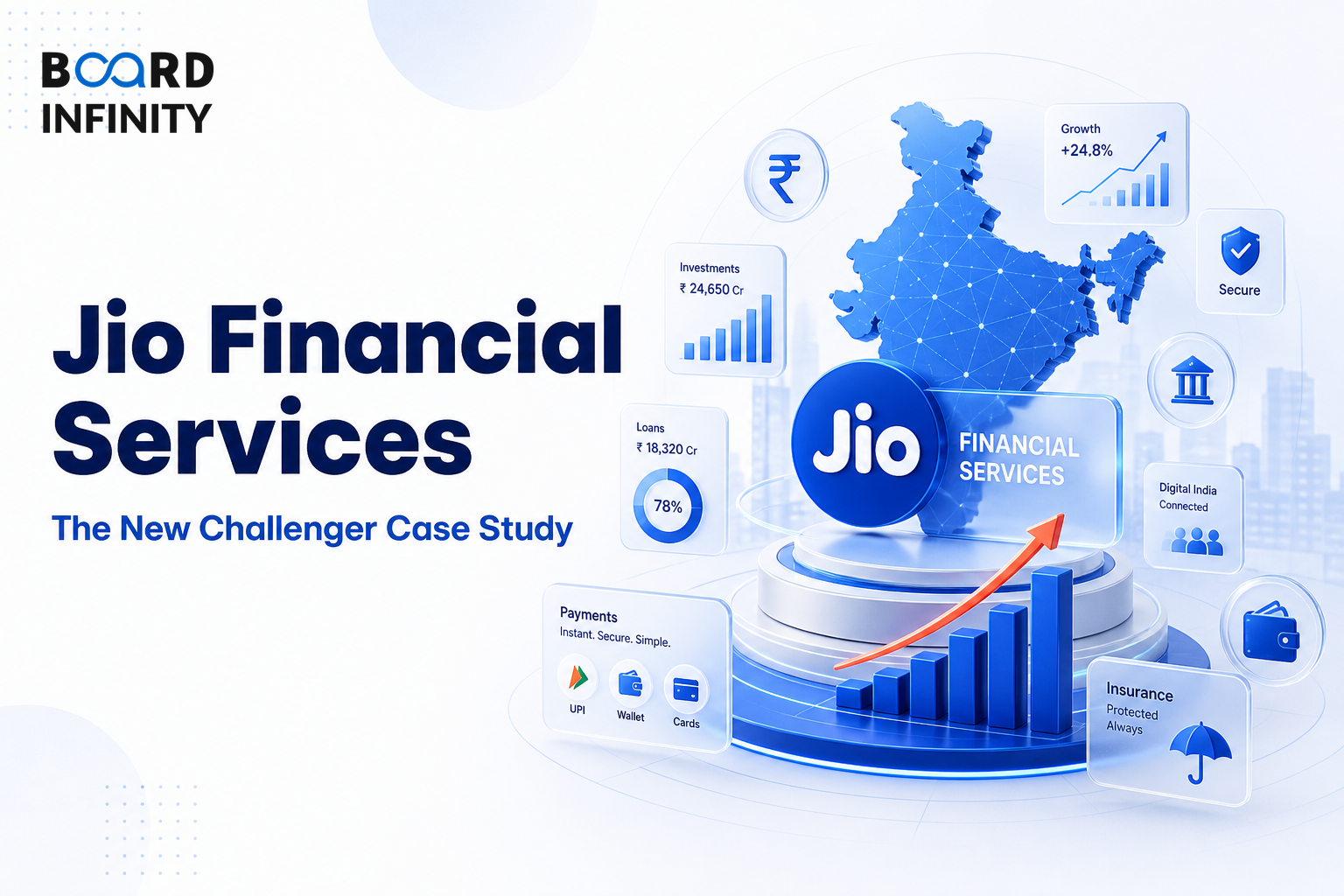
The HDFC-HDFC Bank merger showed how scale can consolidate an existing financial franchise. Jio Financial Services asks the opposite question: can Reliance Industries create a financial services challenger almost from scratch by using Jio's distribution, data, and ecosystem reach? This case matters in interviews because it tests whether you can separate a powerful strategic moat from an execution-heavy business model and a valuation that priced in success early.
- Reliance Industries Ltd. demerged Jio Financial Services in August 2023 and listed it separately on NSE and BSE with an initial market cap of about ₹1.6 lakh crore.
- The bull case is strong distribution: access to 450 million+ Jio telecom users creates a zero marginal distribution cost advantage versus Bajaj Finance's ₹800-95,000 customer acquisition cost per customer.
- If JFS converts even 5% of Jio users into financial product customers, that equals 22.5 million customers, which the source frames as instant Top 5 NBFC scale.
- The data advantage comes from Jio telecom data such as call patterns, data usage, and location, which can support alternative credit scoring for thin-file borrowers excluded from traditional CIBIL scoring.
- The bear case is execution: JFS started with zero lending assets, and building underwriting, collections, and risk management can take 3-5 years; Bajaj Finance took 10+ years to build its current risk engine.
- The listing valuation was pure optionality: ₹1.6 lakh crore for no revenues, no loan book, and no AMC AUM, while Bajaj Finance traded at ₹4.5 lakh crore with ₹3.5 lakh crore AUM.
- A practical view is to monitor JFS for 2-3 years and re-evaluate when its loan book reaches ₹50,000 crore and AMC reaches ₹1 lakh crore AUM.
From Financial Consolidation to a New Challenger
Jio Financial Services is not just another financial stock listing. It is the demerged financial services arm of Reliance Industries Ltd., with a Non-Banking Financial Company, or NBFC, licence and access to Jio's 450 million+ customer base. An NBFC is a financial institution that can provide credit and financial products without being a full bank; in this case, JFS can use the licence to enter lending while building other financial services adjacencies.
The core interview issue is not whether the Jio ecosystem is large. It clearly is. The sharper question is whether size, data, and distribution can be converted into profitable lending, asset management, and potentially insurance businesses under regulatory scrutiny.
Use the case through five lenses: distribution, data, execution, regulation, and valuation.
What JFS Actually Had on Day One
Jio Financial Services was separately listed on NSE and BSE in August 2023 after being demerged from Reliance Industries Ltd. The listing was notable because the company had strategic assets, but not yet the operating financial base that established lenders usually have. Its initial market cap was around ₹1.6 lakh crore.
The three most important starting points were an NBFC licence, access to Jio's 450 million+ customer base, and a joint venture with BlackRock for an Asset Management Company, or AMC. An AMC manages investment products and its Assets Under Management, or AUM, represent the total money it manages for clients.
The Bull Case: Distribution and Data
The clearest argument in favour of JFS is distribution. The source highlights access to 450 million+ Jio telecom users and describes the marginal distribution cost as zero, compared with Bajaj Finance's ₹800-95,000 Customer Acquisition Cost, or CAC, per customer. CAC means the cost incurred to acquire one customer; in lending and financial services, lower CAC can materially improve scalability if credit losses are controlled.
The scale math is powerful. If JFS captures even 5% of Jio users as financial product customers, it would reach 22.5 million customers, which the source describes as instant Top 5 NBFC scale. This is why interviewers expect candidates to discuss JFS as more than a normal NBFC entrant.
The data angle adds to the bull case. Jio's telecom data, including call patterns, data usage, and location, can support alternative credit scoring for thin-file borrowers. A thin-file borrower is someone with limited formal credit history, and the source notes that such borrowers can be excluded from traditional CIBIL scoring; CIBIL is a credit bureau score commonly used by lenders to assess repayment behaviour.
The Bear Case: Execution and Regulation
The biggest mistake in this case is assuming that distribution automatically creates a lending franchise. JFS had no loan book on Day 1. According to the source, building a credit underwriting engine, collections infrastructure, and risk management from scratch takes 3-5 years, while Bajaj Finance took 10+ years to build its current risk engine.
This matters because lending is not only about issuing loans. It is about selecting borrowers, pricing risk, collecting repayments, and managing losses across cycles. The source even frames Paytm as a warning in the two-minute interview answer: building a credit business from zero is harder than it looks.
- Underwriting risk: JFS must convert alternative data into reliable credit decisions.
- Collections risk: It must build infrastructure to collect repayments at scale.
- Regulatory risk: RBI scrutiny on Big Tech entry into banking is a global trend identified in the source.
- Approval risk: SEBI approval is needed for AMC and IRDAI approval is needed for insurance.
- Coordination risk: JFS may need to manage multiple regulatory relationships at the same time.
Jio Financial Services: The Full Framework in One Business
JFS demonstrates the full challenger framework because it combines a real distribution moat with an unproven operating model. A shallow answer says it will disrupt finance because Jio has users. A complete answer asks how those users become profitable financial customers under credit, regulatory, and valuation constraints.
The takeaway is simple: JFS is strategically promising, but interview answers must separate business potential from proven financial performance.
Value JFS as a five-year option: distribution moat plus data advantage plus BlackRock AMC potential, discounted for execution risk, regulatory approvals, and the absence of current revenues, loan book, or AMC AUM at listing.
Worked Example: Reading the Listing Valuation
Suppose an interviewer asks whether JFS was a genuine disruptor or just a valuation exercise by Reliance Industries. The best answer should not take an extreme position. It should show why the market saw a large opportunity while also explaining why the valuation required future execution to catch up.
This is the cleanest case-interview conclusion: the Jio ecosystem makes the opportunity real, but the listing valuation priced in success before the operating business had proved itself.
How to Read the Milestones
The source recommendation is not to ignore JFS, but to monitor it for 2-3 years. The two milestones given are a ₹50,000 crore loan book and ₹1 lakh crore AMC AUM. At those levels, fundamental re-rating becomes easier to justify because the business would have moved from optionality to measurable financial scale.
Structuring a Case Study Interview Answer
"Is Jio Financial Services a genuine disruptor in Indian finance or mainly a valuation exercise by Reliance Industries?"
The strongest answer values JFS as a five-year option, not as a current-year earnings stock. Candidates score better when they say the distribution moat is real but the credit engine, regulatory approvals, and AUM scale still need proof.
Conclusion
Jio Financial Services is a high-potential challenger because Reliance Industries brings Jio distribution, telecom data, and a BlackRock AMC path into financial services. But the case is execution-heavy: the listing valuation priced in future success before revenues, loan book, or AMC AUM existed, so the right answer is optimistic on the opportunity and disciplined on valuation.
The most frequent error is saying JFS will automatically disrupt finance because Jio has 450 million+ users. That ignores the hard part of lending: underwriting, collections, risk management, and regulation. In interviews, this costs points because it confuses distribution reach with a proven financial services franchise.