
Union Budget Analysis Framework for Finance Students
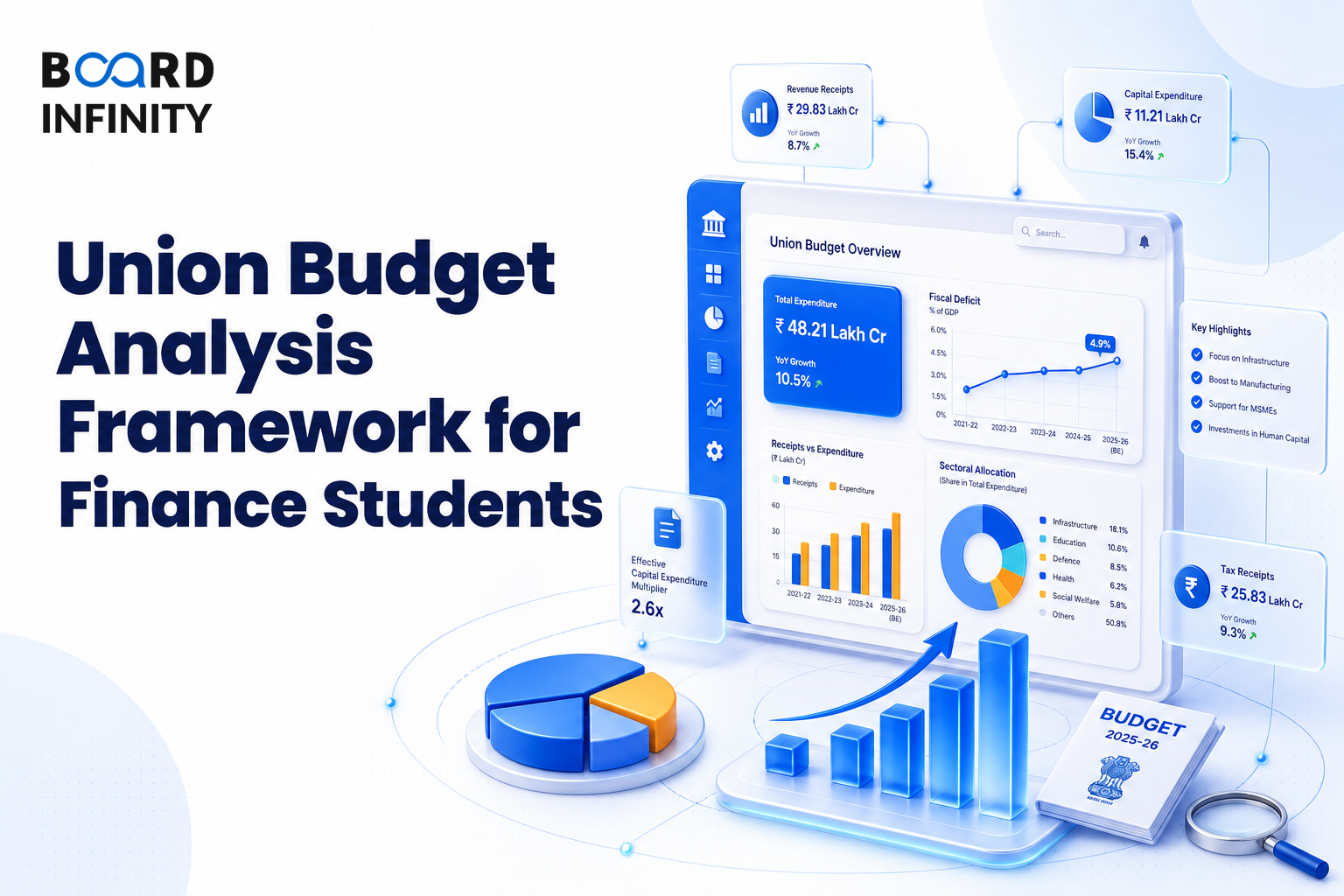
After understanding Government Policies & Regulatory Updates Impacting Finance, the next interview challenge is not just knowing that a policy changed, but analysing what it means under ambiguity. A Union Budget prompt in a finance interview is usually a test of structure: can you break a broad policy or finance-case question into clear buckets, support your view with numbers, and end with a recommendation. Top-tier finance interviews such as Goldman Sachs, JPMorgan, McKinsey and Avendus reward this structured thinking because it shows consulting and banking readiness.
- MECE means Mutually Exclusive, Collectively Exhaustive - no overlap between buckets, and no major part of the problem left uncovered.
- A strong finance-case answer is top-down: start with a hypothesis before going into details.
- The best analysis is data-driven: use numbers such as gross margin falling 300 bps YoY to explain what changed and why.
- The standard finance-case flow has four parts: Situation, Analysis, Synthesis and Recommendation.
- For a Union Budget or policy prompt, do not jump to the answer; first structure the problem into logical buckets that the interviewer can follow.
- A recommendation must be specific, actionable and prioritised, such as divesting loss-making SKUs or renegotiating supplier contracts.
The Big Picture: Budget Analysis as a Finance Case
A Union Budget analysis framework for finance students is less about memorising scattered points and more about building a repeatable answer structure. In interviews, the prompt may be broad, but your response should move from problem framing to MECE analysis, then to synthesis and action.
“Let me break this into three buckets: revenue, costs and capital efficiency. Starting with revenue, I will test whether the issue is volume, pricing or mix, then move to costs and finally evaluate capital efficiency before recommending an action.”
What MECE Means and Why It Matters
MECE stands for Mutually Exclusive, Collectively Exhaustive. Mutually Exclusive means your buckets do not overlap; Collectively Exhaustive means your buckets together cover the full problem. In a finance case, this prevents double counting, missed drivers and unclear recommendations.
The source example is a profitability tree: revenue and cost should be separate buckets because revenue is not the same as cost. Similarly, sources of value can be framed as organic, inorganic and financial engineering, which helps cover all major possibilities without mixing them.
For finance students, this is especially useful in Union Budget discussions because such questions can feel open-ended. A MECE structure gives the interviewer confidence that you are not randomly reacting to announcements; you are building a logical path from problem to answer.
Top-Down Thinking: Start With a Hypothesis
Top-down thinking means beginning with a likely explanation and then testing it, rather than collecting facts without direction. The source example is: “Profitability is low because margins are compressed.” This is not the final answer; it is a hypothesis that guides the next part of the analysis.
In a finance interview, top-down thinking matters because time is limited. The interviewer wants to see how you think in the first few seconds. A strong opening might be: “My initial hypothesis is that the issue is margin compression, but I would like to test this across revenue, costs and capital efficiency.”
The nuance is that a hypothesis should not become a bias. If the numbers do not support margin compression, you should change direction. Interviewers typically reward candidates who use hypotheses to structure analysis, not candidates who force-fit data into a pre-decided answer.
Data-Driven Analysis: Turn Observations Into Evidence
Data-driven analysis means using numbers to support your reasoning. The source gives a clear example: “Gross margin fell 300 bps YoY - why?” Here, bps means basis points, and YoY means Year-on-Year. The number gives the interviewer something concrete to investigate.
This matters because finance interviews are not general discussions. A vague answer such as “margins are under pressure” is weaker than saying, “Gross margin fell 300 bps YoY, so I would investigate whether the decline came from pricing, input costs or product mix.” The second answer shows both numerical discipline and structure.
- Observation: Gross margin fell 300 bps YoY.
- Question: Why did the margin fall?
- Structure: Test revenue drivers, cost drivers and capital efficiency.
- Decision: Recommend the highest-impact action after identifying the key cause.
The common nuance is that data should support your structure, not replace it. Numbers without buckets become a list; buckets without numbers become theory. A strong finance answer needs both.
Action-Oriented Recommendations
An action-oriented answer ends with a clear recommendation. The source example is: “Divest loss-making SKUs, renegotiate supplier contracts.” Here, SKU means Stock Keeping Unit, a specific product or product variant tracked for business decisions.
This recommendation is strong because it is specific and operational. It does not say “improve profitability” in a generic way. It names two actions: divesting products that are losing money and renegotiating supplier contracts to address cost pressure.
In interviews at Goldman Sachs, JPMorgan, McKinsey or Avendus, this is the difference between sounding informed and sounding ready for client or investment work. The best candidates do not just analyse; they decide.
The 4-Part Finance Case Structure
The source gives a simple four-part structure: Situation, Analysis, Synthesis and Recommendation. This works well for Union Budget or finance-case analysis because it prevents the answer from becoming a scattered commentary.
The timing is useful because it mirrors how interviewers evaluate ambiguity. If you spend too long in the situation stage, you may look slow. If you skip analysis and jump to recommendation, you may look unstructured. The flow creates a disciplined path from understanding to action.
Worked Example: Margin Compression Case
Consider a finance-case prompt where profitability is low. The candidate starts with a top-down hypothesis: profitability is low because margins are compressed. The next step is not to recommend immediately, but to test the hypothesis using a MECE structure and data.
The key learning is that the candidate does not claim certainty too early. The recommendation comes after the structure and data have identified the core issue. That is exactly the discipline expected in finance and consulting-style interviews.
Using the Framework for Union Budget Prompts
A Union Budget prompt can be treated like an ambiguous finance case. Instead of reacting with disconnected points, start by clarifying the objective, then structure the answer into MECE buckets that fit the question. The source does not provide specific Budget line items, so the practical lesson here is the interview method rather than a list of fiscal facts.
For example, if the interviewer asks how to analyse a Budget-related development for a company, sector or market, your first move should be to frame the problem. Then you can analyse the impact through logical, non-overlapping drivers, synthesize the main implication and recommend a prioritised action.
This is why the same framework travels well across Goldman Sachs, JPMorgan, McKinsey and Avendus interviews. The interviewer is not only testing what you know; they are testing whether your thinking remains organised when the question is broad.
Structuring a Union Budget Analysis Framework for Finance Students Interview Answer
"How would you structure an analysis of a Union Budget announcement for a finance case interview?"
The fastest way to signal interview readiness is to verbalise your structure before solving: “Let me break this into three buckets: revenue, costs and capital efficiency. Starting with revenue…” This tells the interviewer that you can handle ambiguity in a disciplined way.
Conclusion
A strong Union Budget analysis framework for finance students is a structured case-thinking method: define the situation, analyse through MECE buckets, use numbers, synthesize the core issue and recommend action. In top-tier interviews, the candidate who can make ambiguity easy to follow usually has the stronger answer.
The most frequent mistake is jumping straight to the answer. It costs points because interviewers reward structured thinking, not just speed. Always show the path: situation, MECE analysis, synthesis and recommendation.