
Linking Performance to Pay, Promotion & Progression - Interview-Ready HR Framework
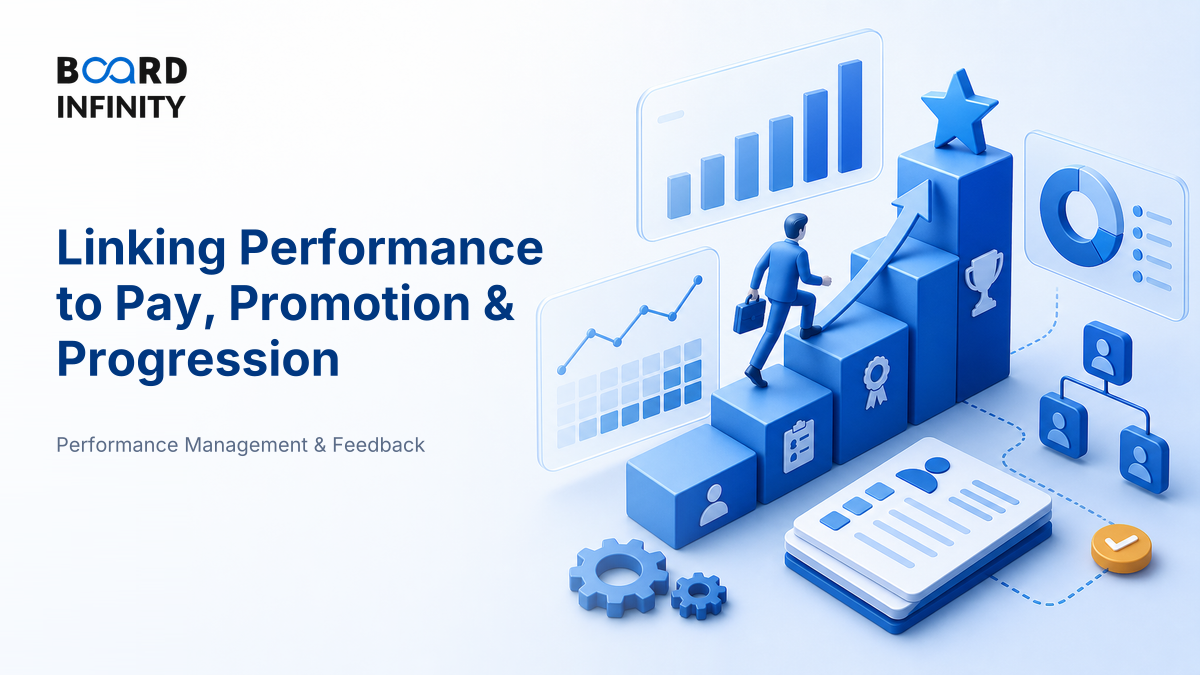
On appraisal day, two employees may both hear, “You did well” - but one gets a higher bonus, one gets a new role, and one gets only a development plan. The difference is not just performance; it is how the organisation translates performance into pay, promotion and progression.
- Performance-to-pay links measured contribution to rewards such as salary increments, bonus, incentives, ESOPs or recognition.
- Promotion is not a reward for past performance alone; it also requires readiness for a larger role, role availability and business need.
- Progression is broader than promotion - it includes skill growth, expanded scope, lateral moves, leadership tracks and career mobility.
- The cleanest system separates three questions: “How did you perform?”, “What reward does that earn?” and “What role are you ready for next?”
- Calibration is critical because managers rate differently; without it, pay and promotion decisions feel unfair.
- Good HR answers mention metrics: compa-ratio, bonus differentiation, promotion rate, high-performer retention, pay equity gap and productivity per FTE.
- The biggest trap is saying “high rating equals promotion” - strong candidates explain performance, potential and role readiness separately.
Big Picture: Performance Is the Input, Rewards Are the Output
Think of the process as a funnel. Many employees set goals and generate performance evidence, but only some outcomes convert into higher pay, fewer into promotion, and even fewer into accelerated leadership progression.
Core Explanation: How Pay, Promotion and Progression Differ
The concept becomes simple when you separate the three outcomes. Pay answers “What should this contribution earn?” Promotion answers “Can this person handle a bigger role?” Progression answers “How should this career grow over time?”
A mature system does not mechanically convert ratings into rewards. It uses performance as a major input, then adjusts for role criticality, pay range, skill scarcity, internal fairness and future potential.
The Practical Framework: From Rating to Reward
Use this five-step logic whenever you are asked how a company should link performance to pay, promotion or progression.
The separation in Step 4 is the heart of the topic. A top performer may deserve a strong bonus but not a promotion if the next role requires people leadership they have not yet demonstrated. Similarly, a high-potential employee may receive a stretch assignment before a formal title change.
The Performance-Potential Matrix
Promotion and progression decisions often use a performance-potential view. Performance shows current contribution; potential or readiness shows ability to succeed at larger scope.
This is why two employees with similar ratings may receive different outcomes. One may get higher variable pay because they delivered results; another may get a developmental move because they show future leadership potential.
Metrics to Track Whether the Link Is Fair and Effective
Interviewers like candidates who can move from concept to measurement. These metrics help HR test whether performance-linked rewards are motivating people, retaining talent and staying fair.
Do not overclaim a universal “best” number. HR metrics depend on industry, role mix, labour market and reward philosophy. The smarter answer is to state the formula, the direction of improvement and the fairness check.
Definitions
- Performance appraisal - Gary Dessler: “evaluating an employee’s current and/or past performance relative to his or her performance standards.”
- Pay-for-performance - A reward approach where compensation varies with measured individual, team or organisational performance.
- Promotion - Movement to a higher-level role, grade or responsibility band, usually with greater scope and accountability.
- Career progression - Planned growth in skills, scope, responsibility and career opportunities over time.
Indian Example: Variable Pay in IT Services
Indian IT services firms such as Infosys, Wipro and TCS have publicly discussed variable pay as a function of company performance, business-unit performance and individual performance. The strategic point is that variable pay is not only an HR tool; it protects cost flexibility in cyclical demand while still signalling performance differentiation to employees.
The primary driver here is the need to balance reward with business performance in a people-heavy cost structure. Supporting drivers include project profitability, utilisation, employee grade, client demand and retention pressure in critical skills.
Case Study: Adobe and the Move Away from Annual Ratings
Adobe replaced its traditional annual review approach with more frequent performance conversations, making it a classic case in linking performance to rewards without relying only on yearly ratings.

Situation: Adobe, a global software company, found that the traditional annual appraisal cycle consumed managerial time and often delayed useful feedback. Like many knowledge-work organisations, its challenge was not simply “how to rate employees,” but how to keep performance conversations timely enough to improve work before the year ended.
The move: Adobe introduced its well-known “Check-in” approach, built around ongoing expectations, feedback and development conversations. The company moved away from a heavy annual rating ritual and placed more responsibility on managers to discuss goals, performance and growth throughout the year.
Outcome and lesson: The case became influential because it showed that performance-linked pay does not require a rigid annual scorecard to be meaningful. The primary driver was continuous manager-employee feedback. Supporting drivers included clearer expectations, stronger manager accountability, development conversations and reward decisions informed by a broader view of contribution.
The takeaway for interviews: Adobe did not remove accountability. It changed the mechanism from episodic rating to continuous performance management, supported by managerial discipline.
How AI Changes Linking Performance to Pay, Promotion & Progression
AI is not replacing managerial judgement, but it is changing the evidence layer behind performance decisions.
- Feedback summarisation: AI can summarise project feedback, peer comments, customer inputs and manager notes into themes. This helps reduce recency bias, where only the latest event dominates the appraisal.
- Calibration support: AI can flag rating outliers across managers, departments or demographic groups. HR can then ask better questions before pay or promotion decisions are finalised.
- Skills intelligence: AI-based skills graphs can map employees to future roles by comparing current skills, learning history and project experience. This makes progression more skill-based than title-based.
AI should support, not decide, pay and promotion outcomes. If historical data contains bias, AI can reproduce it at scale unless HR validates inputs, checks fairness and keeps humans accountable.
Use NotebookLM: upload this lesson, a company annual report and recent HR news articles, then ask, “Generate likely interview questions on how this company may link performance, variable pay and career progression.”
Interview Relevance
“How should an organisation link performance appraisal outcomes to salary increments, bonuses, promotions and employee development?”
Use one sentence that sounds mature: “Performance should strongly influence rewards, but promotion must also test potential, readiness and role availability.”
Common Mistake
The biggest mistake is saying “the highest-rated employee should automatically be promoted.” That costs candidates because it ignores role readiness, potential, business structure and succession planning. One-line fix: link high performance to pay first, and link promotion to sustained performance plus readiness for bigger scope.
What to Revise Next
Now move from the reward logic to the measurement engine behind it. Revise Performance Metrics, Distributions & Productivity Calculations next, then study AI in Performance: Feedback Summarisation & Calibration Support to understand how modern HR teams are improving appraisal quality.