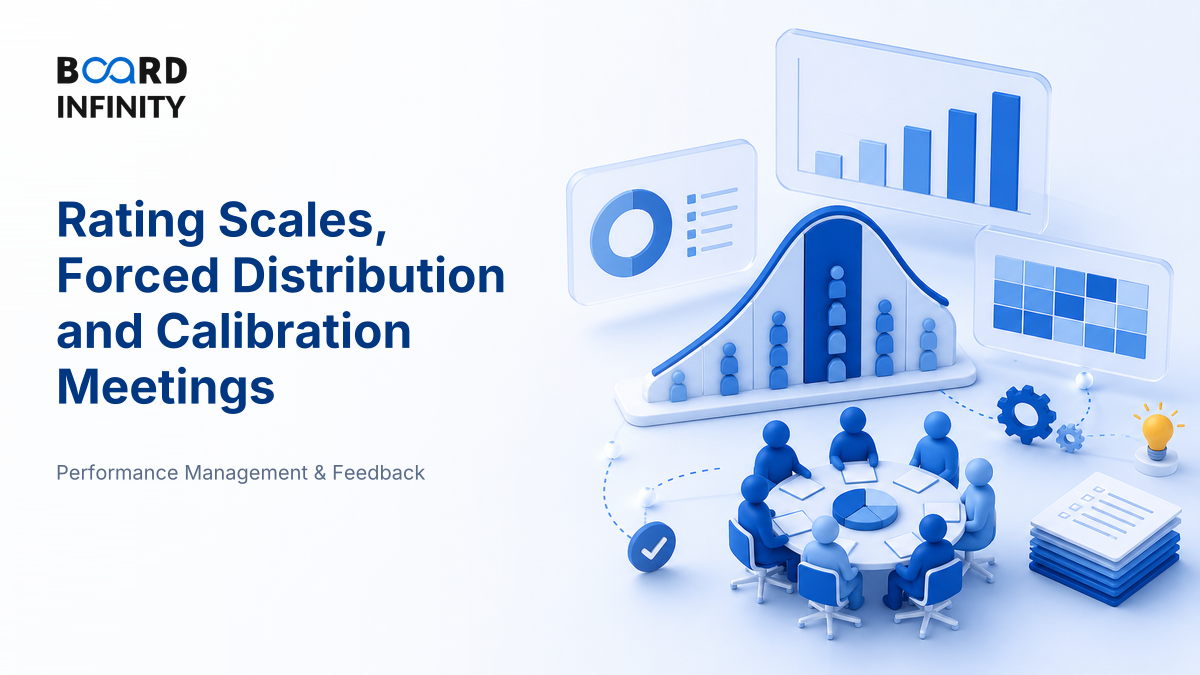
Rating Scales, Forced Distribution and Calibration Meetings - Interview-Ready HR Revision

Rating Scales, Forced Distribution and Calibration Meetings - Interview-Ready HR Revision

A 4 out of 5 is not a fact - it is a judgment made inside a system. Two equally strong employees can receive different ratings simply because one manager is lenient, another is strict, and the company never calibrated what β€œexceeds expectations” really means.

  • Rating scales convert performance judgments into defined levels, such as 1 to 5, using clear behavioral anchors.
  • Forced distribution places employees into pre-set performance buckets, but it can damage trust if used mechanically.
  • Calibration meetings align managers on rating standards before ratings become final, reducing leniency, severity and favoritism.
  • The best systems separate performance evidence from pay, promotion and exit decisions until ratings are checked for fairness.
  • A strong answer explains the full loop: goals - evidence - manager rating - calibration - decision - feedback.
  • The biggest risk is treating ratings as pure math; performance appraisal is a human judgment system that needs evidence, governance and bias checks.

Big Picture

Think of performance ratings as a control system, not a report card. The aim is not to β€œlabel” people; it is to convert messy work evidence into fair decisions on feedback, rewards, promotion, learning and sometimes separation.

Performance ratings work only when evidence, judgment and calibration form a repeatable loop.] <h2>Core Explanation</h2> <p><strong>Rating scales</strong> are the basic language of appraisal. A company may use labels such as β€œNeeds Improvement,” β€œMeets Expectations,” and β€œExceeds Expectations,” or numbers such as 1 to 5. The scale itself is not the problem; vague scale definitions are.</p> <p>A good rating scale answers three questions clearly:</p> <ul> <li><strong>What is being rated?</strong> Goals, competencies, values, behavior, outcomes or potential.</li> <li><strong>What does each level mean?</strong> Each level needs observable evidence, not adjectives.</li> <li><strong>How will ratings be used?</strong> Feedback-only systems need different precision from pay and promotion systems.</li> </ul> <p><strong>Forced distribution</strong> goes one step further. Instead of allowing every manager to rate freely, the organization pre-defines how many employees can fall into each bucket - for example, top, middle and bottom categories. The logic is to fight rating inflation, but the danger is that the curve may punish a genuinely high-performing team.</p> [[FIGURE: {"layout":"compare","items":[{"label":"Rating Scale","note":"Defines performance levels"},{"label":"Forced Distribution","note":"Limits bucket sizes"}]} | caption: A rating scale defines what a rating means; forced distribution controls how many people can receive it.] <p><strong>Calibration meetings</strong> are where managers compare proposed ratings before they are finalized. A manager saying β€œAsha is a 5” must defend that rating with evidence against the same standard used for others. The meeting should not be a political bargaining table; it should be a fairness checkpoint.</p> <h2>Three Tools, Three Different Jobs</h2> <data-table data-headers='["Tool", "Primary Purpose", "Best Used When", "Main Risk"]' data-rows='[ ["Rating scale", "Creates a common language for performance levels", "The company needs consistent appraisal across teams", "Vague labels become subjective opinions"], ["Forced distribution", "Prevents rating inflation by limiting category sizes", "Performance differences are real and roles are comparable", "High-performing teams may be unfairly curved down"], ["Calibration meeting", "Aligns managers and tests evidence before final ratings", "Multiple managers rate similar roles or levels", "Dominant voices can influence ratings without evidence"] ]'> </data-table> <h2>The Calibration Meeting: A Practical Five-Step Process</h2> <p>A calibration meeting is most useful when it is structured tightly. The HR business partner or people manager should run it like an evidence review, not like a negotiation.</p> <roadmap-steps data-steps='[ {"title":"Pre-read the evidence", "desc":"Managers submit proposed ratings, goal outcomes, examples of behavior, peer inputs and business context before the meeting."}, {"title":"Agree the standard", "desc":"The group revisits what each rating level means, especially the difference between solid performance and exceptional performance."}, {"title":"Discuss outliers first", "desc":"Very high and very low ratings are tested first because they usually carry the biggest reward, promotion or exit consequences."}, {"title":"Check comparability", "desc":"Managers compare people in similar roles, levels and contexts without forcing false equivalence across very different jobs."}, {"title":"Record the rationale", "desc":"Final ratings and changes are documented with evidence so feedback, appeals and audit reviews can be handled fairly."} ]'> </roadmap-steps> [[FIGURE: {"layout":"flow","items":[{"label":"Proposed Ratings","note":"Manager submits"},{"label":"Evidence Review","note":"Facts and examples"},{"label":"Peer Challenge","note":"Same standard"},{"label":"Final Rating","note":"Document reason"},{"label":"Feedback Action","note":"Coach and decide"}]} | caption: A good calibration meeting moves from opinion to evidence to a defensible final decision.] <h2>What to Measure: Calibration Quality Metrics</h2> <p>If a company says β€œour calibration is fair,” it should be able to show evidence. These measures do not prove perfection, but they reveal whether the system is drifting into bias, inflation or inconsistency.</p> <data-table data-headers='["Metric", "Formula or Definition", "What Strong Looks Like"]' data-rows='[ ["Rating distribution", "Count of employees in each rating category divided by total rated employees", "Strong means the shape is explainable by business context, not blindly identical across all teams"], ["Calibration adjustment rate", "Number of ratings changed in calibration divided by total proposed ratings", "Strong means changes are evidence-based; a very high rate signals poor manager readiness"], ["Rater leniency spread", "Average rating by manager compared with company or function average", "Strong means managers with similar talent pools do not show unexplained rating extremes"], ["Adverse impact ratio", "Selection rate of a protected group divided by selection rate of the highest selected group", "A ratio below 0.80 is a common warning signal under the four-fifths rule"], ["Appeal reversal rate", "Number of successful rating appeals divided by total appeals", "Strong means reversals are low and root causes are fixed through manager training"], ["Performance-outcome linkage", "Correlation or observed relationship between ratings and later outcomes such as promotion success, retention or goal delivery", "Strong means high ratings are supported by later contribution, not popularity"] ]'> </data-table> <h2>Definitions</h2> <tip-box data-type="info" data-title="Precise Definitions" data-icon="πŸ“˜"> <ul> <li><strong>Rating scale:</strong> A structured set of levels used to convert performance evidence into comparable evaluation categories.</li> <li><strong>Behaviorally Anchored Rating Scale:</strong> A rating scale where each level is described through specific, observable job behaviors.</li> <li><strong>Forced distribution:</strong> A performance appraisal method that assigns employees to pre-determined rating categories or proportions.</li> <li><strong>Calibration meeting:</strong> A structured discussion where managers align proposed ratings using common standards and evidence before final decisions.</li> </ul> </tip-box> <h2>Case Study: Accenture and the Move Away from Forced Rankings</h2> <tip-box data-type="info" data-title="Case Study - Accenture" data-icon="πŸ†"><p>Accenture moved away from annual rankings and toward more frequent performance conversations, showing why calibration must support development, not just sorting.</p></tip-box> [[GOLD-IMAGE: A modern consulting delivery floor in deep purple lighting, laptops open on desks, a manager and employee having a quiet feedback conversation beside a glass meeting room, no logos or readable text | caption: The shift from ranking to coaching changes performance management from a once-a-year verdict into an ongoing conversation.Performance ratings work only when evidence, judgment and calibration form a repeatable loop.] <h2>Core Explanation</h2> <p><strong>Rating scales</strong> are the basic language of appraisal. A company may use labels such as β€œNeeds Improvement,” β€œMeets Expectations,” and β€œExceeds Expectations,” or numbers such as 1 to 5. The scale itself is not the problem; vague scale definitions are.</p> <p>A good rating scale answers three questions clearly:</p> <ul> <li><strong>What is being rated?</strong> Goals, competencies, values, behavior, outcomes or potential.</li> <li><strong>What does each level mean?</strong> Each level needs observable evidence, not adjectives.</li> <li><strong>How will ratings be used?</strong> Feedback-only systems need different precision from pay and promotion systems.</li> </ul> <p><strong>Forced distribution</strong> goes one step further. Instead of allowing every manager to rate freely, the organization pre-defines how many employees can fall into each bucket - for example, top, middle and bottom categories. The logic is to fight rating inflation, but the danger is that the curve may punish a genuinely high-performing team.</p> [[FIGURE: {"layout":"compare","items":[{"label":"Rating Scale","note":"Defines performance levels"},{"label":"Forced Distribution","note":"Limits bucket sizes"}]} | caption: A rating scale defines what a rating means; forced distribution controls how many people can receive it.] <p><strong>Calibration meetings</strong> are where managers compare proposed ratings before they are finalized. A manager saying β€œAsha is a 5” must defend that rating with evidence against the same standard used for others. The meeting should not be a political bargaining table; it should be a fairness checkpoint.</p> <h2>Three Tools, Three Different Jobs</h2> <data-table data-headers='["Tool", "Primary Purpose", "Best Used When", "Main Risk"]' data-rows='[ ["Rating scale", "Creates a common language for performance levels", "The company needs consistent appraisal across teams", "Vague labels become subjective opinions"], ["Forced distribution", "Prevents rating inflation by limiting category sizes", "Performance differences are real and roles are comparable", "High-performing teams may be unfairly curved down"], ["Calibration meeting", "Aligns managers and tests evidence before final ratings", "Multiple managers rate similar roles or levels", "Dominant voices can influence ratings without evidence"] ]'> </data-table> <h2>The Calibration Meeting: A Practical Five-Step Process</h2> <p>A calibration meeting is most useful when it is structured tightly. The HR business partner or people manager should run it like an evidence review, not like a negotiation.</p> <roadmap-steps data-steps='[ {"title":"Pre-read the evidence", "desc":"Managers submit proposed ratings, goal outcomes, examples of behavior, peer inputs and business context before the meeting."}, {"title":"Agree the standard", "desc":"The group revisits what each rating level means, especially the difference between solid performance and exceptional performance."}, {"title":"Discuss outliers first", "desc":"Very high and very low ratings are tested first because they usually carry the biggest reward, promotion or exit consequences."}, {"title":"Check comparability", "desc":"Managers compare people in similar roles, levels and contexts without forcing false equivalence across very different jobs."}, {"title":"Record the rationale", "desc":"Final ratings and changes are documented with evidence so feedback, appeals and audit reviews can be handled fairly."} ]'> </roadmap-steps> [[FIGURE: {"layout":"flow","items":[{"label":"Proposed Ratings","note":"Manager submits"},{"label":"Evidence Review","note":"Facts and examples"},{"label":"Peer Challenge","note":"Same standard"},{"label":"Final Rating","note":"Document reason"},{"label":"Feedback Action","note":"Coach and decide"}]} | caption: A good calibration meeting moves from opinion to evidence to a defensible final decision.] <h2>What to Measure: Calibration Quality Metrics</h2> <p>If a company says β€œour calibration is fair,” it should be able to show evidence. These measures do not prove perfection, but they reveal whether the system is drifting into bias, inflation or inconsistency.</p> <data-table data-headers='["Metric", "Formula or Definition", "What Strong Looks Like"]' data-rows='[ ["Rating distribution", "Count of employees in each rating category divided by total rated employees", "Strong means the shape is explainable by business context, not blindly identical across all teams"], ["Calibration adjustment rate", "Number of ratings changed in calibration divided by total proposed ratings", "Strong means changes are evidence-based; a very high rate signals poor manager readiness"], ["Rater leniency spread", "Average rating by manager compared with company or function average", "Strong means managers with similar talent pools do not show unexplained rating extremes"], ["Adverse impact ratio", "Selection rate of a protected group divided by selection rate of the highest selected group", "A ratio below 0.80 is a common warning signal under the four-fifths rule"], ["Appeal reversal rate", "Number of successful rating appeals divided by total appeals", "Strong means reversals are low and root causes are fixed through manager training"], ["Performance-outcome linkage", "Correlation or observed relationship between ratings and later outcomes such as promotion success, retention or goal delivery", "Strong means high ratings are supported by later contribution, not popularity"] ]'> </data-table> <h2>Definitions</h2> <tip-box data-type="info" data-title="Precise Definitions" data-icon="πŸ“˜"> <ul> <li><strong>Rating scale:</strong> A structured set of levels used to convert performance evidence into comparable evaluation categories.</li> <li><strong>Behaviorally Anchored Rating Scale:</strong> A rating scale where each level is described through specific, observable job behaviors.</li> <li><strong>Forced distribution:</strong> A performance appraisal method that assigns employees to pre-determined rating categories or proportions.</li> <li><strong>Calibration meeting:</strong> A structured discussion where managers align proposed ratings using common standards and evidence before final decisions.</li> </ul> </tip-box> <h2>Case Study: Accenture and the Move Away from Forced Rankings</h2> <tip-box data-type="info" data-title="Case Study - Accenture" data-icon="πŸ†"><p>Accenture moved away from annual rankings and toward more frequent performance conversations, showing why calibration must support development, not just sorting.</p></tip-box> [[GOLD-IMAGE: A modern consulting delivery floor in deep purple lighting, laptops open on desks, a manager and employee having a quiet feedback conversation beside a glass meeting room, no logos or readable text | caption: The shift from ranking to coaching changes performance management from a once-a-year verdict into an ongoing conversation.Set GoalsWhat counts?Collect EvidenceWhat happened?Rate PerformanceManager viewCalibrate RatingsPeer checkAct and CoachReward or develop
Performance ratings work only when evidence, judgment and calibration form a repeatable loop.] <h2>Core Explanation</h2> <p><strong>Rating scales</strong> are the basic language of appraisal. A company may use labels such as β€œNeeds Improvement,” β€œMeets Expectations,” and β€œExceeds Expectations,” or numbers such as 1 to 5. The scale itself is not the problem; vague scale definitions are.</p> <p>A good rating scale answers three questions clearly:</p> <ul> <li><strong>What is being rated?</strong> Goals, competencies, values, behavior, outcomes or potential.</li> <li><strong>What does each level mean?</strong> Each level needs observable evidence, not adjectives.</li> <li><strong>How will ratings be used?</strong> Feedback-only systems need different precision from pay and promotion systems.</li> </ul> <p><strong>Forced distribution</strong> goes one step further. Instead of allowing every manager to rate freely, the organization pre-defines how many employees can fall into each bucket - for example, top, middle and bottom categories. The logic is to fight rating inflation, but the danger is that the curve may punish a genuinely high-performing team.</p> [[FIGURE: {"layout":"compare","items":[{"label":"Rating Scale","note":"Defines performance levels"},{"label":"Forced Distribution","note":"Limits bucket sizes"}]} | caption: A rating scale defines what a rating means; forced distribution controls how many people can receive it.] <p><strong>Calibration meetings</strong> are where managers compare proposed ratings before they are finalized. A manager saying β€œAsha is a 5” must defend that rating with evidence against the same standard used for others. The meeting should not be a political bargaining table; it should be a fairness checkpoint.</p> <h2>Three Tools, Three Different Jobs</h2> <data-table data-headers='["Tool", "Primary Purpose", "Best Used When", "Main Risk"]' data-rows='[ ["Rating scale", "Creates a common language for performance levels", "The company needs consistent appraisal across teams", "Vague labels become subjective opinions"], ["Forced distribution", "Prevents rating inflation by limiting category sizes", "Performance differences are real and roles are comparable", "High-performing teams may be unfairly curved down"], ["Calibration meeting", "Aligns managers and tests evidence before final ratings", "Multiple managers rate similar roles or levels", "Dominant voices can influence ratings without evidence"] ]'> </data-table> <h2>The Calibration Meeting: A Practical Five-Step Process</h2> <p>A calibration meeting is most useful when it is structured tightly. The HR business partner or people manager should run it like an evidence review, not like a negotiation.</p> <roadmap-steps data-steps='[ {"title":"Pre-read the evidence", "desc":"Managers submit proposed ratings, goal outcomes, examples of behavior, peer inputs and business context before the meeting."}, {"title":"Agree the standard", "desc":"The group revisits what each rating level means, especially the difference between solid performance and exceptional performance."}, {"title":"Discuss outliers first", "desc":"Very high and very low ratings are tested first because they usually carry the biggest reward, promotion or exit consequences."}, {"title":"Check comparability", "desc":"Managers compare people in similar roles, levels and contexts without forcing false equivalence across very different jobs."}, {"title":"Record the rationale", "desc":"Final ratings and changes are documented with evidence so feedback, appeals and audit reviews can be handled fairly."} ]'> </roadmap-steps> [[FIGURE: {"layout":"flow","items":[{"label":"Proposed Ratings","note":"Manager submits"},{"label":"Evidence Review","note":"Facts and examples"},{"label":"Peer Challenge","note":"Same standard"},{"label":"Final Rating","note":"Document reason"},{"label":"Feedback Action","note":"Coach and decide"}]} | caption: A good calibration meeting moves from opinion to evidence to a defensible final decision.] <h2>What to Measure: Calibration Quality Metrics</h2> <p>If a company says β€œour calibration is fair,” it should be able to show evidence. These measures do not prove perfection, but they reveal whether the system is drifting into bias, inflation or inconsistency.</p> <data-table data-headers='["Metric", "Formula or Definition", "What Strong Looks Like"]' data-rows='[ ["Rating distribution", "Count of employees in each rating category divided by total rated employees", "Strong means the shape is explainable by business context, not blindly identical across all teams"], ["Calibration adjustment rate", "Number of ratings changed in calibration divided by total proposed ratings", "Strong means changes are evidence-based; a very high rate signals poor manager readiness"], ["Rater leniency spread", "Average rating by manager compared with company or function average", "Strong means managers with similar talent pools do not show unexplained rating extremes"], ["Adverse impact ratio", "Selection rate of a protected group divided by selection rate of the highest selected group", "A ratio below 0.80 is a common warning signal under the four-fifths rule"], ["Appeal reversal rate", "Number of successful rating appeals divided by total appeals", "Strong means reversals are low and root causes are fixed through manager training"], ["Performance-outcome linkage", "Correlation or observed relationship between ratings and later outcomes such as promotion success, retention or goal delivery", "Strong means high ratings are supported by later contribution, not popularity"] ]'> </data-table> <h2>Definitions</h2> <tip-box data-type="info" data-title="Precise Definitions" data-icon="πŸ“˜"> <ul> <li><strong>Rating scale:</strong> A structured set of levels used to convert performance evidence into comparable evaluation categories.</li> <li><strong>Behaviorally Anchored Rating Scale:</strong> A rating scale where each level is described through specific, observable job behaviors.</li> <li><strong>Forced distribution:</strong> A performance appraisal method that assigns employees to pre-determined rating categories or proportions.</li> <li><strong>Calibration meeting:</strong> A structured discussion where managers align proposed ratings using common standards and evidence before final decisions.</li> </ul> </tip-box> <h2>Case Study: Accenture and the Move Away from Forced Rankings</h2> <tip-box data-type="info" data-title="Case Study - Accenture" data-icon="πŸ†"><p>Accenture moved away from annual rankings and toward more frequent performance conversations, showing why calibration must support development, not just sorting.</p></tip-box> [[GOLD-IMAGE: A modern consulting delivery floor in deep purple lighting, laptops open on desks, a manager and employee having a quiet feedback conversation beside a glass meeting room, no logos or readable text | caption: The shift from ranking to coaching changes performance management from a once-a-year verdict into an ongoing conversation.

For years, large professional services and technology firms relied heavily on annual ratings because they had to make difficult decisions on promotion, pay, staffing and exits across huge workforces. In such environments, including India delivery centers, managers often compare employees across projects, client accounts, roles and utilization levels.

Accenture publicly moved away from traditional annual performance reviews and rankings in the mid-2010s and emphasized a model often described around frequent conversations, priorities and individual strengths. The important point is not that ratings disappeared everywhere overnight; the lesson is that a performance system can shift from ranking people after the fact to improving performance during the year.

So what? Accenture’s example proves that the future of performance management is not β€œno evaluation.” It is better evaluation - clearer goals, more continuous evidence, fairer calibration and fewer artificial labels.

In Indian IT, consulting, BFSI and shared-services firms, ratings often affect variable pay, promotion cycles, onsite opportunities and performance improvement plans. That makes documentation, manager training and bias checks crucial, especially when employees challenge ratings or when outcomes appear uneven across gender, location, tenure or manager groups.

How AI Changes Rating Scales, Forced Distribution and Calibration Meetings

AI does not remove managerial judgment, but it changes the evidence base around that judgment. Used well, it makes calibration more consistent; used carelessly, it can scale bias faster.

  • Evidence summarization: AI tools can summarize goals, project updates, customer feedback and manager notes into calibration-ready briefs. The risk is missing context, so managers must verify the evidence.
  • Bias and pattern detection: HR analytics can flag rating patterns by manager, function, gender, location or tenure. This helps identify leniency, severity and possible adverse impact before final decisions.
  • Skills-based calibration: Modern HR platforms increasingly map performance evidence to skills, not just job titles. This matters when roles change fast, especially in tech, analytics, sales and product teams.

Before an HR interview, load this lesson and the target company's latest annual report or careers page into NotebookLM. Ask: β€œGenerate five interview questions on performance management, calibration and fairness for this company, with model answer points.” Then practice answering with one Indian example and one global example.

The 2026 caution: if AI is used in appraisal, companies must be careful about employee data privacy, explainability and bias. In India, this also connects to responsible handling of digital personal data under the DPDP framework.

Interview Relevance

β€œWhat is the difference between a rating scale, forced distribution and a calibration meeting? If you were the HR manager, how would you make the process fair?”

Use the phrase: β€œCalibration is not about making every team fit the same curve; it is about making sure the same rating means the same thing across teams.” That line signals maturity.

Common Mistake

The biggest mistake is saying forced distribution β€œmakes appraisal fair” by itself. It does not. It only forces a spread of ratings; fairness comes from clear standards, evidence, calibration, bias checks and transparent feedback. One-line fix: treat forced distribution as a control tool, not as the performance management system.

What to Revise Next

Next, move from rating fairness to feedback richness. Revise these two topics as a natural sequence:

Mark Lesson Complete (Rating Scales, Forced Distribution and Calibration Meetings - Interview-Ready HR Revision)