
The Performance Cycle: Answer Goals, Check-Ins, Review and Reward in Interviews
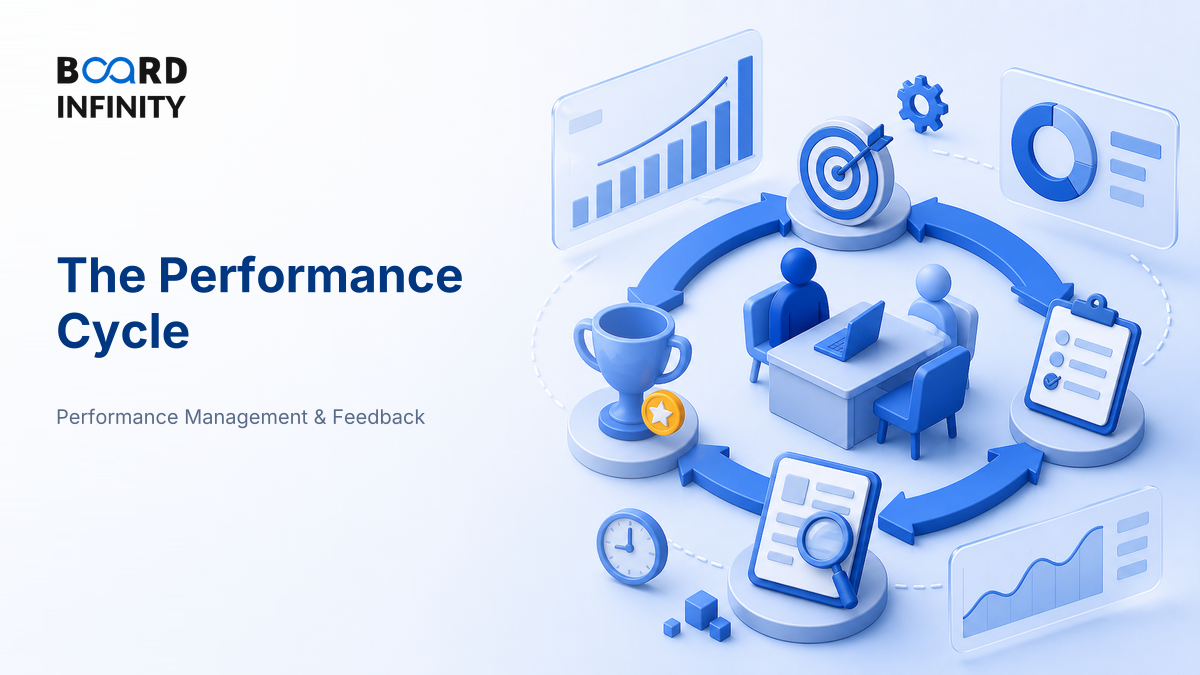
Adobe once did something that sounded reckless for a large company: it moved away from the traditional annual performance review and built a lighter, more frequent check-in rhythm instead. The lesson was not "ratings are bad"; it was sharper - performance improves when goals, coaching, review and reward operate as one connected system, not four separate HR rituals.
- The performance cycle is the recurring system that sets goals, tracks progress, reviews outcomes and links performance to rewards or development.
- The four core stages are goal setting, check-ins, review and reward; if any one is weak, the whole cycle loses credibility.
- Good goals create line of sight: an employee can see how their work connects to team, business and customer outcomes.
- Check-ins are not mini-appraisals; they are coaching conversations to unblock work, adjust priorities and capture evidence early.
- The review stage should combine evidence, manager judgment and calibration to reduce bias and rating inflation.
- Rewards must be differentiated but explainable: pay, bonus, promotion, recognition and learning opportunities should follow contribution.
- The most common candidate mistake is treating appraisal as a once-a-year event instead of a continuous performance system.
Big Picture: Performance Is Managed as a Cycle, Not a Form
A performance system fails when goals are set in April, forgotten by June, rated in March and rewarded with no clear logic. The real model is a closed loop: decide what matters, coach during execution, evaluate fairly, then use the outcome to reward and reset.
Core Explanation: The Four Stages of the Performance Cycle
The performance cycle is a management mechanism. HR may own the process design, but managers own the quality of execution. The employee should never feel surprised at review time because performance signals should have been discussed throughout the year.
1. Goals: Translate Strategy into Expected Contribution
Goals define what the employee is expected to achieve and how success will be judged. Strong goals are aligned, measurable and controllable enough for the employee to influence.
A useful interview phrase is: "Goals create the contract of performance." They tell the employee what matters, tell the manager what to coach, and tell the organization what to reward.
Examples of strong goals:
- For a sales manager: grow revenue while maintaining collection discipline and customer retention.
- For an operations manager: improve on-time delivery while reducing rework and safety incidents.
- For an HR manager: reduce critical-role hiring cycle time while maintaining quality of hire.
2. Check-Ins: Convert Goals into Coaching
Check-ins are periodic manager-employee conversations about progress, blockers, priorities and development. Their purpose is not to create more administration; it is to prevent small performance gaps from becoming year-end surprises.
A good check-in usually covers four questions:
3. Review: Assess Performance Using Evidence and Calibration
Review is the formal evaluation of what was achieved, how it was achieved and what contribution level it represents. A review should use documented evidence: goal outcomes, behavioural examples, stakeholder feedback and role expectations.
Most organizations add calibration: managers compare ratings across teams so that one manager's "excellent" does not become another manager's "average." This is where HR plays a governance role by challenging bias, rating inflation and inconsistent standards.
4. Reward: Make Performance Consequences Visible
Reward is not only money. It includes variable pay, increments, promotion, recognition, special projects, learning investment and sometimes performance improvement plans. The reward stage signals what the organization truly values.
This is why a mature performance system links performance management with talent management. High performers may get accelerated growth paths, while underperformers may receive coaching, role redesign or formal improvement plans.
Definitions You Can Say in One Breath
- Performance cycle: A recurring process of setting goals, checking progress, reviewing contribution and linking outcomes to reward or development.
- Goal setting: The process of defining expected results and standards against which employee performance will be assessed.
- Check-in: A structured performance conversation focused on progress, feedback, blockers and priority changes.
- Performance appraisal, according to Gary Dessler: evaluating an employee's current and/or past performance relative to his or her performance standards.
- Calibration: A review discussion that aligns rating standards across managers, teams and functions.
How to Measure Whether the Performance Cycle Is Working
Do not measure the cycle only by "forms completed." That proves compliance, not effectiveness. Track a mix of process quality, fairness and business linkage.
Use these metrics carefully. A company can hit 95% check-in completion and still have poor coaching if managers are doing rushed, low-trust conversations. The best interpretation combines numbers with employee listening and manager quality audits.
Case Study: Infosys and the Shift to Continuous Performance Conversations
Infosys is a useful Indian example because it moved the performance conversation away from a purely annual, rating-heavy ritual toward a more continuous feedback orientation.

Situation: Large IT services companies manage performance at scale across delivery teams, client accounts, technology practices and global locations. In such environments, an annual appraisal-only model can become slow, memory-dependent and vulnerable to recency bias. Employees also need faster feedback because project priorities and client expectations can change quickly.
The move: Infosys introduced a more continuous performance approach, widely discussed as part of its iCount philosophy, to emphasize ongoing conversations, feedback and employee development rather than relying only on a once-a-year rating event. The primary driver was the need for more frequent, development-oriented performance dialogue. Supporting drivers included a large knowledge-workforce context, changing skill requirements in technology services, and the need for managers to respond faster to project-level performance signals.
The lesson: The strategic point is not that every company must remove ratings. The point is that performance systems must match the pace of work. In IT services, where teams move across projects and skills become obsolete quickly, frequent feedback and goal realignment can be more useful than delayed year-end judgment.
So what: Infosys shows the full logic of the performance cycle: the win comes chiefly from increasing feedback frequency, supported by better goal alignment, manager involvement and development linkage.
How AI Changes the Performance Cycle
AI does not remove the manager's judgment from performance management. It changes the evidence base, the speed of insight and the risk of bias. In 2026, the smart answer is balanced: AI can improve signals, but humans must own fairness and context.
Practical student workflow: Use NotebookLM before an HR interview. Load a company annual report, its careers page and recent culture-related articles, then ask: "What performance goals, check-in mechanisms and reward signals would likely matter for this company's employees?" Use the output to prepare a company-specific answer, not a generic HR textbook answer.
Interview Relevance
"Design a performance management cycle for a fast-growing company where employees complain that appraisals feel unfair and disconnected from rewards."
Use the phrase "no surprises at year-end". It signals that you understand performance management as continuous coaching, not annual documentation.
Common Mistake
Mistake: Explaining only appraisal methods and ignoring goals, check-ins and rewards. Why it costs you: it makes your answer sound like HR administration, not people strategy. One-line fix: frame every answer as a loop - set clear goals, coach continuously, review with evidence, and reward transparently.
What to Revise Next
Revise the performance cycle as the operating system first, then go deeper into its two most interview-tested subtopics: how goals are set and how appraisals introduce bias.