
Marketing Attribution Models Explained
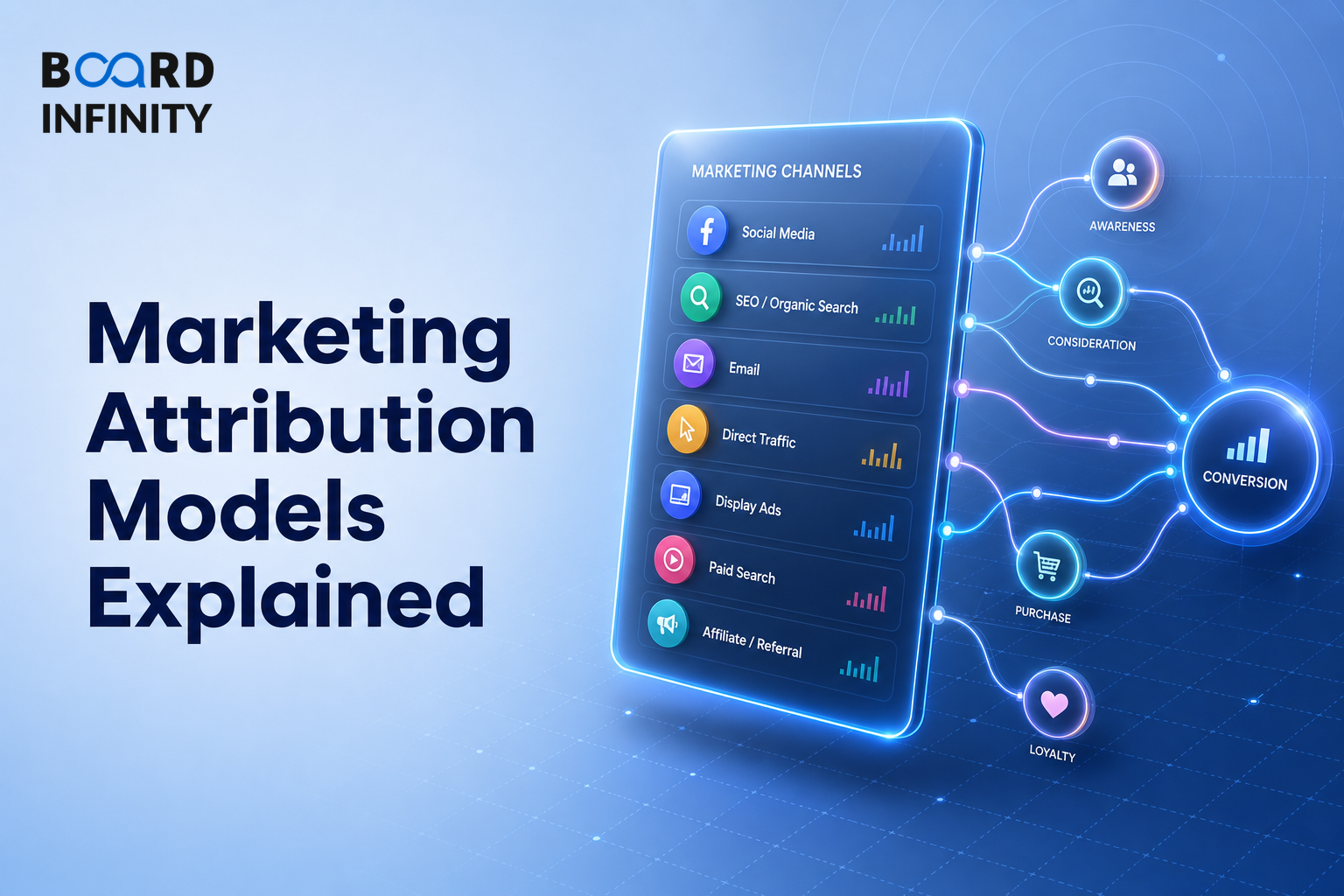
Unit Economics answers whether each customer is profitable. Attribution answers the next practical question: Which touchpoint gets credit for the conversion? In interviews, this matters because attribution is a trade-off between simplicity, accuracy, data maturity, and the business decision being optimized.
- Attribution answers: Which touchpoint gets credit for the conversion?
- Last Click gives 100% credit to the last touchpoint and is simple and easy to implement, but ignores all assist touchpoints.
- First Click gives 100% credit to the first touchpoint and values awareness channels, but ignores the conversion trigger.
- Linear attribution gives equal credit across all touchpoints and is useful as a baseline comparison model.
- Time Decay gives more credit to touchpoints closer to conversion and is best for longer sales cycles like B2B and EdTech.
- Data-Driven / Algorithmic attribution uses an ML model to assign credit based on incremental impact, but needs large data volume and can be a black box.
- No model is perfect: use Marketing Mix Modelling (MMM) for strategic allocation, multi-touch attribution (MTA) for tactical optimisation, and incrementality testing as the ground truth.
Attribution in Marketing Metrics
Attribution answers: Which touchpoint gets credit for the conversion? The big picture is that each model chooses a different way to distribute credit across the customer journey, so the right model depends on the team's data maturity and the decision being optimized.
Attribution answers: Which touchpoint gets credit for the conversion?
Choosing the Right Attribution Model
Last Click is useful for small teams with limited data because it is simple and easy to implement. Its trade-off is that it ignores all assist touchpoints and biases toward bottom-funnel activity.
First Click is useful for brand-focused businesses because it values awareness channels. Its trade-off is that it ignores the conversion trigger.
Linear attribution gives equal credit across all touchpoints. It is fair and simple to understand, but it does not reflect true influence, so it works best as a baseline comparison model.
Time Decay gives more credit to touchpoints closer to conversion. It reflects recency bias, but still undervalues awareness, making it best for longer sales cycles such as B2B and EdTech.
Data-Driven / Algorithmic attribution uses an ML model to assign credit based on incremental impact. It is the most accurate and adjusts automatically, but it needs large data volume and can become a black box, so it is best for mature teams with data infrastructure.
Strategic, Tactical, and Ground Truth Measurement
When discussing attribution, always acknowledge that no model is perfect. The best answer mentions using Marketing Mix Modelling (MMM) for strategic allocation quarterly, multi-touch attribution (MTA) for tactical optimisation weekly, and incrementality testing such as geo holdouts and lift studies as the ground truth.
Structuring a Marketing Attribution Models Explained Interview Answer
"Which attribution model would you use to decide which marketing touchpoint gets credit for a conversion?"
When discussing attribution, always acknowledge that no model is perfect. A strong answer connects the attribution model to the decision being made instead of treating one model as universally correct.
Conclusion
Marketing attribution is about deciding which touchpoint gets credit for the conversion. The strongest interview answer compares the models, names their trade-offs, and explains why MMM, MTA, and incrementality testing work together across strategic allocation, tactical optimisation, and ground truth measurement.
The most frequent mistake is presenting one attribution model as perfect. This costs points because every model has a trade-off: simpler models ignore important touchpoints, while more accurate models need large data volume and can become a black box.