
Risk vs Return at the Portfolio Level
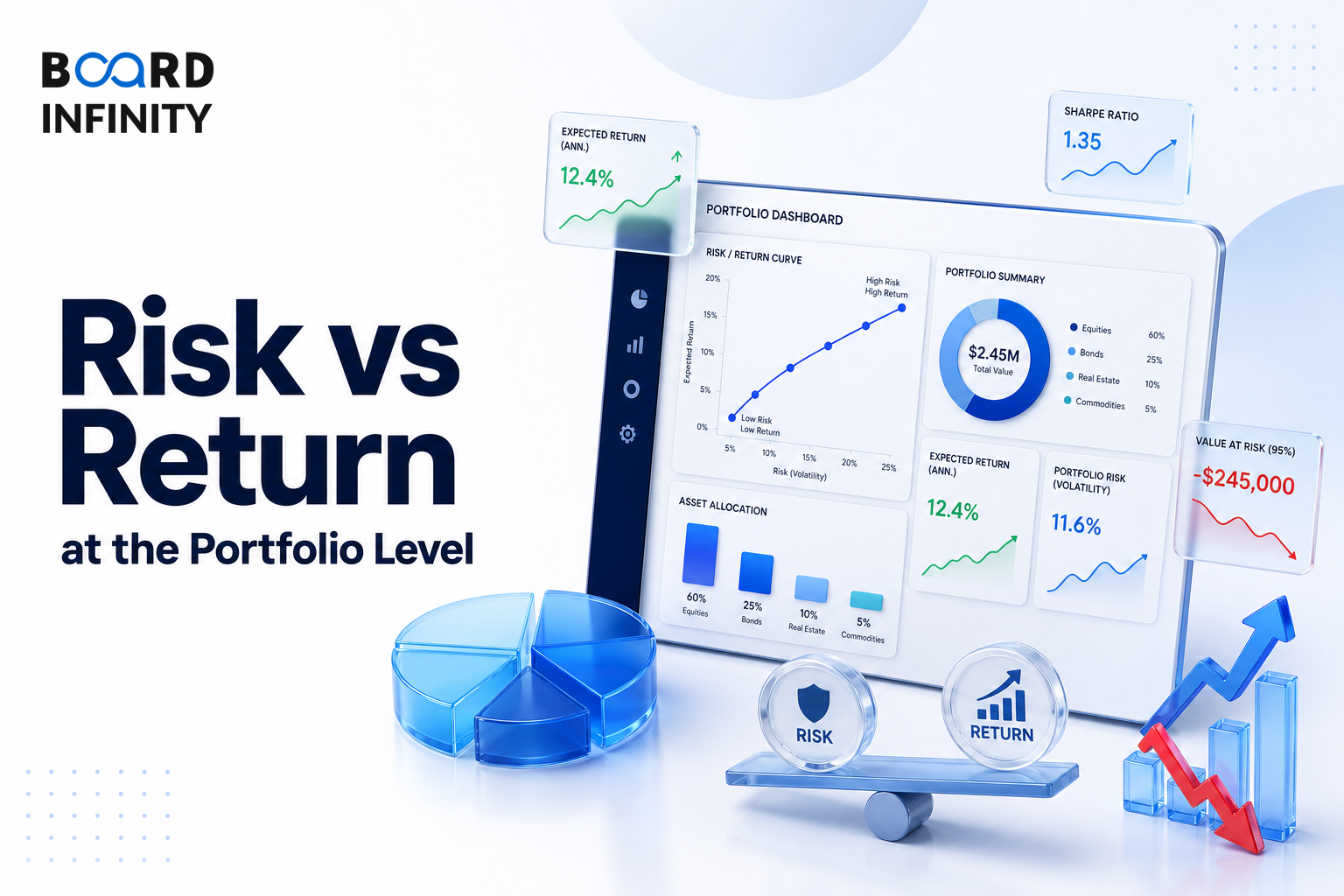
Active vs Passive Investing in India raises the question of what investors are actually choosing when they build a portfolio. Risk vs return at the portfolio level answers that question: higher expected return requires accepting higher risk, while diversification reduces unsystematic risk but cannot eliminate systematic risk. In interviews, this matters because portfolio decisions are rarely about return alone - they are about return earned for the risk accepted.
- The fundamental principle of finance: higher expected return requires accepting higher risk.
- Risk is measured as standard deviation, which captures total risk, or beta, which captures systematic risk.
- Diversification reduces unsystematic risk but cannot eliminate systematic risk.
- Nifty Midcap 100 has higher approximate return than Nifty 50 Equity, but also higher standard deviation.
- Fixed Deposit has 6-7% p.a. approximate return with ~0% standard deviation, while its Sharpe Ratio is N/A.
- The residual ~16-18% risk in a highly diversified stock portfolio is systematic market risk - it cannot be diversified away.
Portfolio Risk-Return in One View
The core portfolio trade-off is simple: higher expected return requires accepting higher risk. Risk is measured as standard deviation, meaning total risk, or beta, meaning systematic risk. Diversification reduces unsystematic risk but cannot eliminate systematic risk.
The fundamental principle of finance: higher expected return requires accepting higher risk.
How Risk Is Measured
Risk is measured as standard deviation, which captures total risk, or beta, which captures systematic risk. Standard deviation shows total volatility of returns around the mean, while beta shows sensitivity to market moves.
Sharpe Ratio = (Rp - Rf) / σp. Higher is better: >1 is good, >2 is excellent.
Systematic, Unsystematic and Total Risk
Diversification reduces unsystematic risk but cannot eliminate systematic risk. This distinction is central to portfolio-level thinking because not all risk is rewarded equally once a portfolio is diversified.
What Diversification Does and Does Not Do
Diversification reduces unsystematic risk but cannot eliminate systematic risk. As the number of stocks increases, portfolio standard deviation falls, but the residual market risk remains.
The residual ~16-18% is systematic market risk - cannot be diversified away. CAPM compensates only for systematic risk. Unsystematic risk is free to eliminate.
Worked Example: Nifty 50 and 10Y Govt Bonds
Portfolio of Nifty 50 (60%) + 10Y Govt Bonds (40%): Rp = 0.6 × 14% + 0.4 × 7% = 8.4% + 2.8% = 11.2%.
Portfolio σ depends on correlation (ρ ≈ -0.2 for equity-bond): σp = √(0.6² × 20² + 0.4² × 5² + 2×0.6×0.4×(-0.2)×20×5) ≈ 11.8%. Sharpe (Rf=7%) = (11.2 - 7) / 11.8 = 0.36 - reasonable.
Structuring a Risk vs Return at the Portfolio Level Interview Answer
"How should an investor think about risk and return at the portfolio level?"
The strongest answers do not say risk disappears after diversification. They clearly state that unsystematic risk can be reduced, while systematic market risk remains.
The single most frequent error is treating diversification as a way to eliminate all portfolio risk. It costs points because diversification reduces unsystematic risk but cannot eliminate systematic risk.
Conclusion
Risk vs return at the portfolio level is the core finance trade-off: investors seek higher expected returns only by accepting volatility and unavoidable systematic risk, while using diversification to reduce asset-specific risk.