
SEO vs SEM: Differences, Pros and Cons
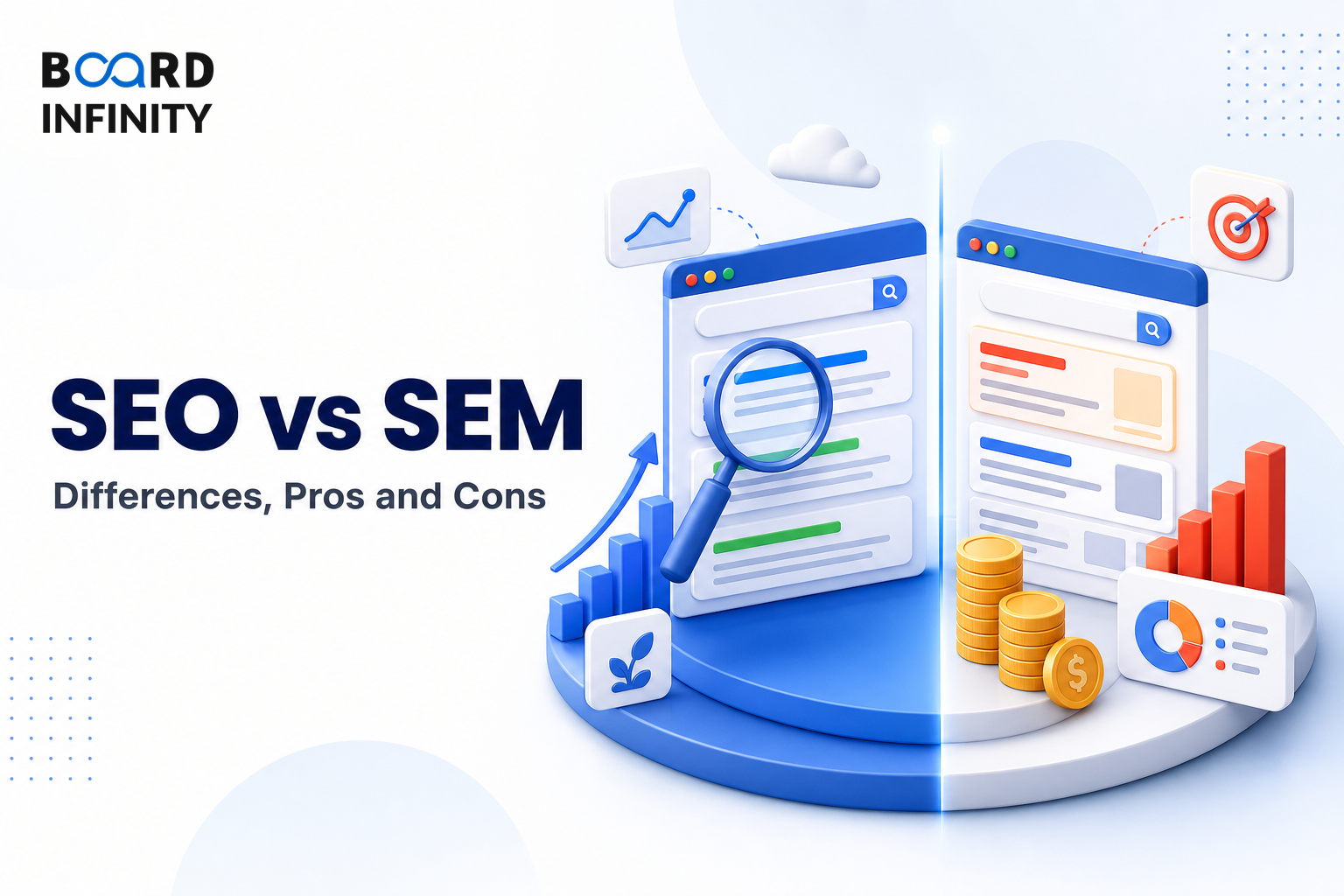
After building a content marketing strategy, the next interview question is how that content earns search visibility and when paid search should be used instead. A common interview question is distinguishing between SEO and SEM. The core trade-off is long-term compounding organic visibility versus immediate paid traffic, and the strongest answer explains why the ideal approach is both.
- SEO (Organic) has free clicks, with investment in content and technical optimization.
- SEM / PPC (Paid) uses pay per click (CPC) or per 1,000 impressions (CPM).
- SEO takes 3-12 months for meaningful rankings, while SEM gives immediate results within hours of campaign launch.
- SEO is compounding and builds a long-term asset, while SEM stops immediately when budget is paused.
- Organic results are trusted 70% more than ads, and 70-80% of total search clicks go to organic.
- The ideal approach is both: Use SEM for immediate traffic and revenue, while building SEO as a long-term organic traffic engine.
The Big Picture
SEO and SEM should not be framed as a simple either-or choice. SEO is a long-term compounding channel, while SEM / PPC is a paid channel that can deliver immediate traffic, precise targeting, and fast testing.
The ideal approach is both: Use SEM for immediate traffic and revenue, especially for competitive commercial keywords, while building SEO as a long-term organic traffic engine. Over time, SEO should reduce your dependence on paid search.
SEO means Search Engine Optimisation: improving organic search visibility through content quality, technical signals, and authority (backlinks). SEM means Search Engine Marketing: paid search advertising, often used to mean paid search specifically. PPC means Pay Per Click, an ad model where advertiser pays only on click.
Cost, Speed, and Sustainability
SEO has free clicks, but it still requires investment in content and technical optimization. The India CPC benchmark for SEO is ₹0, but ₹10-50K/month content investment may be involved.
SEM / PPC works on pay per click (CPC) or per 1,000 impressions (CPM). In India, the benchmark is ₹5-50/click, varying by industry and keyword.
The time difference is central to the trade-off. SEO needs 3-12 months for meaningful rankings, while SEM can show results within hours of campaign launch.
Sustainability is the second major difference. SEO is compounding and builds a long-term asset, while SEM stops immediately when budget is paused.
Trust, Click Share, Targeting, and Testing
Organic visibility carries stronger trust. SEO has higher credibility because organic results are trusted 70% more than ads, while SEM has lower trust because users know these are paid placements.
Click share also differs sharply. 70-80% of total search clicks go to organic, while SEM gets 20-30% of clicks, with higher share for commercial intent queries.
Targeting is broader in SEO because it is based on content relevance and authority. SEM targeting is precise across demographics, location, device, time, and audience.
Testing is slow in SEO because content changes can take months to evaluate. SEM is faster because ads, landing pages, and audiences can be A/B tested in days.
When to Use SEO and When to Use SEM
SEO is best for informational queries, brand building, and thought leadership. It fits situations where the goal is to build organic visibility over time.
SEM is best for commercial intent, product launches, promotions, and competitive terms. It fits situations where the goal is immediate traffic and revenue.
A strong search strategy uses SEM for immediate traffic and revenue while building SEO as a long-term organic traffic engine. Over time, SEO should reduce dependence on paid search.
Structuring a SEO vs SEM Interview Answer
"How would you distinguish between SEO and SEM, and when would you use each?"
Do not frame the answer as SEO versus SEM in isolation. The ideal approach is both: SEM for immediate traffic and revenue, while SEO builds a long-term organic traffic engine.
The most frequent error is treating SEO and SEM as mutually exclusive. This costs points because the stronger answer explains the trade-off, then recommends using SEM for immediate traffic while building SEO to reduce dependence on paid search over time.
Conclusion
SEO and SEM differ across cost, speed, sustainability, trust, targeting, and testing. In interviews, the best answer is to position SEM as the immediate traffic and revenue lever, and SEO as the long-term organic engine that compounds over time.
Social Media Marketing in India: Platform Selection Guide