
The 4 Types of Analytics: Descriptive, Diagnostic, Predictive and Prescriptive
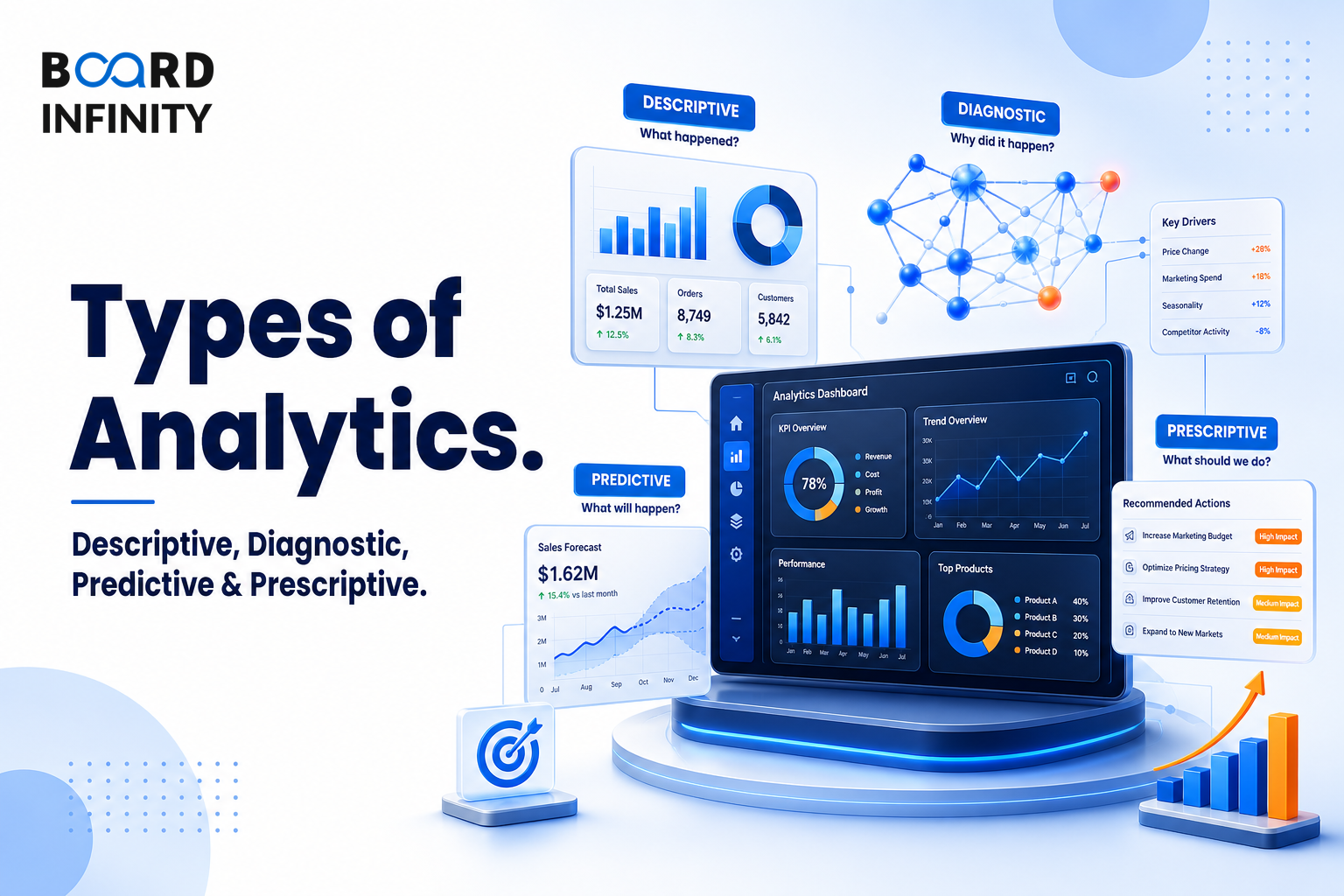
After understanding what analytics is and how the analytics value chain moves from data to impact, the next interview-ready skill is classification: what kind of analytics does the problem actually need? In interviews, always identify which type of analytics a problem needs - descriptive, diagnostic, predictive, or prescriptive - because it shows structured thinking. The core question is simple: are you explaining what happened, why it happened, what will happen, or what should be done?
- Descriptive analytics answers "What happened?" using aggregations, KPI dashboards, histograms, trend charts, Tableau, Power BI, Excel, and SQL.
- Diagnostic analytics answers "Why did it happen?" using drill-down, correlation, root cause analysis, funnel analysis, SQL, Excel, and Python (pandas).
- Predictive analytics answers "What will happen?" using regression, classification, time series, ML models, Python, R, Azure ML, and SageMaker.
- Prescriptive analytics answers "What should we do?" using optimisation, simulation, A/B testing, reinforcement learning, Gurobi, OR-Tools, and Python SciPy.
- Analytics maturity typically moves from descriptive baseline reporting to diagnostic root cause insight, predictive forward-looking advantage, and prescriptive automated optimal decisions.
- Most analytics roles in India (70%+) are still primarily descriptive/diagnostic - dashboards, Excel reports, SQL queries.
The Big Picture: Match the Analytics Type to the Question
The four types of analytics are best understood by the question being asked. The moment you hear an analytics problem, classify it as what happened, why it happened, what will happen, or what should be done.
Always identify 'which type of analytics' a problem needs - shows structured thinking.
1. Descriptive Analytics
Descriptive analytics answers the question: What happened? It uses aggregations, KPI dashboards, histograms, and trend charts.
The typical tools are Tableau, Power BI, Excel, and SQL. A business example is a monthly sales by region report, and an Indian company example is a Flipkart GMV dashboard.
2. Diagnostic Analytics
Diagnostic analytics answers the question: Why did it happen? It uses drill-down, correlation, root cause analysis, and funnel analysis.
The typical tools are SQL, Excel, and Python (pandas). A business example is asking why cart abandonment spiked on Tuesday, and an Indian company example is Swiggy order cancellation analysis.
3. Predictive Analytics
Predictive analytics answers the question: What will happen? It uses regression, classification, time series, and ML models.
The typical tools are Python, R, Azure ML, and SageMaker. A business example is identifying which customers will churn next month, and an Indian company example is HDFC Bank loan default prediction.
4. Prescriptive Analytics
Prescriptive analytics answers the question: What should we do? It uses optimisation, simulation, A/B testing, and reinforcement learning.
The typical tools are Gurobi, OR-Tools, and Python SciPy. A business example is identifying which route minimises delivery cost, and an Indian company example is Delhivery route optimisation.
Analytics Maturity Curve: Value vs Complexity
The analytics maturity curve shows how business value and technical complexity typically increase as companies move from descriptive analytics to prescriptive analytics.
Worked Example: Flipkart Across All Four Types
Flipkart uses all 4: BBD GMV report (Descriptive) → why conversion dropped (Diagnostic) → demand forecast for inventory (Predictive) → dynamic pricing recommendation (Prescriptive).
This example shows how the same business context can move across the analytics maturity curve: first reporting what happened, then explaining why it happened, then forecasting what will happen, and finally recommending what should be done.
Analytics Reality Check in India
Most analytics roles in India (70%+) are still primarily descriptive/diagnostic - dashboards, Excel reports, SQL queries. The 'Predictive Analytics' and 'ML' in job descriptions often means basic regression or simple segmentation.
As a fresher, your SQL and business communication skills matter more than deep ML knowledge. Build those first.
Structuring a The 4 Types of Analytics Interview Answer
"What are the 4 types of analytics?"
Do not jump directly to ML models. First identify whether the problem is asking what happened, why it happened, what will happen, or what should be done.
The most frequent error is treating every analytics problem as predictive analytics or ML. Most analytics roles in India (70%+) are still primarily descriptive/diagnostic - dashboards, Excel reports, SQL queries, so skipping the correct type costs interview points.
Conclusion
The 4 types of analytics give you a clean way to classify any analytics problem by the question being asked: what happened, why it happened, what will happen, or what should be done. In interviews, this structure helps you connect business questions to techniques, tools, and relevant Indian examples.