
What Is Analytics? Definition, Value Chain and Types Explained
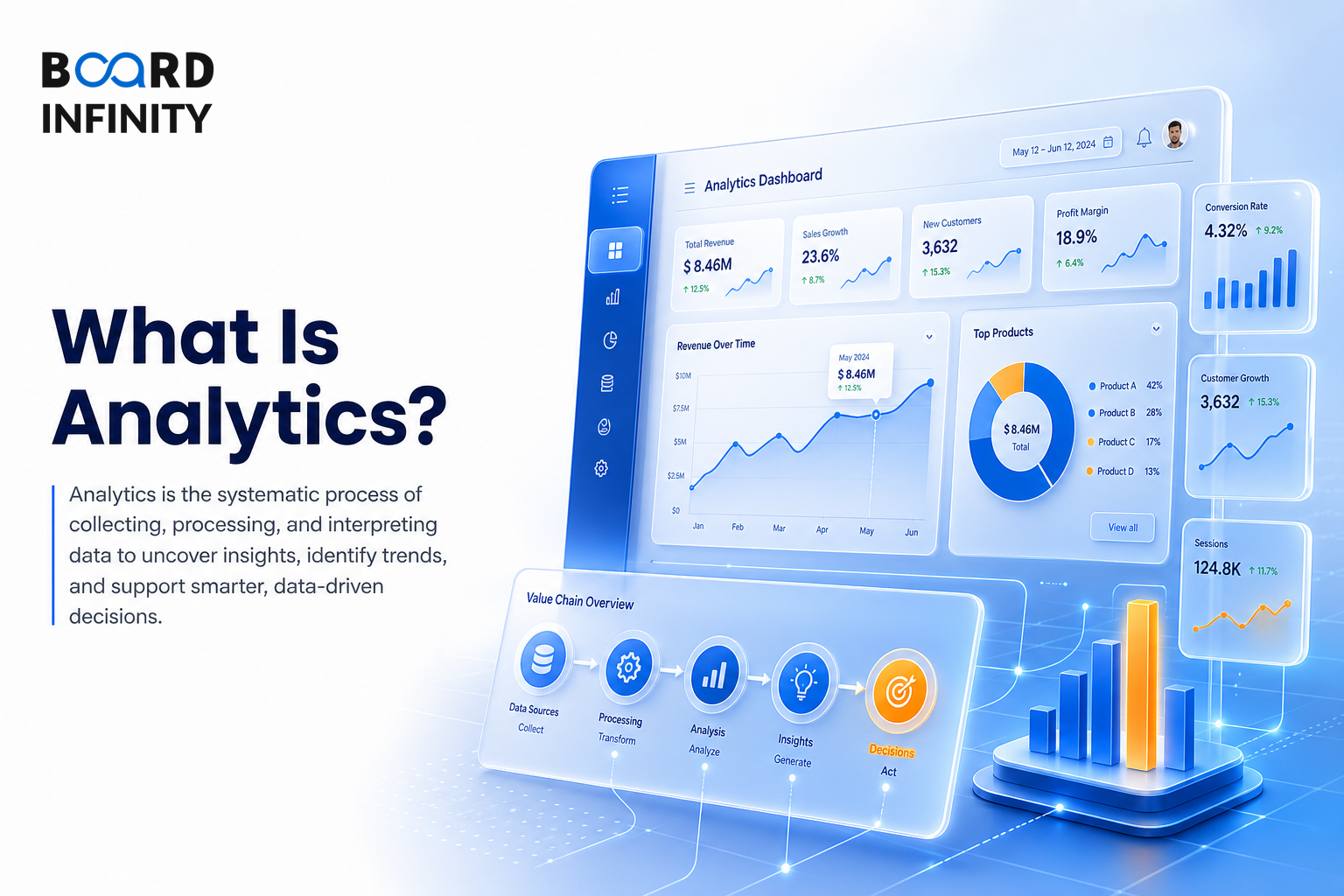
Analytics is the bridge from raw data to business impact. It matters in interviews because candidates are often asked to explain what analytics does, how it creates value, and how it differs from Business Intelligence, Data Science, and Data Engineering.
- Analytics is the systematic computational analysis of data to discover, interpret, and communicate meaningful patterns that support decision-making.
- Gartner describes analytics as 'The science of analysis' - turning raw data into actionable intelligence.
- The Analytics Value Chain moves from Data Collection to Business Impact: sources, quality, patterns, insights, charts, so what, decision, and value.
- The 4 types - Descriptive, Diagnostic, Predictive, Prescriptive - form a maturity curve from hindsight to foresight.
- Business Intelligence asks "What happened?", Analytics asks "Why did it happen?", Data Science focuses on future predictions, and Data Engineering focuses on storing and moving data.
- Indian examples include Wipro BI team, Flipkart analytics, Ola ML team, and Razorpay data platform.
Analytics as the Bridge from Data to Impact
Analytics is the systematic computational analysis of data to discover, interpret, and communicate meaningful patterns that support decision-making. The big picture is simple: analytics starts with data collection and ends only when a decision creates business impact.
This is why analytics is more than reports or charts. It connects raw data, analysis, visualisation, insight, action, and measurable value.
Analytics is the systematic computational analysis of data to discover, interpret, and communicate meaningful patterns that support decision-making.
*Tentative based on open-source data (AmbitionBox, Glassdoor, LinkedIn). Actual figures may vary.
Three Authoritative Ways to Explain Analytics
- Gartner: 'The science of analysis' - turning raw data into actionable intelligence.
- Thomas Davenport (HBR): 'Analytics is the extensive use of data, statistical and quantitative analysis, explanatory and predictive models, and fact-based management to drive decisions and actions.'
- McKinsey Global Institute: 'Data and analytics create a new kind of competitive advantage - one based on insight and speed of learning.'
The 4 Types of Analytics
The 4 types - Descriptive, Diagnostic, Predictive, Prescriptive - form a maturity curve from hindsight to foresight. They help structure analytics answers by moving from what happened to what should be done.
- Descriptive - What happened? (reports, dashboards, KPIs).
- Diagnostic - Why did it happen? (root cause analysis, drill-down, correlation).
- Predictive - What will happen? (ML models, regression, forecasting).
- Prescriptive - What should we do? (optimisation, simulation, recommendation engines).
Worked Example: Flipkart Uses All 4 Types
Indian Example: Flipkart uses all 4: BBD GMV report (Descriptive) → why conversion dropped (Diagnostic) → demand forecast for inventory (Predictive) → dynamic pricing recommendation (Prescriptive).
The learning is that analytics is not a single activity. It can start with a report, move into root cause analysis, forecast future demand, and finally recommend a decision.
Analytics Evolution Timeline
India produces over 500,000 STEM graduates annually - more than the US and Europe combined - making it the world's largest talent pool for analytics and data science roles.
Structuring a What Is Analytics? Definition, Value Chain & Types Explained Interview Answer
"What is analytics, and how is it different from Business Intelligence, Data Science, and Data Engineering?"
Interviewers love this comparison - know 6+ dimensions cold. The strongest answers connect the definition, the value chain, the 4 types, and the BI vs Analytics vs Data Science vs Data Engineering comparison in one flow.
Conclusion
Analytics turns raw data into actionable intelligence by discovering, interpreting, and communicating meaningful patterns that support decision-making. For interviews, the core takeaway is to explain analytics through the value chain, the 4 types, and the role comparison with clear Indian examples.
The most frequent error is using Business Intelligence, Analytics, Data Science, and Data Engineering interchangeably. It costs points because each one answers a different primary question, produces different outputs, uses different skills, and maps to different Indian examples.