
Analytics in Business Functions: Marketing, Finance, HR and More
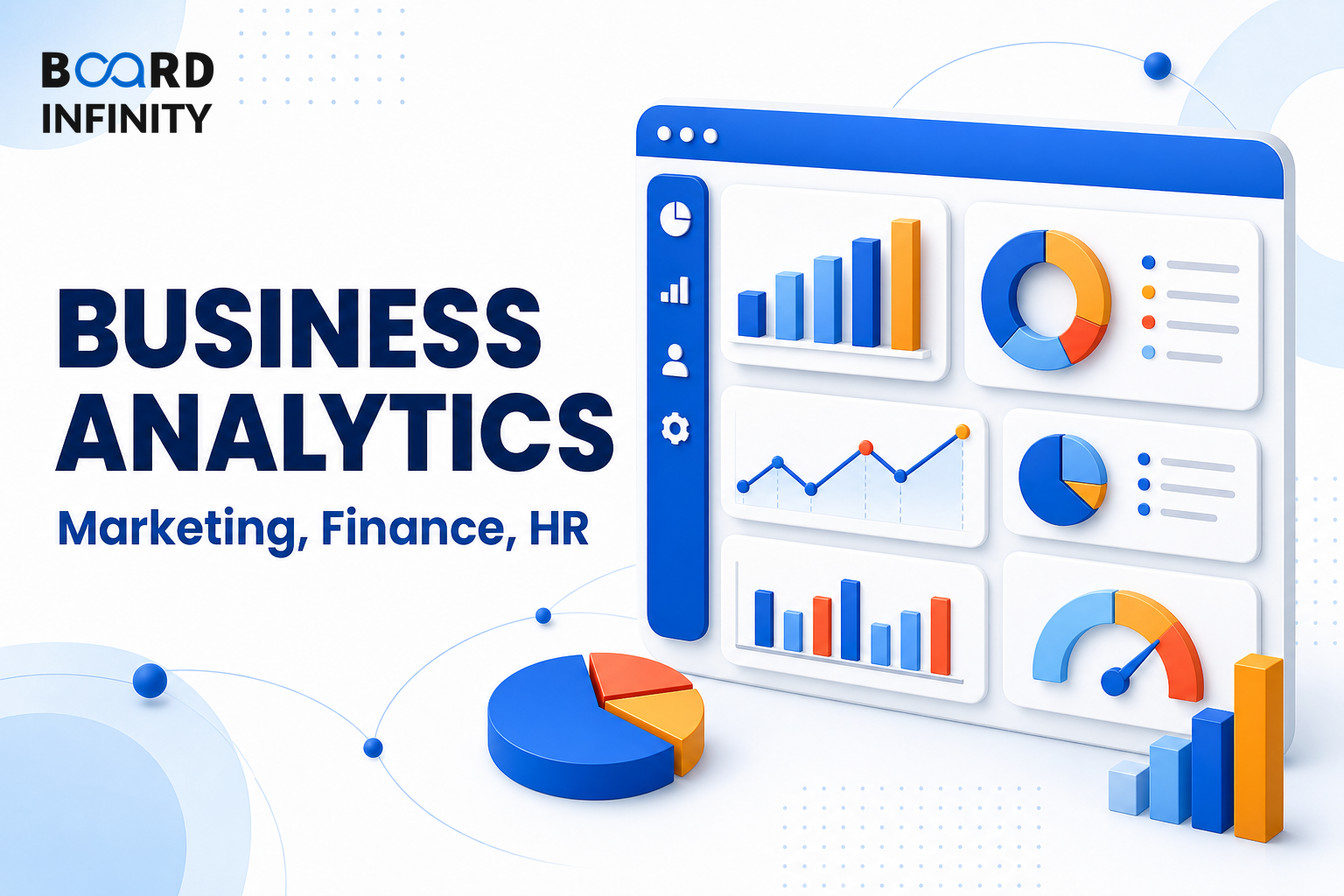
After understanding The 4 Types of Analytics: Descriptive, Diagnostic, Predictive & Prescriptive, the next interview question is where those analytics questions show up inside a business. Analytics in business functions is a function-by-function toolkit: Marketing, Finance, HR / People, Operations / SCM, Sales, Product, Customer Success, and Risk each use analytics differently, track different metrics, and create different business decisions.
- Marketing analytics focuses on campaign attribution, customer segmentation, and channel ROI, with metrics such as CAC, ROAS, CTR, and Conversion Rate.
- Finance analytics covers revenue forecasting, fraud detection, credit scoring, and FP&A; with metrics such as Revenue, EBITDA, NPA ratio, and DSO.
- HR / People analytics includes attrition prediction, workforce planning, and hiring funnel analysis, tracked through Attrition Rate, Time-to-Hire, and eNPS.
- Operations / SCM analytics uses demand forecasting, route optimisation, and inventory management, measured through OTIF, Inventory Turns, and Stockout Rate.
- Sales, Product, Customer Success, and Risk analytics connect business decisions to metrics such as Win Rate, DAU/MAU, NPS, CSAT, Churn Rate, LTV, Fraud Rate, FPR, and Detection Rate.
- Strong interview answers connect every function to three things: analytics application, key metrics, and an Indian example such as Myntra, HDFC Bank, Infosys, Reliance Jio, Tata Steel, CRED, Freshworks, or Razorpay.
Big Picture: Analytics as a Function-by-Function Toolkit
Each business function has a different decision problem. The same analytical thinking translates into different applications, metrics, and Indian company examples depending on whether the function is Marketing, Finance, HR / People, Operations / SCM, Sales, Product, Customer Success, or Risk.
Marketing Analytics
Marketing analytics applies campaign attribution, customer segmentation, and channel ROI. Key metrics include CAC, ROAS, CTR, and Conversion Rate. A named Indian example is Myntra personalised email campaigns (₹AOV uplift).
Finance Analytics
Finance analytics applies revenue forecasting, fraud detection, credit scoring, and FP&A. Key metrics include Revenue, EBITDA, NPA ratio, and DSO. A named Indian example is HDFC Bank credit risk scoring model.
HR / People Analytics
HR / People analytics applies attrition prediction, workforce planning, and hiring funnel analysis. Key metrics include Attrition Rate, Time-to-Hire, and eNPS. A named Indian example is Infosys headcount planning analytics.
Operations / SCM Analytics
Operations / SCM analytics applies demand forecasting, route optimisation, and inventory management. Key metrics include OTIF, Inventory Turns, and Stockout Rate. A named Indian example is Reliance Jio network capacity planning.
Sales Analytics
Sales analytics applies sales forecasting, territory analysis, pipeline health, and win rate. Key metrics include Win Rate, Pipeline Coverage, and ACV. A named Indian example is Tata Steel B2B sales analytics.
Product Analytics
Product analytics applies feature adoption, funnel analysis, A/B testing, and North Star. Key metrics include DAU/MAU, Activation Rate, and Retention. A named Indian example is CRED product analytics - CRED coins adoption.
Customer Success Analytics
Customer Success analytics applies churn prediction, NPS driver analysis, and health scoring. Key metrics include NPS, CSAT, Churn Rate, and LTV. A named Indian example is Freshworks customer health scoring.
Risk Analytics
Risk analytics applies fraud detection, compliance monitoring, and anomaly detection. Key metrics include Fraud Rate, FPR, and Detection Rate. A named Indian example is Razorpay real-time fraud detection.
Structuring a Analytics in Business Functions Interview Answer
"How would you explain analytics across Marketing, Finance, HR / People, Operations / SCM, Sales, Product, Customer Success, and Risk using Indian examples?"
Do not stop at listing use cases. The strongest answer links every function to its analytics application, key metrics, and Indian example.
The most frequent error is to talk about analytics as one generic skill instead of mapping it to a specific business function. It costs points because the answer misses the business context behind Marketing, Finance, HR / People, Operations / SCM, Sales, Product, Customer Success, and Risk.
Conclusion
Analytics in business functions is about translating the same analytical thinking into function-specific applications, metrics, and Indian examples. In interviews, the final takeaway is simple: always connect the function, the business problem, the metric, and the company example.