
The Data Roles Ecosystem: Analyst vs Data Scientist vs Data Engineer
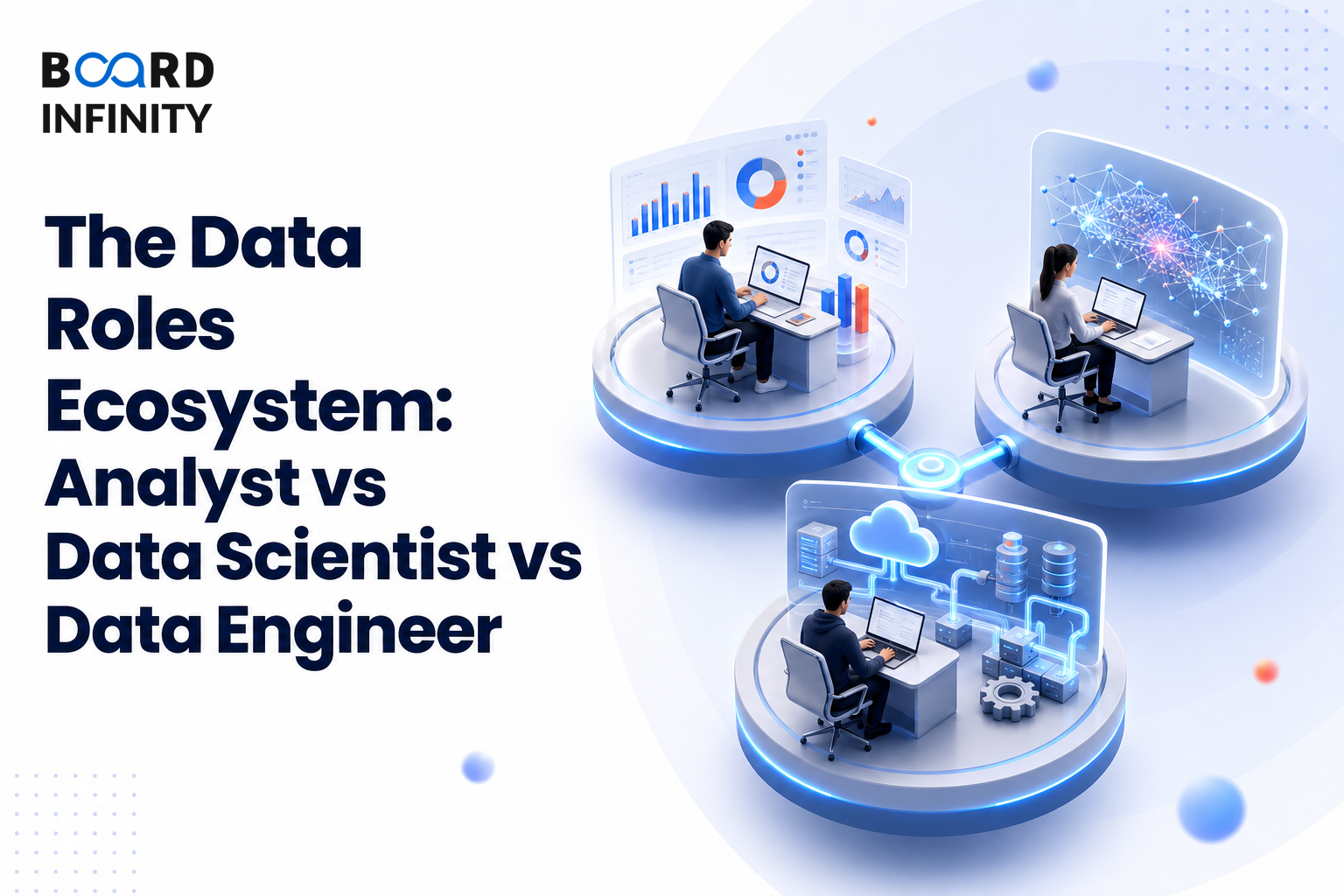
After Analytics in Business Functions: Marketing, Finance, HR & More, the natural next question is who owns each part of the analytics work. The data roles ecosystem answers that by separating infrastructure, insight, prediction, automation, and strategy. In interviews, this matters because candidates often mix up dashboards, pipelines, ML models, MLOps, and data strategy in one answer.
- Data Engineer sits in the infrastructure layer and builds pipelines, data warehouses, ETL/ELT processes.
- Data / Business Analyst sits in the insight layer and analyses data, creates dashboards, and answers business questions.
- Data Scientist sits in the prediction layer and builds ML models, runs experiments, and develops algorithms.
- ML Engineer / AI Engineer sits in the automation layer and deploys models at scale, builds ML systems, and works on MLOps.
- Analytics Manager / Head of Data sits in the strategy layer and defines data strategy, manages teams, and communicates with CXOs.
- MLOps bridges data science and production engineering - ensuring models work reliably at scale.
- Most analytics roles in India are still primarily descriptive/diagnostic - dashboards, Excel reports, SQL queries.
The Layered View
The data roles ecosystem is best understood as a layered operating model. Infrastructure creates reliable, clean data at scale; insight converts it into reports and recommendations; prediction builds models and experiments; automation deploys ML systems; strategy sets team direction.
Infrastructure: Data Engineer
Data Engineer builds pipelines, data warehouses, ETL/ELT processes. The key output is reliable, clean data at scale.
In role-description language, Data Engineers build and maintain data pipelines that feed analytics. They ensure data arrives on time and in the right format. Their day-to-day work includes pipeline development, schema management, and performance optimisation.
Insight: Data / Business Analyst
Data / Business Analyst analyses data, creates dashboards, and answers business questions. The key output is insights, reports, and recommendations.
A Business Analyst bridges between business and technology. They translate business needs into analytics requirements, build reports, and guide decisions. Typical skills include SQL, Excel, PowerPoint, stakeholder management, and domain knowledge.
Prediction: Data Scientist
Data Scientist builds ML models, runs experiments, and develops algorithms. The key output is predictive models and statistical analysis.
Data Science primarily asks, "What will happen?" Its output is predictions and recommendations. This makes it different from the analyst role, where the output is focused on insights, reports, and recommendations.
Automation: ML Engineer / AI Engineer
ML Engineer / AI Engineer deploys models at scale, builds ML systems, and works on MLOps. The key output is production ML systems.
MLOps bridges data science and production engineering - ensuring models work reliably at scale. A typical production query is: "Deploy churn model to score 10M users/day." After monitoring: if drift detected, trigger retraining, then loop back to Feature Engineering. This is the core MLOps cycle.
Strategy: Analytics Manager / Head of Data
Analytics Manager / Head of Data defines data strategy, manages teams, and communicates with CXOs. The key output is data strategy and team direction.
At senior levels, the role owns the entire analytics and data science capability for a BU or company, including board reporting. This layer connects the work of engineers, analysts, scientists, and ML engineers to team direction.
How the Roles Work Together
The roles work as a connected system rather than isolated job titles. Data Engineers create reliable, clean data at scale; Data / Business Analysts use that data to answer business questions; Data Scientists build predictive models; ML Engineers / AI Engineers deploy models at scale; Analytics Managers / Heads of Data define data strategy and team direction.
Indian examples of this role split include Flipkart analytics, Ola ML team, and Razorpay data platform.
Reality Check for Freshers
Most analytics roles in India are still primarily descriptive/diagnostic - dashboards, Excel reports, SQL queries. The "Predictive Analytics" and "ML" in job descriptions often means basic regression or simple segmentation. As a fresher, your SQL and business communication skills matter more than deep ML knowledge. Build those first.
Structuring a The Data Roles Ecosystem Interview Answer
"Explain the difference between a Data Engineer, Data / Business Analyst, Data Scientist, ML Engineer / AI Engineer, and Analytics Manager / Head of Data."
The answer is always: start with data infrastructure, not ML models. You can't build a mansion on a swamp.
The common mistake is treating the ecosystem as if every role is about building ML models. The stronger answer starts with data infrastructure, then moves to insight, prediction, automation, and strategy.
Conclusion
The data roles ecosystem is a layered operating model: engineers create reliable data, analysts create insight, scientists build prediction, ML engineers automate production systems, and leaders set strategy. In interviews, the winning answer is precise about what each role does and what output it creates.