
The 4As of Rural Marketing in India Through HUL Project Shakti
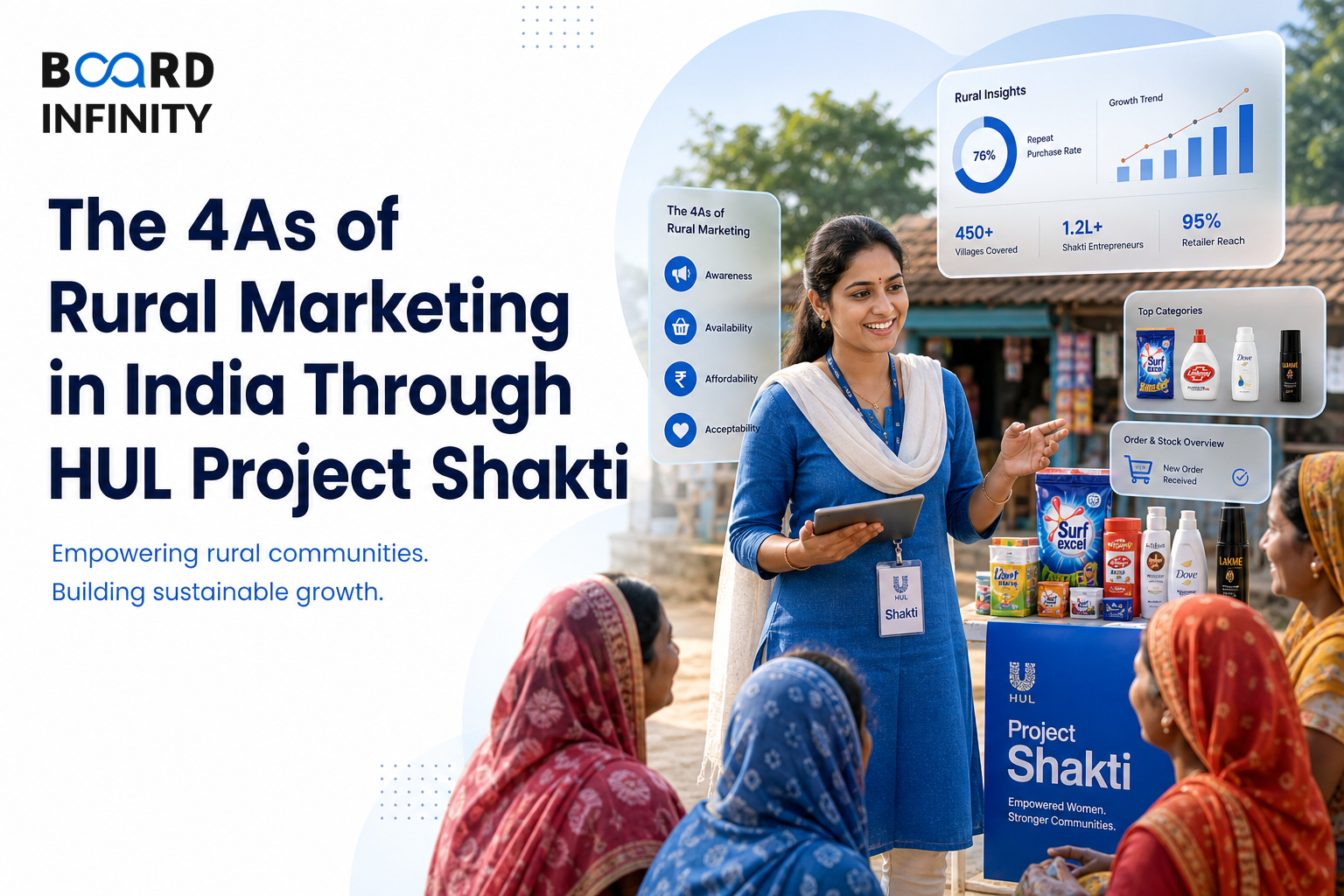
After understanding Distribution Channel Levels and Retail Channels in India, the natural next question is: what happens when the channel itself does not exist? That is the rural marketing problem Hindustan Unilever faced in 2001, when it could not effectively reach 600,000+ villages where 65% of Indians lived. The 4As of rural marketing help candidates explain not just distribution, but the full market-entry challenge: making a product available, affordable, acceptable, and known in a hard-to-reach market.
- The 4As of rural marketing are Availability, Affordability, Acceptability, and Awareness.
- HUL's Project Shakti is the gold standard case for applying the 4As in rural India.
- The core problem was last-mile access: traditional roads, warehouses, and retail outlets were almost non-existent across many villages.
- HUL solved Availability through Shakti Ammas, women from Self-Help Groups who sold products door-to-door.
- Affordability was addressed through sachets, while Acceptability came from trusted local women and Awareness came from in-person demos.
- The model scaled to 50,000+ Shakti Ammas across 18 states, reaching 100,000+ villages.
- In interviews, do not describe rural marketing as only a distribution problem - use all four 4As to show a complete market execution view.
The Big Picture: Why the 4As Matter in Rural India
Rural marketing is not only about taking urban products into villages. In HUL's case, the company needed to redesign how products reached villages, how consumers could buy them, who communicated their value, and how trust was created locally.
The 4As give a simple structure for diagnosing this challenge before recommending a solution.
Context: The Rural Marketing Problem HUL Had to Solve
In 2001, Hindustan Unilever faced a structural growth barrier. Rural India represented a massive market, but HUL could not effectively reach 600,000+ villages where 65% of Indians lived.
The issue was not only demand. The source problem was that traditional distribution infrastructure such as roads, warehouses, and retail outlets was almost non-existent. This made the last-mile problem the biggest barrier to growth.
Last-mile distribution means the final leg of moving products from the company or distributor network to the end consumer. In this case, the final leg was difficult because many villages could not be served effectively through conventional retail channels.
Traditional Rural Distribution vs Project Shakti
Project Shakti changed the distribution logic from relying only on fixed infrastructure to building a human, village-level selling network. This is why it is more than a sales case - it is a market execution case.
Availability: Making the Product Physically Reachable
Availability means the consumer can actually access the product when and where they need it. In urban markets, availability often depends on retail outlets, modern trade, kirana stores, and distributor coverage. In the rural case from the source, those channels were not enough because the infrastructure was weak.
HUL's answer was to recruit women from Self-Help Groups, or SHGs. A Self-Help Group is a local community group that can support members through financial and social participation. These women became Shakti Ammas, micro-entrepreneurs who sold HUL products door-to-door in their villages.
This directly solved the last-mile problem. Instead of waiting for shops, warehouses, and roads to become adequate, HUL created a village-level human distribution network. In the 4Ps marketing mix, this is a Place innovation, because the route to customer changed.
The interview point is simple: do not say only "increase distribution". Explain how distribution is made possible when formal infrastructure is weak. Project Shakti made availability local, personal, and repeatable.
Affordability: Matching the Product to Rural Buying Power
Affordability means the customer can buy the product in a price and pack format that fits their spending pattern. In Project Shakti, the source specifically links Affordability to sachets.
Sachets matter in rural marketing because they reduce the cash required for a purchase. The case does not require you to invent a new product - it shows how existing HUL products could be made more suitable for the rural market through pack and price architecture.
This also connects to the Ansoff Matrix, a strategy framework that compares products and markets. Project Shakti is a Market Development case because HUL used existing products and took them to a new rural market.
The nuance is that affordability is not the same as discounting. In many rural marketing cases, the issue is not just whether the product is cheap, but whether the purchase unit makes sense for the buyer. In this case, sachets helped solve that problem.
Acceptability: Building Trust Through Local Women
Acceptability means customers find the product, seller, and usage context credible. A product may be available and affordable, but rural adoption can still remain weak if consumers do not trust who is selling it or do not see it as relevant to their lives.
HUL addressed this by making trusted local women the face of the model. Shakti Ammas were not anonymous sales representatives from outside the village. They were women from Self-Help Groups who already belonged to the local context.
Each Shakti Amma received training on selling techniques and product knowledge. This mattered because acceptability requires more than presence - the seller must be able to explain the product and handle questions.
The social impact angle also strengthens the case. The model gave Shakti Ammas a sustainable income of ₹3,000-5,000/month, described in the source as transformative in rural India. A strong interview answer should connect this to sustainable business model design: the channel worked because it created value for HUL, the consumer, and the local entrepreneur.
Awareness: Converting Product Presence into Understanding
Awareness means the target customer knows the product exists, understands what it does, and has enough information to consider buying it. In rural markets, awareness cannot be assumed just because the product is present.
Project Shakti created awareness through in-person demos. Because Shakti Ammas were trained in product knowledge and selling techniques, they could demonstrate products directly in the village context.
This is especially important for brands like Lifebuoy and Wheel, which achieved 80%+ rural penetration according to the source. The case shows that awareness and availability worked together: products reached villages, and trained local sellers helped consumers understand them.
The nuance for interviews is that awareness is not just advertising. In Project Shakti, awareness was interpersonal, village-level, and linked to selling. That makes it very different from a campaign-only answer.
Hindustan Unilever: The Full Framework in One Business
HUL demonstrates the full 4As framework because Project Shakti did not solve just one bottleneck. It combined last-mile availability, sachet-led affordability, local trust, and direct product education into one operating model.
A shallow answer says HUL improved distribution. A complete answer says HUL redesigned the rural go-to-market model across all four 4As.
How Project Shakti Worked as a Business Model
Project Shakti worked because HUL built support around the local entrepreneur rather than merely appointing a seller. Each Shakti Amma received working capital loans and initial inventory on credit, which helped her start selling without carrying the full burden upfront.
HUL also provided training on selling techniques and product knowledge. This linked the selling role to both acceptability and awareness, because the same person who carried the product also explained it.
The model later included tablets for digital ordering and inventory management under Shakti 2.0. This strengthened the operating system behind the village-level network by supporting ordering and inventory management digitally.
Worked Example: Expanding an FMCG Brand in Rural India
FMCG means Fast-Moving Consumer Goods - frequently purchased consumer products. The source explicitly says Project Shakti is the gold standard answer for "How would you expand an FMCG brand in rural India?" Here is how to convert the case into a complete worked example.
The worked example is interview-ready because it moves from business context to diagnosis, then to framework, action, result, and learning.
How the 4As Connect to Other Strategy Frameworks
Project Shakti is powerful in placement interviews because it can be connected to multiple frameworks without forcing the case. The source explicitly links it to the Ansoff Matrix, 4Ps, STP, and the 4As.
STP means Segmentation, Targeting, and Positioning. In this case, the rural BOP segment was specifically targeted. BOP means Bottom of Pyramid, a term used here for the rural segment identified in the source.
The nuance is that these frameworks should not be listed mechanically. Use the 4As as the core answer, then bring in Ansoff, 4Ps, or STP only when they sharpen your reasoning.
A Reusable 4As Answer Template
Use this template when an interviewer asks about rural expansion, FMCG market development, or last-mile distribution. It keeps your answer structured and prevents you from focusing only on logistics.
Structuring a The 4As of Rural Marketing in India Interview Answer
"How would you expand an FMCG brand in rural India?"
The strongest answers do not stop at "create more distributors". They show how the channel solves trust, affordability, and education at the same time.
Conclusion
The 4As of rural marketing turn Project Shakti from a distribution story into a complete market execution framework. HUL succeeded because it solved availability through door-to-door access, affordability through sachets, acceptability through trusted local women, and awareness through in-person demos - a model every placement candidate should be able to explain clearly.
The most frequent mistake is treating rural marketing as only a logistics or distribution problem. That loses points because Project Shakti worked by solving all four barriers together: access, price format, trust, and product understanding.