
Understanding the Sales Funnel and BANT Lead Qualification
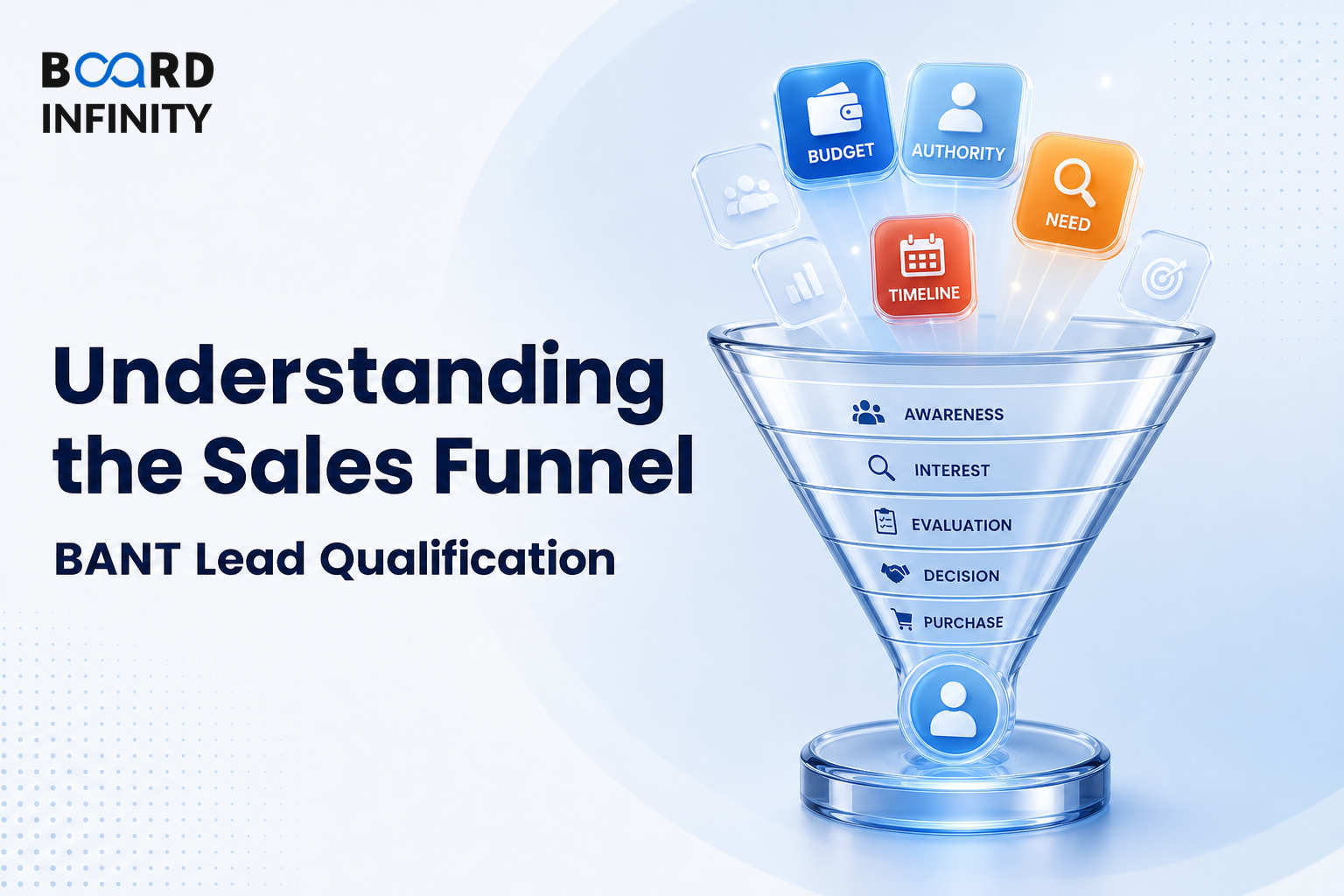
Sales teams rarely have unlimited time, so they need a quick way to decide which prospects deserve active pursuit. BANT, originally developed at IBM, gives reps a practical qualification lens by testing whether a lead has Budget, Authority, Need, and Timeline. In interviews, this topic matters because it connects sales funnel thinking with real execution - how a rep separates interest from a serious buying opportunity.
- BANT is one of the oldest and most widely used lead qualification frameworks, originally developed at IBM.
- It helps sales reps quickly assess whether a prospect is worth pursuing before spending more time on the deal.
- Budget checks whether the prospect has financial resources, allocated budget, or enough pain to create budget.
- Authority checks whether the contact is the decision maker, an influencer, or part of a broader buying committee.
- Need tests whether the prospect has a genuine pain point and whether the solution is a must have or only a nice to have.
- Timeline identifies implementation urgency, including hard deadlines such as fiscal year end or regulatory compliance.
- BANT remains popular for SMB and mid-market sales, while enterprise deals increasingly use more nuanced frameworks like MEDDPICC.
At a high level, BANT sits inside the qualification stage of the sales funnel: it helps a rep decide whether a lead should move forward into deeper selling effort or be deprioritised.
What BANT Means in Sales Qualification
BANT is a lead qualification framework used to assess whether a prospect is worth pursuing. The acronym stands for Budget, Authority, Need, and Timeline. Each dimension answers a practical sales question: can the buyer pay, can the buyer decide, does the buyer truly need the solution, and when will they act?
The framework is especially useful because it turns a vague lead into a structured sales judgment. Instead of relying only on enthusiasm, a sales rep evaluates whether the prospect has financial readiness, decision access, business pain, and urgency. That makes BANT a fast screening tool for sales funnel execution.
Why BANT Matters in the Sales Funnel
A sales funnel is only useful if teams can decide which leads should progress. BANT provides that decision filter. It helps reps avoid spending too much time on prospects that may be interested but lack budget, decision power, a real need, or urgency.
For interview answers, the important point is that BANT is not just a checklist. It is a prioritisation tool. A lead with a strong need, clear authority path, available budget, and near-term timeline is typically more worth active pursuit than a lead that is curious but vague on all four dimensions.
Lead qualification means assessing whether a prospect is likely enough to buy that the sales team should invest active effort. In BANT, that assessment is made through Budget, Authority, Need, and Timeline.
Budget: Can the Prospect Pay?
Budget asks whether the prospect has the financial resources for the solution. A rep should understand whether budget is already allocated for this type of solution or whether it needs approval. If no budget exists, the next question is whether the pain is significant enough to create one.
This matters because a prospect can have interest and still be commercially weak. Without budget, the opportunity may stall unless the need is strong enough to justify approval. In many sales conversations, budget qualification helps a rep judge whether to pursue now, nurture for later, or explore whether the problem is painful enough to unlock funding.
The nuance is that lack of current budget does not automatically mean the lead is bad. The source criterion explicitly asks whether the pain is significant enough to create one. A strong rep avoids treating Budget as a yes-or-no gate too early and instead links it with Need.
Authority: Who Can Decide?
Authority checks whether the person speaking to the sales rep is the decision maker. If they are not, the rep should understand whether they can influence the decision. The framework also asks the rep to map the full buying committee, including the economic buyer, technical evaluator, end user, and champion.
This matters because in many buying processes, one enthusiastic contact may not control the final decision. The economic buyer is the person or group connected to commercial approval. The technical evaluator assesses whether the solution works technically. The end user is the person who will use the solution. The champion is an internal supporter who can help the deal move forward.
The key interview nuance is that Authority is not only about finding one powerful person. It is about understanding the buying committee. A contact who is not the final decision maker may still be valuable if they influence the process or act as a champion.
Need: Is the Pain Real?
Need tests whether the prospect has a genuine pain point that the solution solves. It also asks whether the solution is a nice to have or a must have. The stronger the need, the shorter the sales cycle.
This is the core of qualification because Budget and Timeline often become clearer when the need is severe. A must-have need gives the buyer a reason to act, seek approval, and commit resources. A nice-to-have need may generate conversation but not necessarily progress.
For interviews, explain Need as the difference between curiosity and business pain. A prospect may like the idea of a solution, but BANT asks whether the problem is important enough to justify action.
Timeline: When Will the Prospect Act?
Timeline asks when the prospect needs to implement. It looks for urgency and hard deadlines, such as fiscal year end or regulatory compliance. Urgency drives deal velocity, which means it affects how quickly a deal may move through the funnel.
Timeline matters because even a strong-fit prospect may not be ready now. A clear implementation deadline can make a lead more actionable. A vague or distant timeline may signal that the rep should not treat the opportunity as immediately sales-ready.
The nuance is that Timeline should be interpreted with the other BANT criteria. A short timeline without Budget or Authority may still be risky. A longer timeline with strong Need and mapped Authority may still be worth nurturing, depending on the sales motion.
BANT Components at a Glance
This table is a reusable interview structure: state the criterion, ask the diagnostic question, describe what a rep is looking for, and add the nuance that prevents a mechanical answer.
Worked Example: Applying BANT to a Lead
The main learning is that BANT helps a rep move from vague interest to a defensible sales decision. The framework does not require every answer to be perfect immediately, but it gives the rep a clear map of what must be understood before investing more effort.
BANT in SMB, Mid-Market, and Enterprise Contexts
The source notes that BANT remains popular for SMB and mid-market sales. SMB means small and medium-sized businesses, where sales cycles are often more direct than large enterprise deals. Mid-market usually refers to companies between SMB and large enterprise, where qualification still needs speed but may involve more stakeholders.
For enterprise deals, the source notes that organisations increasingly use more nuanced frameworks like MEDDPICC. MEDDPICC is another sales qualification framework, but the important point here is not to explain it in detail. The interview-safe statement is that BANT is fast and practical, while enterprise deals may require more detailed qualification because buying committees and processes can be more complex.
This is where candidates can show maturity. Do not position BANT as outdated or universally sufficient. A balanced answer is that BANT is still widely used and useful, especially for quick qualification, but more complex enterprise deals may require additional nuance.
How to Use BANT in a Sales Conversation
A strong sales rep does not ask BANT questions like an interrogation. The rep uses the framework to guide discovery and understand whether the opportunity deserves active pursuit. The goal is to uncover evidence, not simply fill four boxes.
This sequence is not mandatory in every conversation, but it is interview-friendly because it begins with the customer problem and then connects it to budget, decision process, and urgency.
IBM and the Origin of BANT
BANT was originally developed at IBM, which is why it is often described as one of the oldest and most widely used lead qualification frameworks. That origin is useful in interviews because it shows that the framework was built for practical sales execution rather than abstract theory.
When referencing IBM, keep the point precise: IBM is the origin associated with BANT in the source content. Avoid adding unsupported claims about IBM's internal sales process or specific results. The safe takeaway is that BANT has endured because it gives sales reps a simple, fast way to judge whether a lead is worth pursuing.
Structuring a Understanding the Sales Funnel & BANT Lead Qualification Interview Answer
"How would you use BANT to decide whether a sales lead should move forward in the funnel?"
The strongest answers do not just expand the acronym. They show how a sales rep uses the four signals together to make a pursuit decision in the funnel.
The most frequent mistake is treating BANT as four isolated yes-or-no questions. That costs points because real qualification requires judgment - Budget can depend on Need, Authority may involve a buying committee, and Timeline only matters when urgency is connected to a real buying process.
Conclusion
BANT is a fast, practical qualification framework that helps sales reps decide whether a lead deserves active pursuit by testing Budget, Authority, Need, and Timeline. Use it in interviews as a funnel prioritisation tool, not just an acronym, and always add the nuance that the four criteria work together.