
Distribution Channel Levels and Retail Channels in India
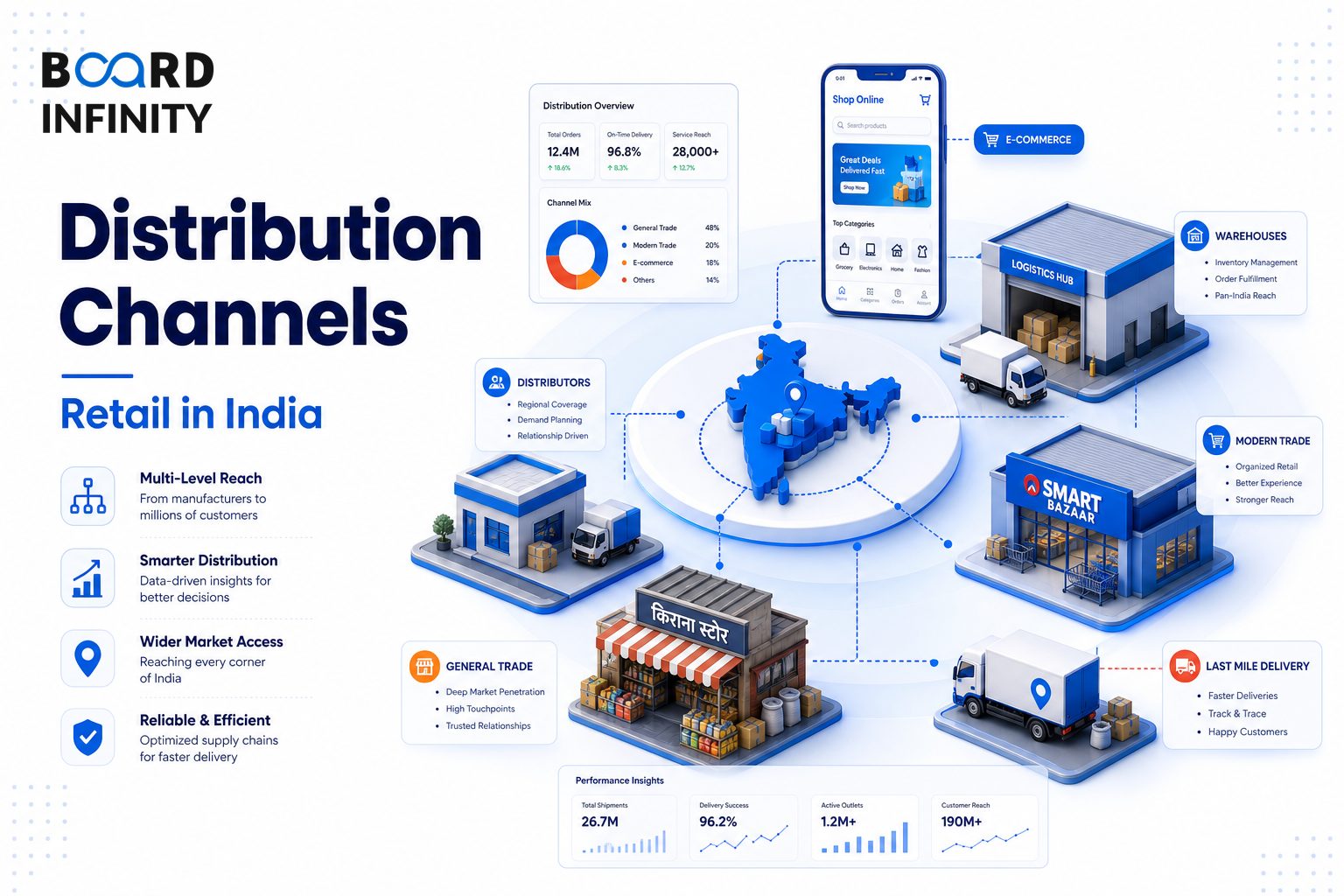
After learning Distribution Strategy - Intensive, Selective and Exclusive, the next interview question is execution: which retail channels actually reach the customer in India? India is not a single-format market; it combines neighbourhood kiranas, organised retail, online marketplaces, quick commerce, direct-to-consumer channels, franchise chains, wholesale platforms and person-to-person selling. For placement interviews, this matters because a strong answer connects channel choice to reach, control, speed, scale and customer relationship instead of listing formats mechanically.
- India's retail system is hybrid: traditional formats coexist with rapid digital adoption, so distribution design typically needs more than one channel.
- General trade, especially kirana stores, remains the backbone of Indian retail with 12M+ stores and 80% of FMCG sales.
- Modern trade covers organised self-service formats such as supermarkets and hypermarkets, with examples including DMart, Reliance Retail and Big Bazaar.
- E-commerce uses online marketplaces and brand websites, with Amazon, Flipkart and Meesho as key examples from the source.
- Quick commerce focuses on ultra-fast 10-30 min delivery from dark stores, with Blinkit, Zepto and Swiggy Instamart cited at $5B FY25.
- D2C websites give brands a direct customer relationship, while franchise chains, wholesale/B2B and direct selling serve different execution goals.
- In interviews, do not call one channel universally superior; explain which channel fits the product, customer, service expectation and control requirement.
India's Hybrid Retail System
The big picture is that India has multiple route-to-market formats operating at the same time. Some channels maximise physical reach, some create an organised shopping experience, some deliver online convenience, and some give brands direct control over the customer relationship.
What Channel Levels Mean in an India Retail Answer
Distribution channel levels describe how a product moves from a brand to the final buyer through different route-to-market formats. In this lesson, the levels are best understood as practical retail routes: direct brand-owned channels, online marketplaces, physical retail, bulk business channels and person-to-person selling.
FMCG means fast-moving consumer goods, a category where frequent purchase and availability matter heavily. The source highlights that kiranas account for 80% of FMCG sales, which is why candidates should treat general trade as central rather than outdated.
- D2C means direct-to-consumer: a brand-owned online channel where the brand has a direct customer relationship, such as Mamaearth, boAt and Lenskart.
- B2B means business-to-business: bulk purchase channels for institutions and resellers, such as Metro Cash & Carry, Udaan and JioMart B2B.
- FY25 means fiscal year 2025; the source cites quick commerce at $5B FY25.
- Dark stores are the fulfilment base named in the source for quick commerce, enabling 10-30 min delivery models.
General Trade: The Kirana Backbone
General trade refers to neighbourhood mom-and-pop stores, commonly called kiranas. The source calls them the backbone of Indian retail and gives the strongest scale signal in the entire channel mix: 12M+ stores and 80% of FMCG sales.
This matters because distribution in India is not only about digital convenience or large-format stores. For FMCG categories, the interview logic is simple: if a product needs daily or frequent availability, general trade is often the channel that gives the broadest physical reach.
The practical role of kiranas is reach and accessibility. A candidate can use this channel when explaining intensive distribution, especially for categories where being available near the customer is more important than creating a premium or controlled buying environment.
The nuance is that kiranas should not be treated as a single, uniform channel in an answer. The source gives a national scale figure, but execution still requires recognising that these are neighbourhood stores, not a standardised self-service format like modern trade.
Modern Trade: Organised Self-Service Retail
Modern trade means organised retail, including supermarkets and hypermarkets with a self-service format. The source examples are DMart, Reliance Retail and Big Bazaar.
Modern trade matters because it changes the shopping environment. Unlike a kirana counter-led purchase, self-service retail allows the customer to browse in a structured store format, compare products and interact with a more organised retail shelf.
In an interview, modern trade is useful when discussing organised execution, visibility and a more planned retail format. It is not a replacement for kiranas in every category; it is a different channel with a different customer experience.
Digital Retail: E-Commerce, Quick Commerce and D2C
Digital retail in India is not one channel. The source separates e-commerce, quick commerce and D2C websites, and this distinction is important in case interviews.
E-commerce includes online marketplaces and brand websites. Amazon, Flipkart and Meesho are named examples. This channel is useful when the answer needs to cover online ordering, marketplace reach and digital retail participation.
Quick commerce is ultra-fast delivery in 10-30 min from dark stores. Blinkit, Zepto and Swiggy Instamart are the named examples, and the source cites the format at $5B FY25. In an interview, quick commerce should be positioned around immediacy and fulfilment speed, not merely as another e-commerce app.
D2C websites are brand-owned online channels with a direct customer relationship. Mamaearth, boAt and Lenskart are the examples from the source. The key difference is control: the brand owns the online channel and the relationship more directly than in a marketplace-led purchase journey.
Franchise Chains, Wholesale/B2B and Direct Selling
The remaining channels are not minor add-ons; they solve distinct execution problems. Franchise and retail chains are standardised branded outlets operated by franchisees, with McDonald's, Domino's and Chai Point as examples. Their role is a repeatable branded outlet format.
Wholesale/B2B channels support bulk purchase by institutions and resellers. The source examples are Metro Cash & Carry, Udaan and JioMart B2B. This channel is relevant when the buyer is not just an individual end-consumer but a business, institution or reseller buying in bulk.
Direct selling is person-to-person selling through independent distributors. Amway, Tupperware and Oriflame are the source examples. The interview use is relationship-led distribution where sales happen through independent sellers rather than only through stores or apps.
A Reusable Channel Selection Framework
When an interviewer asks you to choose a distribution channel, do not start with a favourite app or retailer. Start with the job the channel must do: reach, organised experience, online access, speed, direct customer relationship, branded outlet standardisation, bulk buying or relationship-led selling.
Worked Example: Designing a Hybrid Channel Answer
This worked answer is interview-safe because it uses only the source channels, exact source scale points and named examples. It also shows decision logic: start from the execution goal, then choose the channel.
Structuring a Distribution Channel Levels & Retail Channels in India Interview Answer
"How would you explain India's retail channel landscape, and how would you decide which channels a brand should use?"
The strongest candidates avoid an offline-versus-online debate. They explain what each channel is designed to achieve, then show how India's retail system often requires a portfolio of channels.
The most frequent error is treating e-commerce, quick commerce and D2C as the same digital channel. That costs points because the source defines them differently: marketplaces and brand websites for e-commerce, 10-30 min dark-store delivery for quick commerce, and brand-owned direct customer relationships for D2C.
Conclusion
India's retail landscape is best understood as a hybrid channel system where kiranas still dominate FMCG reach, while modern trade, e-commerce, quick commerce, D2C, franchise chains, wholesale/B2B and direct selling each solve a different execution problem. In interviews, the winning answer is not a list of channels but a clear explanation of channel fit.