
Distribution Strategy: Intensive, Selective and Exclusive
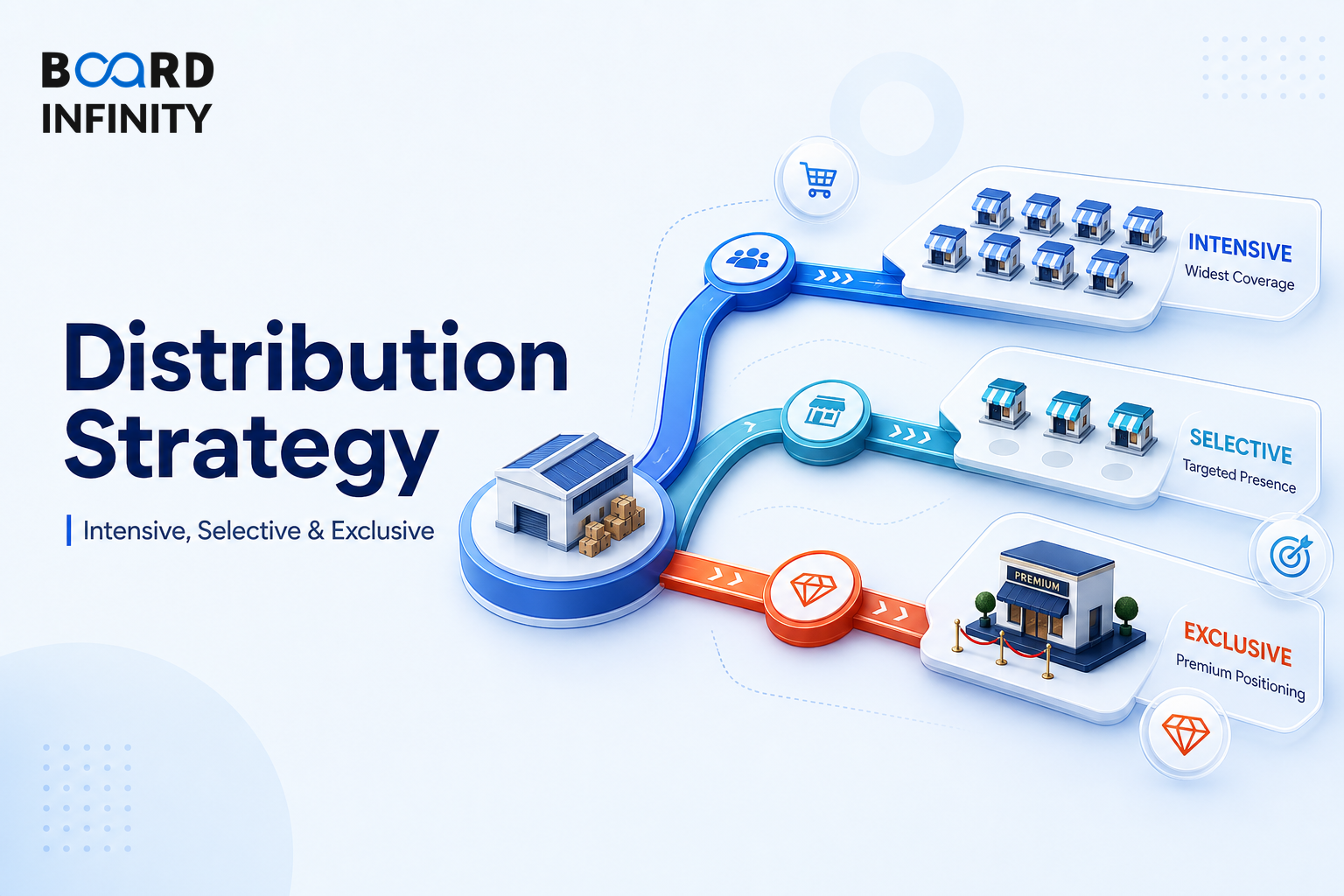
After understanding the Hunter vs Farmer Sales Model and Value Selling, the next question is not only how a product is sold, but where it should be available. Distribution strategy answers that question by deciding how widely a product is made available across outlets. In interviews, this matters because the right answer is rarely "sell everywhere" - it is a trade-off between reach, brand control, pricing power and channel conflict.
- Distribution strategy determines how widely a product is made available to the target market.
- Intensive distribution aims for maximum outlets and prioritises availability over exclusivity, as seen with Coca-Cola, Parle-G and Maggi.
- Selective distribution uses limited, carefully chosen outlets that align with brand image and provide a quality experience, as seen with Nike, Samsung and Titan.
- Exclusive distribution uses a single outlet per territory to create scarcity, premium positioning and deep retailer commitment, as seen with Louis Vuitton, Rolex and Tesla.
- The choice depends on product category, brand positioning and target market.
- Distribution directly impacts pricing power, brand perception and channel conflict.
- A premium brand using intensive distribution can risk diluting its brand equity.
The Big Picture: Distribution as a Trade-Off
At a high level, distribution strategy is a choice between being widely available and staying tightly controlled. The more outlets a product enters, the more reach it gets, but the harder it can become to protect brand perception, pricing power and channel discipline.
What Distribution Strategy Means
Distribution strategy determines how widely a product is made available. It connects the product to the target market through an availability model that fits the product category and brand positioning.
The key interview insight is that distribution is not only a logistics choice. It shapes how consumers perceive the brand, how much pricing power the brand can hold and whether different channels create conflict with one another.
- Pricing power means the ability of a brand to maintain price strength instead of being forced into weaker pricing because of uncontrolled availability.
- Brand perception means how the market interprets the brand based on where and how it is available.
- Channel conflict means tension across distribution channels when availability, positioning or customer ownership becomes difficult to manage.
- Brand equity means the value built into a brand through its image and positioning; premium brands can dilute it if they become too widely available.
The right strategy depends on three questions: what kind of product it is, how the brand wants to be positioned and where the target market expects to find it. A mass-consumption product usually needs a different availability logic from a premium product.
Intensive Distribution
Intensive distribution means placing the product in maximum outlets so that it is available wherever the consumer shops. The aim is to minimise friction in purchase by making the product easy to find.
This strategy prioritises availability over exclusivity. It is especially suitable when the product category rewards convenience and frequent access, and when the brand benefits from being seen across many outlets.
Coca-Cola, Parle-G and Maggi are examples of intensive distribution. The common logic is simple: the consumer should not have to search hard for the product. If the product is part of everyday consumption, wider availability supports the brand objective.
The nuance is that intensive distribution is powerful, but not universally right. If a premium brand uses intensive distribution, it may risk diluting brand equity because the brand starts appearing less exclusive than its positioning suggests.
Selective Distribution
Selective distribution means selling through limited, carefully chosen outlets. These outlets are selected because they align with the brand image and can provide a quality experience.
This strategy sits between intensive and exclusive distribution. It does not chase maximum availability, but it also does not restrict the brand to one outlet per territory. Instead, it balances reach with experience control.
Nike, Samsung and Titan are examples of selective distribution. Their availability is not positioned as "everywhere"; the distribution choice supports brand image and customer experience while still allowing meaningful market access.
In interviews, selective distribution is often the most balanced answer when the brand needs scale but cannot afford weak customer experience or confused positioning. The mistake is to treat it as a compromise without explaining why the chosen outlets matter.
Exclusive Distribution
Exclusive distribution means using a single outlet per territory. The purpose is to create scarcity, premium positioning and deep retailer commitment.
This model is the most controlled of the three. By limiting availability, the brand can make access feel more selective and can support a premium image. However, it sacrifices the broad reach of intensive distribution.
Louis Vuitton, Rolex and Tesla are examples of exclusive distribution from the source set. The distribution choice supports scarcity and premium positioning rather than mass availability.
The nuance is that exclusive distribution should not be confused with weak distribution. It is not about failing to reach more outlets; it is a deliberate positioning choice when scarcity and control matter more than maximum availability.
Comparing Intensive, Selective and Exclusive Distribution
The three strategies are best understood on a spectrum. Intensive maximises availability, exclusive maximises control and selective balances the two depending on brand image and target market needs.
This comparison is useful because interviewers often test whether a candidate can move beyond definitions. A strong answer explains what each model gains and what it gives up.
A Practical Decision Framework
When deciding distribution strategy, start with the product category, then evaluate brand positioning and target market. Finally, test the decision against the four trade-offs: reach, brand control, pricing power and channel conflict.
A reusable way to structure the answer is: Category - Positioning - Target Market - Trade-off - Strategy. This keeps the response commercial rather than theoretical.
Worked Example: Choosing a Strategy for Titan
Consider Titan from the selective distribution examples. The situation is a brand that needs availability, but not at the cost of brand image or customer experience. The decision should therefore be tested against the distribution trade-off rather than answered with a blanket "maximum outlets" approach.
The lesson is that distribution strategy should match the role the brand wants to play in the market. For Titan, the selected-outlet logic is more consistent with brand image and experience than an intensive model.
Why This Matters in Sales and Market Execution
Distribution strategy affects how sales teams execute in the market. If the company chooses intensive distribution, the execution priority becomes outlet coverage and availability. If it chooses selective distribution, the priority shifts to choosing the right outlets and protecting the experience.
For exclusive distribution, the execution logic changes again. The focus becomes scarcity, premium positioning and deep retailer commitment in a territory rather than broad outlet expansion.
This is why distribution is closely linked to pricing power and channel conflict. A product can have strong demand, but the wrong availability model can weaken brand perception or create avoidable channel tension.
Structuring a Distribution Strategy Interview Answer
"A brand is planning its market distribution. How would you decide whether it should use intensive, selective or exclusive distribution?"
The strongest answers do not memorise examples alone. They explain why each example fits its strategy through the trade-off between reach, brand control, pricing power and channel conflict.
Conclusion
Distribution strategy is the choice of how widely a product should be made available, and the best choice depends on product category, brand positioning and target market. In interviews, the winning answer is to show the trade-off clearly: intensive builds reach, selective balances reach with experience and exclusive protects scarcity and premium positioning.
The most frequent error is assuming wider distribution is always better. That costs points because the source concept is a trade-off: premium brands using intensive distribution risk diluting brand equity, and every strategy affects pricing power, brand perception and channel conflict.