
Agriculture, Food Processing & Rural Markets
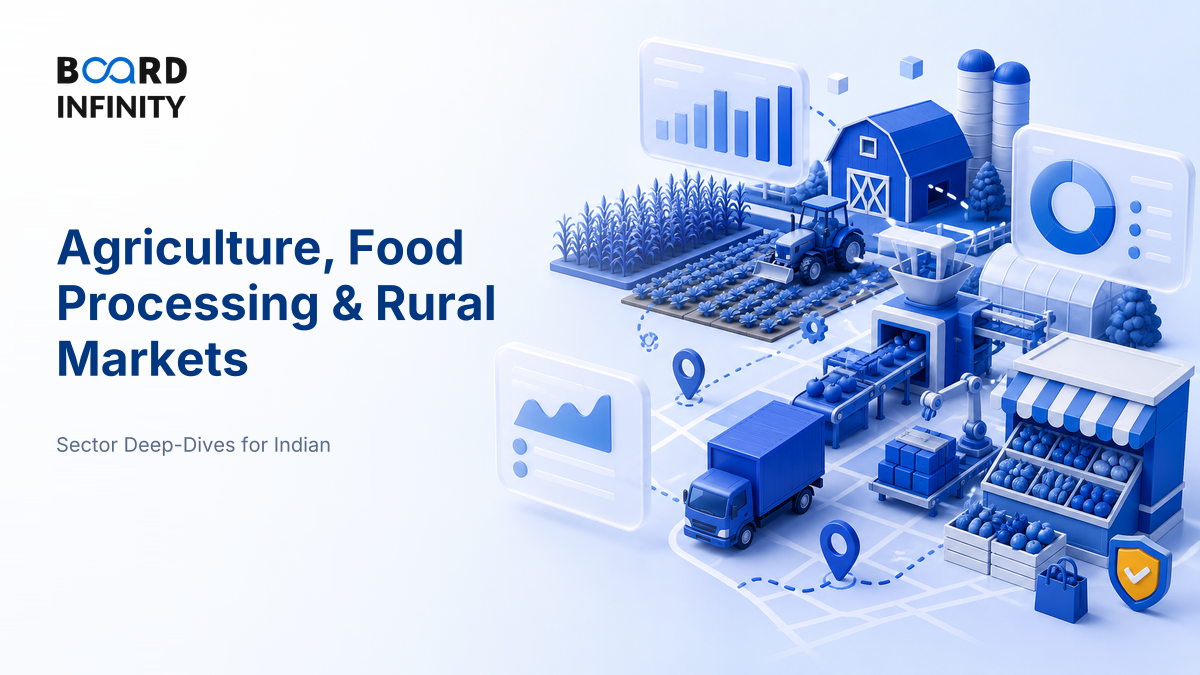
A tomato harvested near Nashik does not become ketchup, curry base or a retail pack by “just moving through the supply chain.” It passes through weather risk, mandi prices, grading, cold storage, processing capacity, distributor credit and the rural buyer’s trust in a brand.
- Agriculture, food processing and rural markets are one connected system: farms create supply, processing adds shelf life and value, rural markets shape demand and distribution.
- The core interview lens is farm-to-fork: inputs → production → aggregation → processing → distribution → consumption.
- Rural demand is not “cheap demand.” It is income-seasonal, trust-led, channel-constrained and often value-conscious rather than only price-conscious.
- Food processing wins by reducing perishability, improving consistency and creating branded, higher-margin products.
- The big constraints are fragmentation, perishability, working capital, infrastructure gaps, quality variation and last-mile reach.
- The best answers connect strategy to metrics: wastage, capacity utilisation, inventory turns, gross margin, distribution reach and procurement spread.
- The biggest mistake: treating “rural India” as one homogeneous low-income market instead of segmenting by crop, income, infrastructure, geography and channel.
The Big Picture: Think Farm-to-Fork, Not Farm Alone
The sector is easiest to understand as a value chain where each stage either reduces risk, adds value or creates access. Agriculture produces raw output. Food processing converts that output into safer, more convenient and more durable products. Rural markets are both the supply base and a huge demand base.
Core Explanation: The Three Businesses Hidden Inside One Sector
When an interviewer says “agriculture and rural markets,” do not jump only to farmers. The sector has three linked businesses with different economics.
1. Agriculture is supply creation. It includes crop production, livestock, fisheries and allied activities. The managerial issue is not just yield - it is volatility. Weather, pest risk, input cost, credit access, price realisation and post-harvest loss all affect farm income.
2. Food processing is value addition. Processing converts raw produce into products with better shelf life, consistency, convenience or brandability - for example flour, edible oil, dairy products, frozen foods, ready-to-cook mixes, snacks and beverages.
3. Rural markets are demand and distribution systems. Rural consumers buy FMCG, durables, financial services, telecom, farm inputs and increasingly digital services. Their purchases are shaped by income cycles, festivals, local influencers, retailer credit, pack size and trust.
How to Analyse Any Agriculture or Rural Market Problem
Use this five-step structure when the case is about a food brand, an agri-input company, a dairy player, a rural fintech, a cold-chain business or a processed foods market entry.
If the question is about entering a new agri or rural category, combine this with Competitive Landscape & Barriers to Entry so your answer covers incumbents, procurement lock-ins, channel power and regulatory constraints.
The Perishability vs Value-Addition Matrix
Every farm output does not require the same strategy. A fresh vegetable business, a dairy business, a branded atta business and a spice business have very different operating priorities. Use this matrix to identify what really matters.
High perishability, low value addition categories need speed, aggregation and loss reduction. High perishability, high value addition categories need cold chain, quality control and processing discipline. Low perishability, high value addition categories can build brands and margins. Low perishability, low value addition categories compete on scale, sourcing and logistics efficiency.
Key Metrics to Track in Agriculture, Food Processing and Rural Markets
Good candidates do not stop at “increase farmer income” or “expand rural distribution.” They name the operating metric that proves whether the strategy is working.
Notice the balance: some metrics are supply-side, some are processing-side and some are market-side. A complete answer connects all three.
Definitions You Can Say in One Breath
- Agriculture: The production of crops, livestock and allied outputs using land, labour, inputs, technology and natural resources.
- Food processing: Converting agricultural or animal produce into safer, more durable, convenient or higher-value food products.
- Rural market: A non-urban demand system shaped by local income cycles, informal channels, trust networks and access constraints.
- Agribusiness: The full commercial system around farm inputs, farming, aggregation, processing, logistics, finance and distribution.
- Value chain: The sequence of activities that transforms input into output while adding cost, quality, access or differentiation.
Case Study: ITC e-Choupal and the Power of Trust-Based Procurement
ITC built e-Choupal as a rural digital procurement and information network, showing how farm value chains improve when information, trust and market access move together.
The situation was classic Indian agriculture: fragmented farms, uneven price information, quality variation and multiple intermediaries between farmer and buyer. Farmers needed better market information and buyers needed more reliable procurement.
ITC’s move was to create a village-level digital interface through e-Choupal, supported by local coordinators and linked procurement systems. ITC describes e-Choupal as an initiative that uses information technology to empower farmers with information, services and market access (ITC e-Choupal).
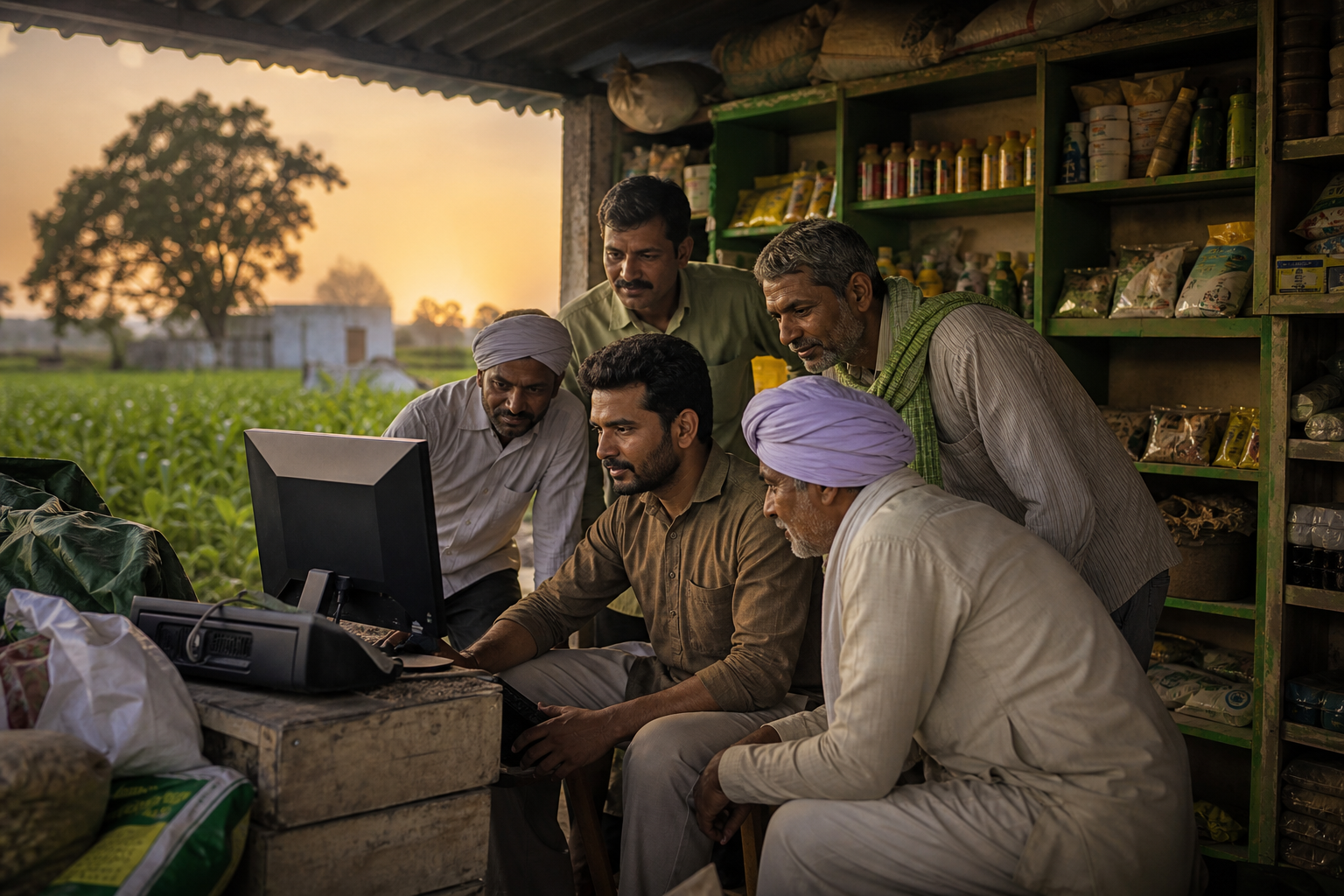
The primary driver was not “internet access” alone. The real driver was trusted intermediation - a local human layer made digital information usable. Supporting drivers included better price transparency, direct procurement linkages, quality awareness and ITC’s downstream need for agricultural raw material.
The lesson: rural transformation rarely comes from technology alone. It comes when technology is embedded inside trust, incentives, physical access and a business model that benefits both producer and buyer.
How AI Changes Agriculture, Food Processing & Rural Markets
AI is not landing evenly across the sector. It is first showing up where decisions are repeated, data is observable and the cost of error is high.
1. Demand forecasting and procurement planning. Food processors can use machine learning to forecast demand by geography, season, festival period and channel. This helps decide how much raw material to procure, when to run plants and where to position inventory.
2. Computer vision for quality grading. AI-enabled image models can help grade produce by size, colour, defects or ripeness. This is especially useful where manual grading is inconsistent and quality affects price realisation.
3. Rural go-to-market personalisation. Brands can use transaction, retailer and location data to decide pack sizes, promotions, outlet coverage and sales-beat plans. The caveat: rural data can be sparse or biased, so human sales feedback remains essential.
Practical student workflow: Load a food processing company’s annual report, distributor notes and this framework into NotebookLM. Ask it to generate likely interview questions on procurement risk, rural distribution, working capital and AI use cases. Then practise the answers using AI as a mock interviewer.
Interview Relevance
A packaged foods company wants to launch a processed millet snack in rural India. How would you evaluate the opportunity?
If the recommendation involves building a procurement network versus partnering with FPOs, distributors or processors, use the logic in Entry Modes: Organic, Partnership, Joint Venture or Acquisition to justify the route.
In agriculture and rural market answers, always separate consumer demand from farmer supply. A product may have strong rural demand but weak local sourcing economics, or strong farm supply but poor branded demand.
Common Mistake
The mistake: saying “rural India is price-sensitive, so launch a low-price product.” This costs candidates because it ignores heterogeneity, seasonality, trust, channel margins and category economics. One-line fix: segment rural markets by income cycle, geography, infrastructure, channel access and use occasion before recommending price or distribution.