
Logistics, Mobility & Infrastructure
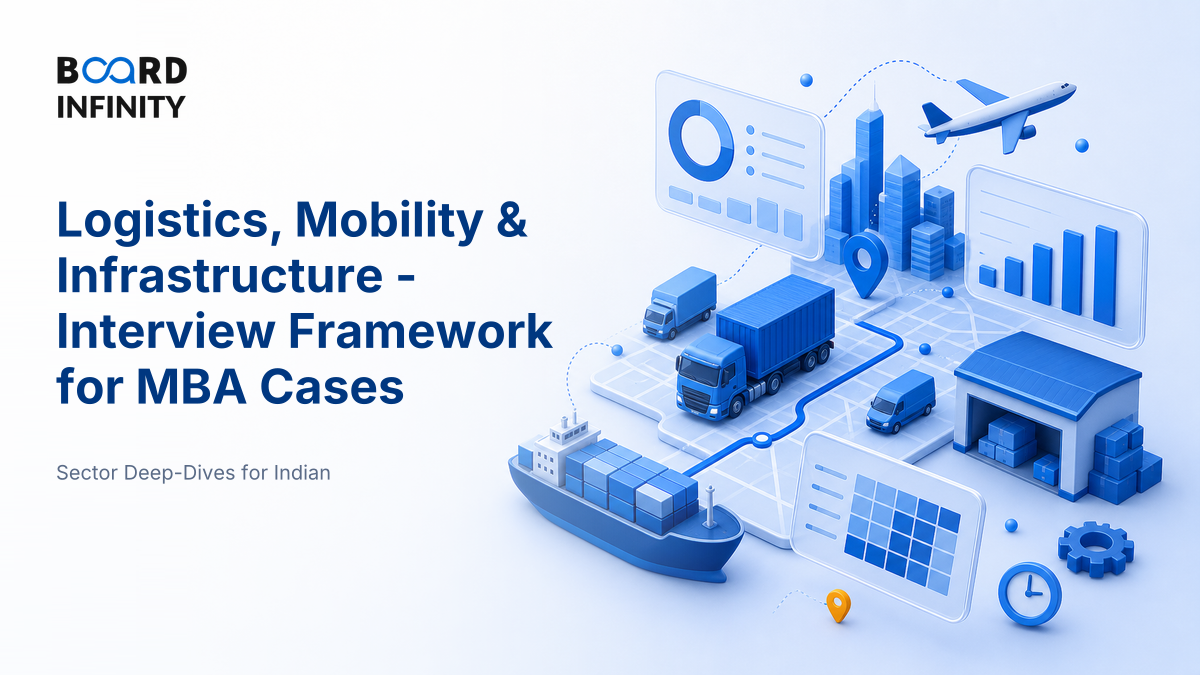
A truck stuck outside a city warehouse, a metro line running below full capacity, and a toll plaza queue are not three separate problems. They are the same management puzzle: how do you move people, goods and capital through a network without wasting time, money or trust?
- Logistics moves goods and information; mobility moves people and vehicles; infrastructure creates the long-lived capacity that both depend on.
- The core trade-off is service level vs cost vs asset intensity. Faster networks usually need more nodes, inventory, vehicles or digital control.
- Interview cases usually ask one of four things: reduce logistics cost, improve service reliability, evaluate infrastructure investment, or design a mobility/logistics market entry.
- Always map the network first: demand points, nodes, modes, bottlenecks, asset ownership, regulatory constraints and unit economics.
- Key metrics: OTIF, cost per shipment, vehicle utilisation, dwell time, network uptime and capex productivity.
- In India, the winning answer must include ground realities: fragmented trucking, multimodal gaps, land and approvals, tolling, warehousing, state-level execution and public-private coordination.
- The common mistake is giving a generic “use technology” answer before diagnosing the physical bottleneck.
The Big Picture: Think Network, Not Vehicle
The fastest way to understand logistics, mobility and infrastructure is to stop looking at a single truck, bus, port or highway. Look at the network: where demand originates, where it is consolidated, which mode carries it, where it gets delayed, and who pays for each handoff.
Core Explanation: The Three Layers You Must Separate
This topic becomes manageable when you separate it into three layers. Most weak answers mix them up.
Logistics is operating-heavy: daily dispatch, routing, inventory, fleet, labour and service levels. Mobility is behaviour-heavy: route choice, waiting time, affordability, reliability and access. Infrastructure is capital-heavy: large upfront investment, long payback, utilisation risk, regulation and public interest.
The Operating Chain: Where Value Is Created or Lost
In a logistics case, draw the operating chain before recommending anything. Costs usually hide in handoffs: loading delays, poor truck fill, reverse logistics, wrong warehouse location, failed delivery attempts, port dwell time or weak demand forecasting.
For mobility and infrastructure, the same chain appears differently. A metro line has stations as nodes, trains as linehaul capacity, interchange points as handoffs and feeder transport as the last mile. A highway has entry and exit points, toll plazas, service areas, enforcement, maintenance and traffic control.
An e-commerce company can reduce delivery time by adding city warehouses, but that may raise rent, inventory holding cost and complexity. The primary driver of the decision is the service-cost trade-off, supported by demand density, product mix, return rates, labour availability and transport access. The strategic point: faster delivery is a network design choice, not only a courier performance issue.
The Economics: Service, Cost and Asset Intensity
Logistics and mobility cases are full of trade-offs. A premium same-day delivery network needs dense nodes and high reliability. A low-cost long-haul network needs high utilisation, fewer empty runs and disciplined scheduling. Infrastructure projects need utilisation over many years, not just a strong launch story.
This is why a consultant should never recommend “buy more trucks” or “build more lanes” without checking utilisation. Capacity solves a bottleneck only when the bottleneck is truly capacity, not scheduling, routing, pricing, loading discipline or demand imbalance.
Metrics That Actually Matter
Use metrics to prove that you understand both operations and economics. In interviews, name the metric, give the formula and interpret it. Benchmarks vary sharply by sector, geography, customer promise and asset type, so the safest “good” number is one that beats the SLA, improves versus baseline and does not destroy margin.
A Small Worked Example: Cost per Shipment
Suppose a regional logistics operator handles 50,000 shipments in a month. It has fixed warehouse and staff cost of ₹20 lakh, variable handling and delivery cost of ₹48 per shipment, and fuel, toll and maintenance cost of ₹7 lakh.
The interview insight is not the arithmetic. It is the question after the arithmetic: did cost fall because the network genuinely improved, or because service quality was quietly reduced?
Definitions You Can Say Clearly
- Logistics: Logistics management plans, implements and controls efficient forward and reverse flows of goods, services and information, adapted from the CSCMP supply chain glossary.
- Mobility: Mobility is the ability of people, vehicles or goods to move across a transport system with acceptable time, cost and access.
- Infrastructure: Infrastructure is long-lived physical or digital capacity that enables movement, production, public services and economic activity.
- Multimodal logistics: Multimodal logistics uses more than one mode - for example road, rail, air or water - in one movement chain.
Case Study: FASTag/NETC and the Power of Frictionless Infrastructure
India's FASTag ecosystem shows how a small digital layer can change the operating performance of a physical highway network.
Highway tolling is a classic infrastructure bottleneck. The road may have capacity, but if vehicles queue at toll plazas, the user experiences delay, fuel waste and uncertainty. For freight operators, that uncertainty affects route planning, delivery promises and vehicle utilisation.
The strategic move was to make tolling interoperable and electronic. FASTag uses RFID-based tags linked to payment accounts, while the National Electronic Toll Collection system enables toll payments across participating plazas; the product overview is described by NPCI's NETC FASTag page. The primary driver was not “digitisation” in the abstract. It was standardised, interoperable toll payment. Supporting drivers included bank participation, toll-plaza acceptance, user adoption, enforcement and back-end settlement.
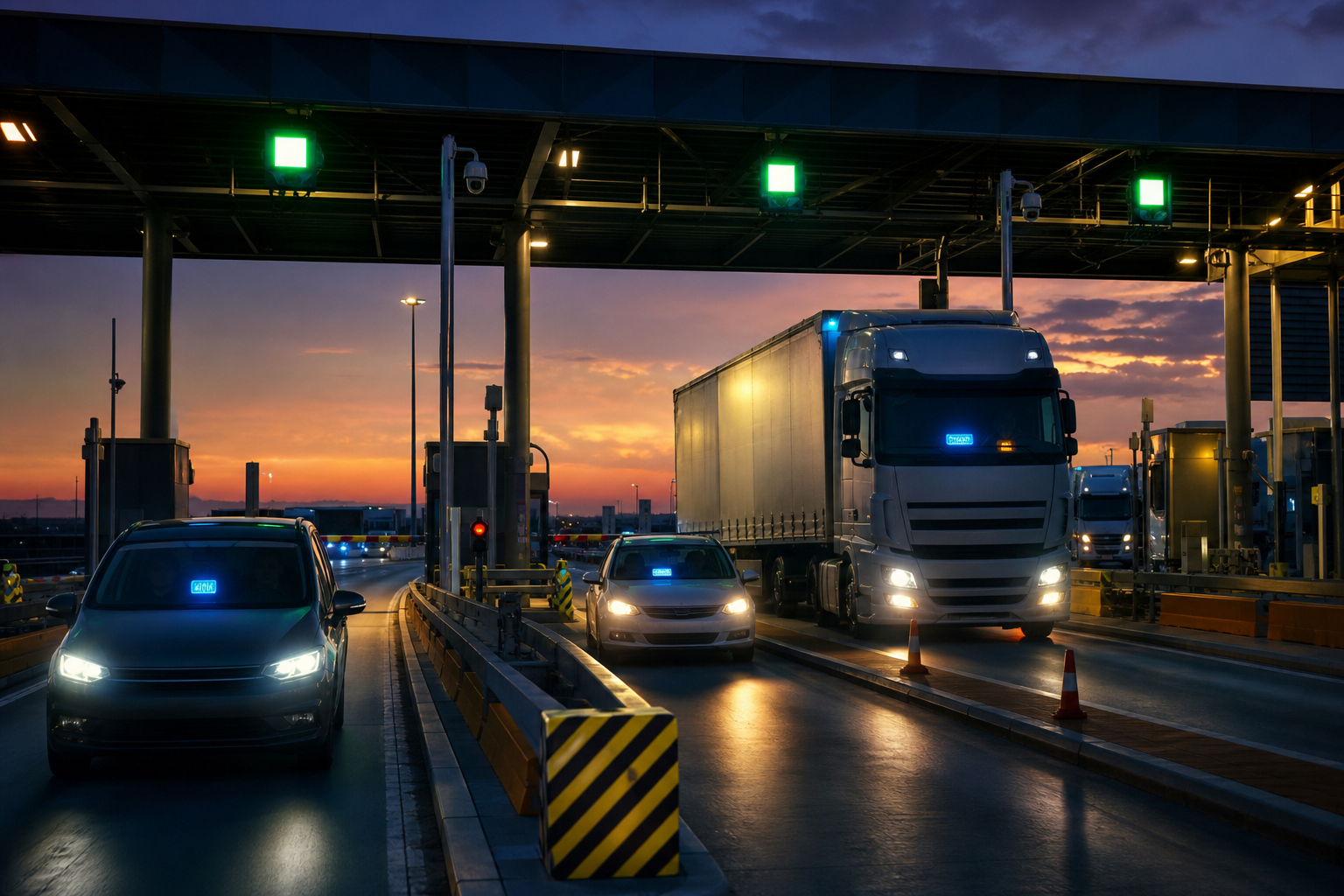
The lesson for an MBA answer is powerful: infrastructure productivity is not only about building bigger assets. Sometimes the biggest gain comes from reducing friction at the interface - payment, access, scheduling, permits, documents or handoffs. A complete answer explains the primary driver and the supporting system, not just the visible technology.
How AI Changes Logistics, Mobility & Infrastructure
AI is changing this sector in very practical ways, especially where networks are too complex for manual planning.
The caveat: AI cannot rescue bad process design. If loading discipline, master data, vendor contracts or asset ownership incentives are broken, the model will optimise a flawed system.
Use NotebookLM or Perplexity to load a company annual report, investor presentation and one sector note. Ask: “Map this logistics or infrastructure business into demand, nodes, modes, bottlenecks, metrics and risks.” Then practise follow-up questions using AI as a mock interviewer.
Interview Relevance
“A logistics company's costs are rising while delivery reliability is falling. How would you diagnose the problem and recommend actions?”
If the case is about market entry or investment, add two lenses: competitive landscape and barriers to entry, and asset ownership choices such as organic build, partnership or acquisition. If the case is about cost takeout, revise cost reduction without killing growth before the interview.
Say this line early: “I will first separate the physical network problem from the commercial and regulatory problem.” It signals mature thinking immediately.
Common Mistake
The mistake is recommending technology before diagnosing the bottleneck. “Use AI routing” sounds smart, but it fails if the real issue is warehouse dwell time, poor truck fill, land constraints, weak vendor SLAs or demand volatility. One-line fix: map the network, locate the bottleneck, then choose the lever.