
AI in Inventory, Replenishment & Allocation
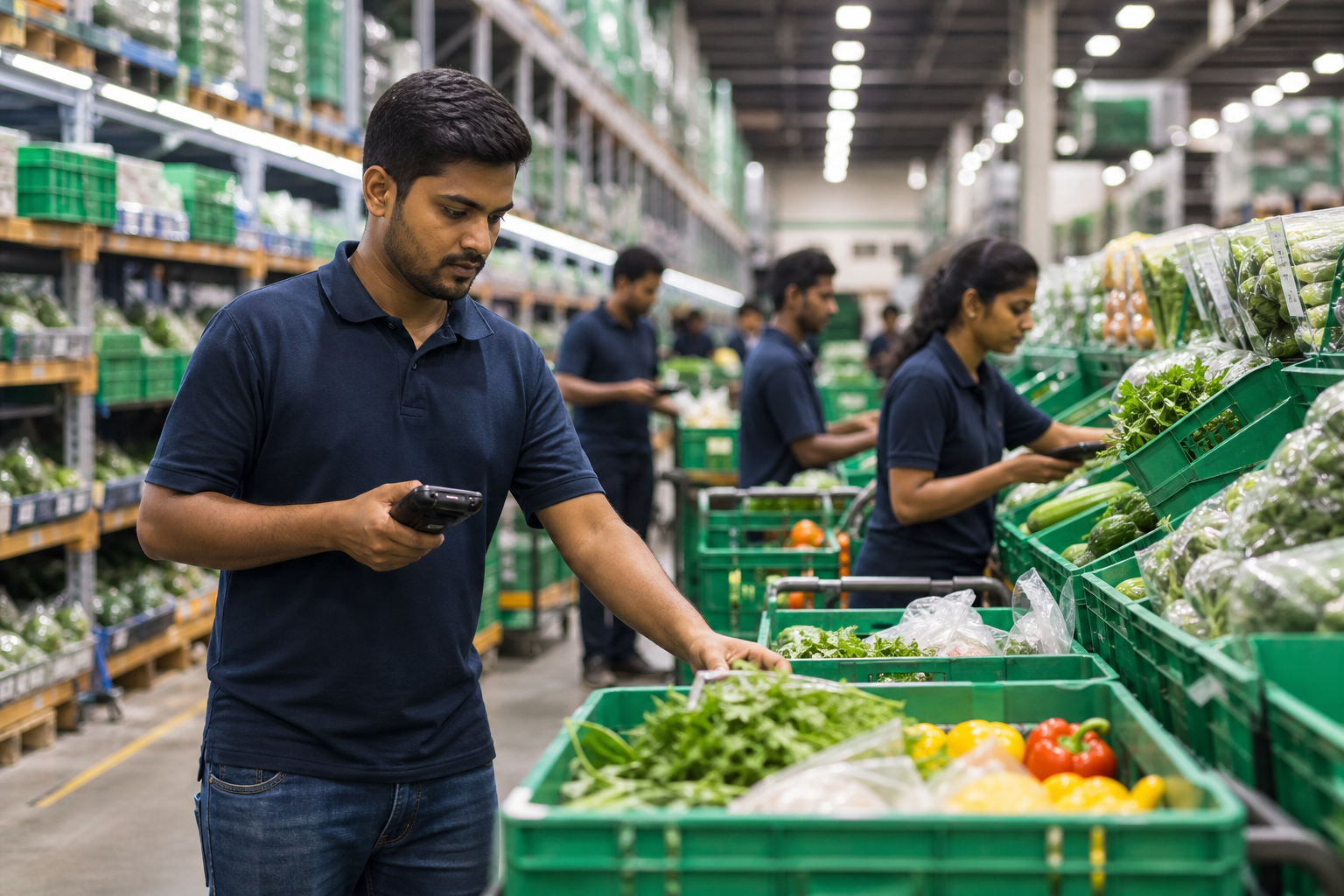
A grocery picker in a Bengaluru fulfilment centre scans the last packet of paneer at 7:40 p.m. The system already knows three things a human planner may miss: rain is lifting dinner orders, tomorrow is a local holiday, and this SKU usually substitutes poorly when out of stock.
That is AI in inventory at work - not a robot making glamorous decisions, but a prediction-and-policy engine deciding what to stock, where to stock it, and who gets scarce supply first.
- AI in inventory uses data and machine learning to predict demand, set replenishment actions and allocate limited supply across locations.
- The core flow is: demand signals - forecast - inventory policy - replenishment - allocation - feedback.
- Forecasting alone is not enough. The business value comes when forecasts become order quantities, safety stock and allocation rules.
- Replenishment answers: when to reorder and how much. Allocation answers: where constrained stock should go first.
- Track business KPIs, not only model accuracy: fill rate, stockout rate, inventory turns, days of inventory and forecast error.
- Best use cases are high-SKU, high-variability environments: grocery, fashion, pharma, auto spares, electronics and quick commerce.
- The interview trap: praising AI accuracy without explaining constraints, service levels, lead times and human exception control.
Big Picture - AI Converts Demand Signals into Stock Decisions
Inventory decisions used to depend heavily on backward-looking averages: last month sales, fixed reorder points and planner judgement. AI adds a live layer: it reads more signals, forecasts demand more granularly, recommends the stock action and learns from the outcome.
The practical idea is simple: AI does not replace inventory logic; it improves the inputs and speeds the decisions. A good answer should still mention demand variability, lead time, service level, safety stock and cost of holding inventory. If the basic inventory policy is weak, AI only automates a weak policy faster. For a deeper base on classical policy design, revise setting inventory policy for a multi-product business.
Core Explanation - The Three Jobs of AI in Inventory
Think of AI in inventory, replenishment and allocation as three connected jobs.
1. Inventory Optimisation - How Much Stock Should We Hold?
Inventory optimisation means setting the right stock level by balancing availability, working capital, storage capacity, obsolescence and waste. AI helps because demand is rarely smooth. A sunscreen SKU may spike in summer, a jersey may spike during a cricket tournament, and a medicine may be steady but critical.
AI models can segment items by demand pattern, volatility, margin, shelf life and substitutability. Then the system recommends different policies: more safety stock for critical medicines, lower depth for slow-moving fashion, tighter replenishment for perishables.
2. Replenishment - When to Reorder and How Much?
Replenishment is the decision of triggering new supply so the business does not run out before the next delivery arrives. Traditional systems use fixed reorder points. AI-enabled systems adjust the trigger based on changing demand, supplier lead time, promotions, holidays, weather, stock-on-hand and capacity.
Classic replenishment still matters. The basic reorder point logic is:
Reorder Point = Demand during Lead Time + Safety Stock
AI improves both inputs: it estimates lead-time demand more accurately and updates safety stock when volatility changes. To understand the pull logic behind many replenishment systems, revise Kanban and pull-based replenishment.
3. Allocation - Where Should Limited Stock Go?
Allocation becomes important when supply is constrained. If a brand has only 5,000 units of a fast-moving shoe size, should those units go to Mumbai stores, Bengaluru warehouses, marketplace sellers or its own app?
AI allocation engines rank demand opportunities using expected sales, margin, service-level commitments, customer priority, regional preferences and substitution risk. In fashion, size-colour-location combinations matter. In grocery, freshness and delivery promise matter. In B2B spares, customer downtime risk may matter more than margin.
Definitions - Say These Cleanly in an Interview
- Inventory: Stock held to meet future demand or support operations.
- Replenishment: The process of deciding when and how much stock to reorder.
- Allocation: The distribution of available supply across products, locations, channels or customers.
- Safety stock: Extra inventory kept to absorb demand or lead-time uncertainty.
- AI in inventory: Machine learning systems that predict demand and recommend stock decisions under real business constraints.
Metrics to Track - Prove AI Is Helping the Business
Do not stop at “the model became more accurate.” In operations, accuracy matters only if it improves availability, cash efficiency and waste. Use 4-6 metrics together.
Worked Example - AI Forecast to Reorder Decision
Suppose an AI model forecasts that a store will sell 100 units per day of a SKU. Supplier lead time is 4 days. Demand uncertainty during lead time is estimated at 60 units. The planner wants approximately a high service level, so the safety factor used is 1.65.
Step 1: Demand during lead time = 100 × 4 = 400 units
Step 2: Safety stock = 1.65 × 60 = 99 units
Step 3: Reorder point = 400 + 99 = 499 units
If current inventory position is 460 units, the system should trigger replenishment. The AI part is not the formula itself; it is the better estimate of daily demand, volatility and lead-time risk.
Case Study - BigBasket and AI-Led Grocery Replenishment
BigBasket shows why online grocery needs AI-led replenishment: thousands of SKUs, local demand variation, perishability and strict delivery promises make manual planning too slow.
Situation: Online grocery is one of the hardest inventory environments. A banana, a detergent pack and a premium cheese SKU behave very differently. Demand changes by city, neighbourhood, day of week, weather, salary cycle and festival period. At the same time, customers expect high availability and fast delivery.
The move: An AI-led grocery replenishment system uses SKU-location demand signals, past sales, search behaviour, promotion calendars, local seasonality, supplier lead times and substitution patterns. It then recommends replenishment quantities for fulfilment centres and dark-store-like nodes. Planners do not disappear; they handle exceptions such as vendor disruption, unusual events, quality issues and new-product launches.
Outcome or lesson: The primary driver is granular demand sensing at SKU-location level. Supporting drivers include supplier lead-time visibility, perishable shelf-life rules, substitution logic, warehouse capacity constraints and exception-based human review. This is why the case is useful: AI wins not because it “predicts better” in isolation, but because it links prediction to replenishment and allocation decisions.
How AI Changes Inventory, Replenishment & Allocation
By 2026, AI is changing this topic in three concrete ways.
Use NotebookLM for interview prep: upload this lesson, a target company annual report or operations write-up, and your inventory notes. Ask: “Identify where AI could improve replenishment, allocation and inventory KPIs for this company, and generate five interview questions with structured answers.”
Interview Relevance
“Suppose you manage inventory for an online grocery or fashion retailer. How would you use AI to improve replenishment and allocation, and what KPIs would you track?”
Use one sharp line: “AI creates value only when the forecast is converted into a better inventory policy and measured through service, cash and waste.”
Common Mistake
The mistake: Saying “AI improves forecast accuracy” and stopping there. Why it costs candidates: it sounds like a data science answer, not an operations answer. One-line fix: always connect forecast accuracy to replenishment quantity, allocation priority, service level, working capital and waste.