
Predictive Maintenance and Asset Reliability
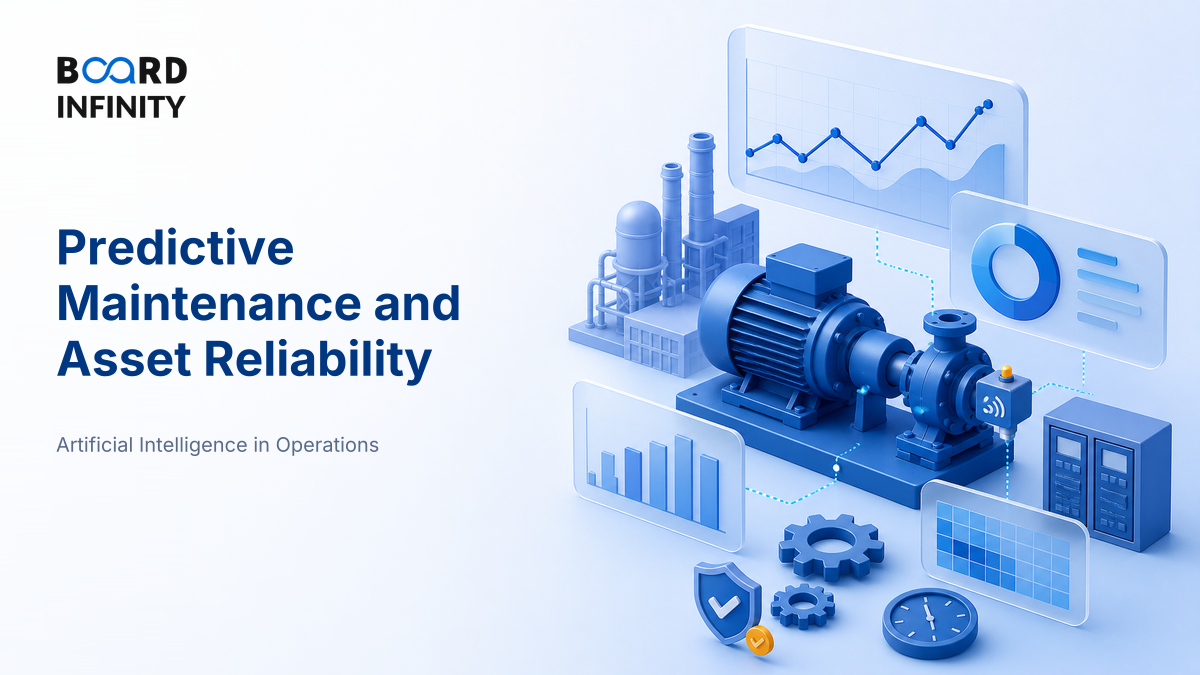
A steel rolling mill does not fail politely. One bearing overheats, a motor trips, the line stops, downstream orders slip, and a maintenance team suddenly becomes the most important unit in the business.
Predictive maintenance is the discipline that tries to catch that bearing before the breakdown. The surprise is this: the winning companies are not the ones with the most sensors - they are the ones that convert machine signals into better reliability decisions.
- Predictive maintenance uses asset condition data to estimate failure risk and schedule intervention before breakdown.
- Asset reliability is the ability of equipment to perform its required function for a stated time under stated conditions.
- The core logic is: sense condition - diagnose abnormality - predict failure risk - plan maintenance - execute and learn.
- Use predictive maintenance where asset criticality is high and failure signals are measurable; do not force it on every asset.
- Track MTBF, MTTR, availability, planned maintenance percentage, breakdown rate, and maintenance cost per operating hour.
- The business case improves when prediction is linked to spare parts, technician capacity, shutdown windows, and production priorities.
- The biggest interview mistake is treating predictive maintenance as an AI model problem instead of an operations reliability system.
Big Picture: Predictive Maintenance Is a Decision Loop, Not a Dashboard
Think of predictive maintenance as a left-to-right operating process. Data is useful only if it changes the maintenance decision early enough to avoid business damage.
The concept sits at the intersection of operations, analytics, maintenance engineering, and finance. A good answer therefore should not stop at “use IoT and AI.” It should explain which assets matter, what failure signals exist, how the intervention is scheduled, and how the business impact is measured.
Core Explanation: From Breakdown Thinking to Reliability Thinking
Maintenance approaches differ by when action is taken. Reactive maintenance waits for failure. Preventive maintenance acts at a fixed time or usage interval. Predictive maintenance acts when data suggests that failure risk is rising.
Predictive maintenance is most powerful where failures are both costly and detectable. For example, vibration, heat, oil quality, acoustic signals, current draw, pressure, and error codes can reveal deterioration before functional failure. But if a component fails randomly without warning, a predictive model may not help much.
This matrix is a strong interview tool. It prevents the common overclaim that “all machines should be predictive.” A ₹10,000 non-critical tool may not deserve sensors, data pipelines, and model monitoring. A bottleneck machine feeding an entire production line may deserve all of them, especially if it affects throughput, order fulfilment, or safety. If the stoppage creates a queue or idle stations, connect your answer to line balancing and workstation design, because reliability directly affects flow.
The Five-Step Predictive Maintenance Process
The last step is what separates mature reliability systems from pilot projects. If technicians ignore alerts because they are false alarms, the model fails socially even if it looks accurate on a laptop. If the model predicts failure but spare parts are unavailable, the business still suffers. That is why predictive maintenance must connect to procurement, stores, and inventory planning. For spare-heavy operations, the natural next step is using AI for inventory optimisation and replenishment.
Definitions You Can Say in One Breath
- Reliability: ASQ defines reliability as “the probability that a product, system, or service will perform its intended function adequately for a specified period of time.”
- Predictive maintenance: Maintenance triggered by condition data and failure-risk prediction before functional failure occurs.
- Asset availability: The proportion of scheduled time an asset is ready and capable of performing its required function.
- Maintainability: The ease and speed with which a failed asset can be restored to operating condition.
- Failure mode: The specific way in which an asset, component, or process fails to perform its function.
Key Reliability Metrics and How to Read Them
Interviewers like metrics because they reveal whether you understand operations performance, not just buzzwords. Use these six measures as your reliability scorecard.
Worked Example: Reading the Reliability Numbers
Suppose a packaging line runs for 2,160 scheduled hours in a quarter. It has 6 unplanned failures and 18 total repair downtime hours.
- MTBF = 2,160 operating hours / 6 failures = 360 hours.
- MTTR = 18 downtime hours / 6 repairs = 3 hours per repair.
- Availability = (2,160 - 18) / 2,160 = 99.17%.
Now assume condition monitoring detects early bearing deterioration and the team converts 4 of those unplanned failures into planned one-hour interventions during low-load windows. Downtime falls because the repair is prepared, parts are available, and the line is stopped at a better time. The business benefit does not come only from prediction - it comes from prediction plus planning.
Example - Rolls-Royce and Availability-Based Maintenance
Rolls-Royce TotalCare is a useful example because the business logic moves from selling an engine to supporting engine availability. The primary driver is outcome-based service economics: the manufacturer has an incentive to monitor health, plan maintenance and reduce disruption. Supporting drivers include deep product data, long-term service contracts, engineering expertise and customer dependence on aircraft uptime. So what: predictive maintenance often changes the revenue model, not just the maintenance schedule.
Case Study - Tata Steel Kalinganagar: Reliability as a Plant-Wide System
Tata Steel Kalinganagar shows why predictive maintenance must be connected to throughput, safety, planning and frontline execution in asset-heavy manufacturing.

Situation: Steel manufacturing is a classic reliability challenge. Assets such as conveyors, furnaces, cranes, rolling mills, pumps and motors are interdependent. A failure in one critical asset can delay upstream flow, starve downstream processes, increase energy waste, and create safety exposure.
The move: Tata Steel Kalinganagar has been recognised in the World Economic Forum Global Lighthouse Network, a programme that highlights advanced manufacturing sites using digital and analytics-led operating systems. In a predictive maintenance lens, the important move is not simply “install sensors.” It is building a plant operating model where condition data, production planning, maintenance work orders, spare availability and operator routines speak to each other.
The result or lesson: The reliability lesson is that asset performance improves when prediction is embedded into the daily management system. The primary driver is the integration of digital asset visibility with operational decision-making. Supporting drivers include standardised maintenance processes, skilled frontline teams, production discipline, data capture from real failures and leadership focus on throughput and safety. So what: predictive maintenance succeeds when it is treated as a plant performance system, not a technology showcase.
How AI Changes Predictive Maintenance and Asset Reliability
AI is making predictive maintenance more practical, but also more dangerous when firms confuse prediction accuracy with operational readiness.
- From threshold alerts to remaining-useful-life estimates: Older systems often flagged simple breaches such as high temperature. Newer ML models combine sensor history, operating load, maintenance logs and environmental context to estimate which asset is degrading faster than expected.
- From technician memory to reliability knowledge bases: LLMs can search manuals, work orders, fault codes and past repair notes so technicians can diagnose recurring problems faster. The caveat is governance: wrong recommendations can create safety and compliance risk.
- From isolated maintenance to network planning: AI can connect failure predictions with spare inventory, vendor lead times, production plans and technician rosters. This is where reliability links naturally to planning systems rather than remaining a maintenance dashboard.
Use NotebookLM or ChatGPT to prepare for a company interview: load the company annual report, sustainability report and a plant operations note, then ask, “List the top asset-reliability risks, likely predictive maintenance use cases, data required, KPIs, and one business case for reducing downtime.” Cross-check every company-specific claim before saying it.
Interview Relevance
“A manufacturing client wants to reduce unplanned downtime using predictive maintenance. How would you approach the problem, and what metrics would you track?”
Use the phrase “failure mode” early. It signals that you understand maintenance scientifically: different failures need different detection signals, interventions and economics.
Common Mistake
The mistake: saying “use IoT sensors and AI to predict failures” and stopping there. It costs candidates because it ignores asset criticality, failure modes, spare parts, technician workflows, false alarms and business value. One-line fix: always answer predictive maintenance as “critical asset - failure mode - data signal - planned action - KPI impact.”