
AI in Logistics: Routing, Freight & Capacity Matching
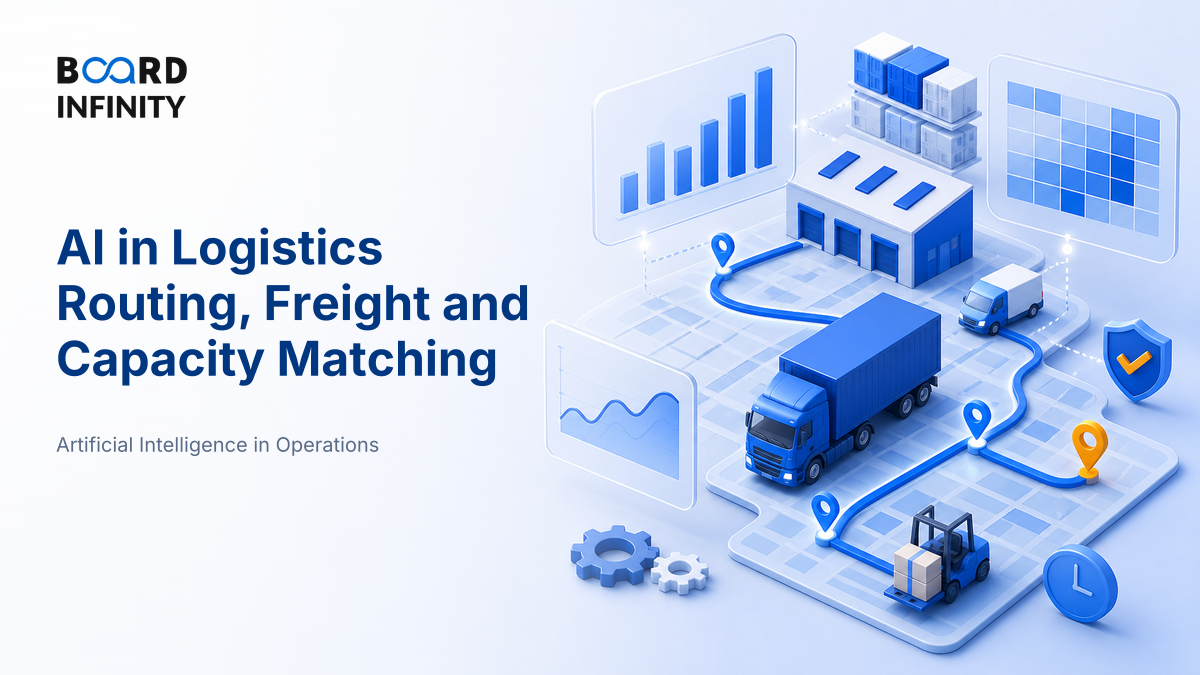
A dispatcher has 40 promised deliveries, three delayed trucks, one driver nearing his duty limit, and a customer asking, “Where is my shipment?” The old answer was phone calls and instinct; the new answer is a live decision engine that keeps recalculating the best route, carrier and capacity option as reality changes.
- AI in logistics uses prediction and optimization to decide which load moves, on which vehicle, by which route, at what cost.
- The three core use cases are routing, freight pricing and capacity matching.
- Routing AI solves a live trade-off: service promise, vehicle utilization, distance, fuel, driver constraints and disruption risk.
- Freight AI predicts lane-level cost and price using demand, supply, seasonality, carrier history and service requirements.
- Capacity matching is like a marketplace engine: it matches shipment demand with truck, container, rider or warehouse capacity.
- The best KPI set balances cost, service and asset utilization; optimizing only one can damage the others.
- The interview trap: saying “AI finds the shortest route.” In real logistics, AI finds the best feasible route under constraints.
Big Picture - AI Turns Logistics from Planning Once to Replanning Continuously
Traditional logistics plans are often built before the day starts. AI-enabled logistics keeps sensing demand, capacity and disruptions, then updates decisions while the network is running.
Core Explanation - The Three Decisions AI Improves
AI in logistics is not one tool. It is a decision system built around three recurring questions: Where should goods move? What should freight cost? Which capacity should serve the load?
1. Routing Optimization
Routing optimization selects the best feasible movement plan across stops, vehicles, time windows and operating constraints. It is not simply Google Maps for trucks.
A good routing model may consider distance, traffic, delivery time windows, driver availability, vehicle capacity, loading sequence, tolls, road restrictions, fuel consumption and customer priority. In interviews, this is often called the vehicle routing problem, but real business routing adds messy operational constraints.
2. Freight Pricing and Lane Intelligence
Freight AI estimates what a shipment should cost on a lane, and what price will attract reliable capacity. The model learns from historical lane rates, demand peaks, fuel sensitivity, seasonality, load type, lead time and carrier performance.
This connects naturally to procurement. If a company uses long-term transporter contracts, the AI output should feed contracting, incentives and service agreements so that cost savings do not come at the expense of reliability.
3. Capacity Matching
Capacity matching assigns shipment demand to available trucks, riders, containers, warehouse slots or carriers. The goal is to reduce empty movement, improve utilization and keep service promises.
For example, a manufacturer shipping from Pune to Bengaluru may need a return load from Bengaluru back toward Maharashtra. A matching system looks for compatible return freight so the vehicle does not travel empty.
What the AI Actually Optimizes
Strong candidates explain the objective function clearly. AI logistics systems usually optimize a weighted trade-off, not a single target.
This is why logistics AI works best when connected to demand and inventory planning. If order promises and stock positions are unstable, even the smartest routing engine will firefight. For the upstream link, revise using AI for inventory optimisation and replenishment.
Key Metrics to Track
In an interview, never say “AI improved efficiency” without naming the measure. Use a balanced scorecard across service, cost and utilization.
Worked Example - Why Matching Capacity Beats Just Cutting Distance
Assume a truck carries an outbound load for 300 km. Without a return load, it drives 300 km back empty.
The saving is not only from a shorter route. The bigger improvement is asset utilization: more kilometres earn revenue or serve a load. That is the heart of freight and capacity matching.
Definitions You Can Say in One Breath
- AI in logistics: Prediction and optimization models that improve movement planning, freight decisions and capacity allocation.
- Routing optimization: Choosing the best feasible path and stop sequence under cost, time, capacity and service constraints.
- Freight matching: Pairing shipment demand with suitable carriers or vehicles based on price, fit, availability and reliability.
- Capacity matching: Allocating available logistics capacity to demand so utilization improves without hurting service quality.
- ETA prediction: Estimating arrival time using route, traffic, vehicle, driver, weather and historical performance signals.
Case Study - BlackBuck and Digital Freight Matching in India
BlackBuck shows how an Indian trucking platform can use data, digital workflows and network scale to reduce freight discovery friction and improve truck utilization.

Situation. Indian road freight is fragmented: many shippers need reliable capacity, while many truck owners need better load discovery and return-load opportunities. Traditionally, this depended heavily on brokers, phone calls and relationship networks.
The move. BlackBuck built a digital trucking ecosystem around shipper demand, truck supply, operator workflows and data signals. The strategic logic is simple: once loads, vehicles, routes and payments become more visible, AI can improve matching, pricing guidance, tracking and exception management.
Primary driver. The biggest driver is digitizing supply and demand in a fragmented freight market. AI cannot match invisible trucks to invisible loads.
Supporting drivers. The model is supported by mobile access for truck operators, lane-level data, digital payments, tracking signals and a growing shipper-carrier network. Together, these make the platform more useful than a one-time route optimizer.
Outcome and lesson. The strategic lesson is not “AI replaces brokers.” It is that AI becomes powerful when a platform captures real demand, real capacity and real performance feedback. In logistics, the data network is often the moat.
How AI Changes Logistics Routing, Freight & Capacity Matching
AI is reshaping this topic in three concrete ways.
Practical student workflow: Use NotebookLM to upload a logistics company annual report, your class notes and this lesson. Ask: “Create five interview questions on how AI can improve routing, freight pricing and capacity matching for this company, with KPI-led answers.”
Interview Relevance
Question: “A consumer goods company is facing high logistics cost and missed delivery windows. How would you use AI to improve routing and capacity utilization?”
Use this sentence in interviews: “I would not optimize for the shortest route; I would optimize for the best feasible route under service, capacity, cost and disruption constraints.”
Common Mistake
The mistake: Treating AI logistics as only a map-routing problem. Why it costs candidates: it ignores freight economics, carrier behaviour and capacity utilization. One-line fix: always connect routing with pricing, matching and KPI trade-offs.